Evaluating Beautiful Types of Wood: A Hardwood Grading Guide
Master the NHLA grading system to select beautiful types of wood. Learn how to evaluate hardwood yields, figure, moisture content, and pricing.

The Intersection of Aesthetics and NHLA Lumber Grades
When sourcing beautiful types of wood for fine cabinetry, architectural millwork, or bespoke furniture, buyers often conflate visual appeal with structural lumber grading. The National Hardwood Lumber Association (NHLA) grading system is the North American standard for hardwoods, but it was designed to measure the yield of clear cuttings, not subjective beauty. Understanding this distinction is the most critical step in procuring premium hardwoods.
A board graded as FAS (Firsts and Seconds) guarantees a minimum clear-cutting yield of 83.3% on one face, with minimum cutting sizes of 3 inches by 7 feet or 4 inches by 5 feet. However, an FAS board of Hard Maple might be perfectly clear but visually sterile, while a #1 Common board of Claro Walnut might contain a spectacular burl cluster that technically reduces its NHLA grade but exponentially increases its aesthetic and monetary value.
If your project requires consistent, defect-free grain for painted or stained shaker cabinets, strictly buy FAS or Select grades. If you are building a live-edge dining table or a statement piece where knots, mineral streaks, and spalting are desired, purchasing #1 Common or #2 Common will save you 30% to 50% on material costs while providing the exact visual character you need.
Top Beautiful Types of Wood and Their Grade-Specific Quirks
Every wood species interacts with the NHLA grading rules differently. Here is how to navigate the grading nuances of the most highly sought-after aesthetic hardwoods in 2026.
Black Walnut (Juglans nigra): The Sapwood Dilemma
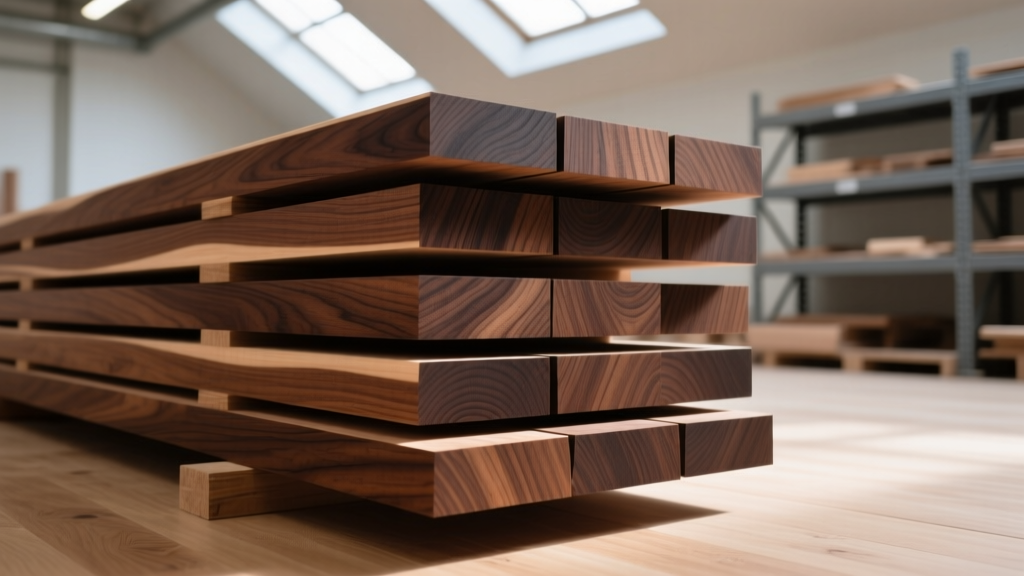
Black walnut is prized for its rich, chocolate-brown heartwood. However, the outer sapwood is pale yellow-white. Under standard NHLA rules, sapwood is not considered a defect unless specifically restricted by the buyer. Therefore, an FAS Walnut board can legally contain significant sapwood. To ensure you receive the dark, beautiful heartwood, you must explicitly order 'Sap Restriction' or 'Heartwood Only' Walnut. Be aware that kiln operators often steam walnut to darken the sapwood, which can result in a muted, grayish-brown hue compared to the vibrant, naturally air-dried heartwood.
Cherry (Prunus serotina): Color Oxidation and Pitch Pockets
American Cherry starts as a light pinkish-brown and oxidizes to a deep, warm reddish-brown when exposed to UV light. Like walnut, cherry has stark white sapwood. When sourcing beautiful types of wood for high-end millwork, specify '90/50 Red' (90% heartwood on the good face, 50% on the reverse). Additionally, cherry is prone to pitch pockets and gum spots. While NHLA grading allows a certain number of pin knots and small pitch pockets in FAS, these can cause tear-out during CNC machining or hand planing. Inspect boards for localized resin buildup before purchasing.
Hard Maple (Acer saccharum): When 'Defects' Command Premiums
Hard Maple presents the ultimate grading paradox. Standard NHLA rules penalize boards with heavy figure. Birdseye, curly (flame), and quilted maple patterns are caused by irregular grain growth. In the eyes of an NHLA grader, dense birdseye figure is considered a 'defect' because it compromises the structural predictability of the board and makes it difficult to machine cleanly. Consequently, a spectacular piece of 3D curly maple might be downgraded to #1 Common or #2 Common. Do not rely solely on the FAS tag when buying figured maple; you must visually inspect the bundles and be prepared to pay a premium for 'character' wood that technically carries a lower structural grade.
2026 Hardwood Pricing and Specification Matrix
Market pricing for premium hardwoods fluctuates based on regional availability, export demand, and kiln-drying energy costs. The table below outlines current estimated pricing and specifications for architectural-grade hardwoods.
| Species | Janka Hardness (lbf) | Est. FAS Price (Per BF) | Best Grade for Millwork | Primary Grading Quirk |
|---|---|---|---|---|
| Black Walnut | 1,010 | $14.00 - $18.50 | FAS (Sap Restricted) | Steaming alters natural color |
| American Cherry | 950 | $9.50 - $13.00 | Select / FAS | Pitch pockets count as defects |
| Hard Maple | 1,450 | $7.50 - $10.00 | FAS (for clear) / #1C (for figure) | Heavy figure lowers NHLA grade |
| White Oak | 1,360 | $8.00 - $11.50 | FAS | Medullary rays require quartersawing |
Moisture Content: The Invisible Quality Metric
You can select the most visually stunning FAS Black Walnut, but if the moisture content (MC) is incorrect for its end-use environment, the wood will warp, check, or destroy the joinery. According to the USDA Forest Products Laboratory, wood is hygroscopic and will constantly exchange moisture with the surrounding air until it reaches Equilibrium Moisture Content (EMC).
Improper kiln-drying can result in 'case-hardening,' where the outside of the board is dry but the core remains wet. When you rip a case-hardened board on a table saw, the internal stresses release, causing the wood to pinch the blade violently or bow severely. Always test the MC of the core by cutting a sample board in half and using a pin-type moisture meter on the freshly exposed center. For interior heated spaces in North America, the target MC is strictly 6% to 8%.
The Lumberyard Inspection Checklist
When evaluating beautiful types of wood at a hardwood dealer, do not simply accept the grade stamp on the end of the bundle. Perform this physical inspection protocol:
- Check for Sticker Stain: Look at the faces of the boards for dark, horizontal shadows. This indicates the wood was stacked with wet stickers (spacers) during air-drying, causing fungal staining that cannot be planed out.
- Measure the End-Grain Sealer: Premium hardwoods should have a thick coat of wax or commercial sealer (like Anchorseal) on the end grain. Unsealed ends dry 10 to 15 times faster than the face grain, leading to deep end-checks that reduce your usable yield by up to 12 inches per board.
- Sight Down the Edge (Crook and Bow): Hold one end of the board up to your eye and look down the length. FAS allows a specific tolerance for crook (curvature along the edge) and bow (curvature along the face). If a 10-foot board has more than a 1/2-inch deviation, it will require aggressive jointing, reducing your final thickness and width.
- Verify the Tally: Hardwoods are sold by the board foot (BF). Use the standard formula: (Thickness in inches × Width in inches × Length in feet) / 144. Dealers often round up widths to the nearest half-inch. Bring a tape measure to verify the actual width of the rough-sawn board to ensure you are not paying for air.
Understanding Quartersawn vs. Plainsawn Aesthetics
For species like White Oak and Sycamore, the sawing method drastically alters the visual grade. Plainsawn boards exhibit a 'cathedral' grain pattern but are prone to tangential shrinkage and cupping. Quartersawn boards, where the growth rings intersect the face of the board at 60 to 90 degrees, reveal the spectacular medullary rays (flecks or ray figure). While quartersawn lumber is more expensive due to lower yield and higher labor costs, it is dimensionally superior and essential for high-end architectural paneling and mission-style furniture. For a deep dive into cellular wood structures and shrinkage coefficients, consult the Wood Database dimensional shrinkage guides.
Frequently Asked Questions
Can I use #2 Common lumber for fine furniture?
Yes, if you are skilled at nesting parts. #2 Common requires only 50% clear yield, meaning the board will have large knots, wane, and color variations. However, for small components like drawer sides, cabinet face frames, or segmented turnings, you can cut around the defects and utilize the clear sections, saving significant money compared to FAS.
Why does my FAS Cherry have white streaks?
Those are mineral streaks, caused by the tree absorbing trace minerals from the soil, or localized gum pockets. Under NHLA rules, mineral streaks are generally not considered defects in FAS Cherry unless they severely compromise the structural integrity of the clear cutting. If you require a uniform color, you must sort through the bundle and hand-pick your boards.
Is it better to buy rough-sawn or S2S (Surfaced Two Sides) lumber?
For professionals with a 16-inch jointer and a thickness planer, buying rough-sawn is always preferable. S2S lumber is planed to a uniform thickness (often 13/16''), which removes your ability to flatten warped boards and leaves you with less material to work with if the board cups after acclimating to your shop. Rough-sawn allows you to mill the wood to your exact required dimensions while maximizing yield.
Written by
Elena RodriguezElena Rodriguez is a civil engineer and technical writer specializing in concrete technology, masonry systems, and ASTM/ACI compliance. She earned her B.S. in Civil Engineering from Texas A&M University and spent a decade at a materials testing laboratory, performing over 2,000 concrete compressive strength tests and masonry prism evaluations. Elena is an ACI-certified Field Testing Technician (Grade I) and a member of ASTM Committee C12 on Natural Building Stone. She currently consults on forensic engineering cases involving concrete failures and moisture intrusion. Based in San Antonio, TX, Elena is a proud member of the Society of Women Engineers (SWE) and coaches her daughter's FIRST Robotics team.
More from Elena Rodriguez
View all
Walls & Panels
Cost Analysis: Light Gauge Steel Framing Advantages and Disadvantages
Evaluate light gauge steel framing advantages and disadvantages through a strict cost analysis lens, comparing material, labor, and lifecycle expenses.
Aug 4, 2026

Walls & Panels
Gypsum Board Types: Exact Specifications, Thickness & Dimensions
Compare standard, Type X, and moisture-resistant gypsum board types. Get exact specifications, thicknesses, dimensions, and ASTM standards for your project.
Aug 4, 2026

Fire Resistance
Best Fire-Resistant Outdoor Decking Materials: 2026 Buyer Guide
Discover the best fire-resistant outdoor decking materials for 2026. Compare Class A PVC, aluminum, and hardwood options for WUI compliance and safety.
Aug 4, 2026