Comparing Types of Nails for Wood Framing: A Cost Analysis
Analyze the true cost of wood framing nails. Compare smooth, ring shank, galvanized, and stainless types for maximum structural value and ROI.

The Hidden Economics of Wood Fasteners
Fasteners represent less than 1.5% of total framing material costs, yet they dictate the structural load transfer, wind uplift resistance, and longevity of the entire wood assembly. Selecting the wrong fastener based purely on upfront unit cost is a primary driver of structural callbacks, rust jacking, and premature sheathing delamination. When evaluating the types of nails for wood construction, the true cost analysis must factor in withdrawal resistance, corrosion lifecycle, and labor efficiency, not just the price per pound.
Unit Economics: Material Costs and Applications
The baseline cost of framing nails fluctuates with raw steel wire prices, but the relative premiums between coatings and shank geometries remain consistent. Below is a breakdown of standard 16d (3.5-inch) framing nail economics based on 2026 bulk procurement rates.
| Nail Type & Coating | Avg. Cost / lb | Shank Type | Best Application |
|---|---|---|---|
| Bright (Uncoated Steel) | $1.45 - $1.70 | Smooth | Interior, dry framing, temporary bracing |
| Electro-Galvanized (EG) | $1.80 - $2.10 | Smooth / Ring | Interior moisture-prone (bathrooms) |
| Hot-Dipped Galvanized (HDG) | $2.60 - $3.10 | Ring Shank | Exterior sheathing, treated lumber, decks |
| 304 Stainless Steel | $7.50 - $9.00 | Ring Shank | Coastal zones, cedar/redwood, high-salt |
| 316 Stainless Steel | $11.00 - $14.00 | Ring Shank | Direct saltwater exposure, heavy ACQ lumber |
Shank Geometry: Calculating Withdrawal Resistance Value
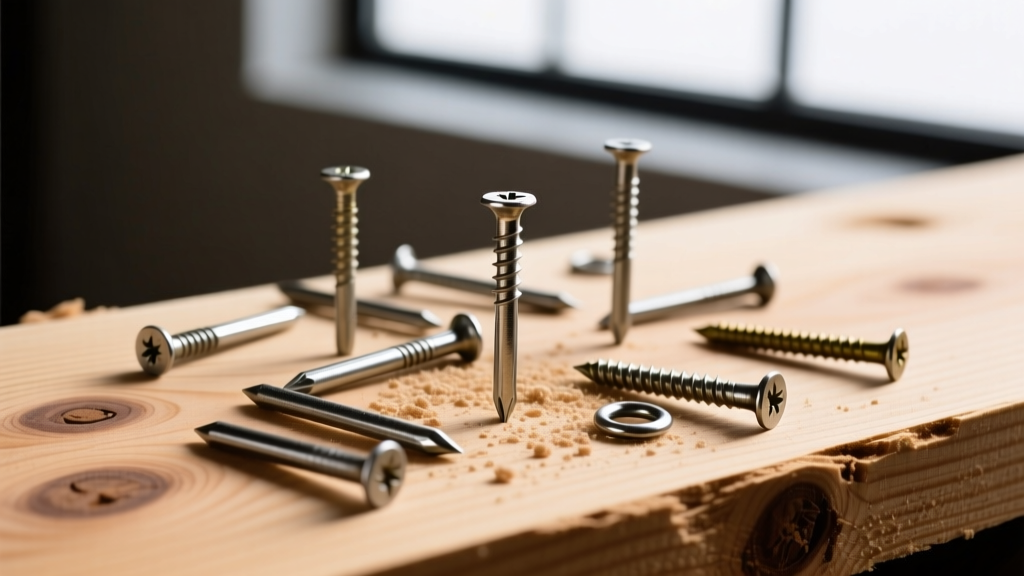
The shank design directly impacts the mechanical interlock with wood fibers. According to the USDA Forest Products Laboratory Wood Handbook, withdrawal resistance is a function of shank diameter, wood specific gravity, and shank deformation.
Smooth Shank vs. Deformed Shank
A standard 16d smooth shank common nail (0.162-inch diameter) driven into Spruce-Pine-Fir (SPF) lumber yields an ultimate withdrawal capacity of approximately 45 to 55 pounds per inch of penetration. In contrast, a 16d ring shank nail of the same diameter generates between 130 and 160 pounds per inch. This 250% increase in holding power is critical for shear walls and roof diaphragms subject to seismic or wind uplift forces.
- Smooth Shank: Lowest cost, easiest to pull. Use only for gravity-load bearing interior walls where lateral withdrawal is not a primary engineering factor.
- Ring Shank: Features annular threads that act as one-way wedges. The industry standard for roof sheathing and exterior structural panels.
- Screw Shank: Helical threads that twist into the wood. Offers withdrawal resistance similar to ring shanks but excels in dense hardwoods and edge-nailing scenarios where ring shanks might split the timber.
Coating Lifespan and the Treated Lumber Mandate
The phase-out of Chromated Copper Arsenate (CCA) in favor of Alkaline Copper Quaternary (ACQ) and Micronized Copper Quaternary (MCQ) preservatives fundamentally altered fastener economics. These modern preservatives are highly corrosive to standard zinc coatings.
Code Requirement: The International Residential Code (IRC) and Simpson Strong-Tie Corrosion Guidelines mandate that fasteners in contact with ACQ or MCQ treated lumber must be hot-dipped galvanized to ASTM A153 (minimum 1.0 oz/ft² zinc coating) or stainless steel (ASTM F1667). Electro-galvanized (EG) nails will corrode and fail within 3 to 5 years when embedded in modern treated lumber.
While EG nails are $0.80 cheaper per pound than HDG, using them in sill plates or treated deck framing guarantees premature structural failure. The value proposition heavily favors HDG for all treated lumber applications, reserving 304 or 316 stainless steel strictly for coastal environments (within 3,000 feet of saltwater) or highly acidic wood species like Western Red Cedar and Redwood.
Pneumatic Collated vs. Hand-Drive: The Labor ROI
When analyzing the types of nails for wood framing, the delivery system dictates the true installed cost. Collated nails (plastic or paper strip, or wire coil) carry a manufacturing premium of 30% to 50% over loose, hand-drive nails in a bulk box. However, this material premium is entirely eclipsed by labor savings.
Labor Cost Breakdown (Per 1,000 Nails)
Hand-Drive (Loose 16d): A skilled carpenter can drive approximately 120 to 150 nails per hour, including picking up, positioning, and striking. At a burdened labor rate of $65/hour, driving 1,000 nails takes roughly 7.5 hours.
Labor Cost: $487.50
Pneumatic (Collated Strip): Using a 21-degree pneumatic framing nailer, a carpenter can drive 600 to 800 nails per hour. Driving 1,000 nails takes roughly 1.5 hours.
Labor Cost: $97.50
Net Savings: The $25 premium paid for collated nails yields $390 in labor savings, representing a 1,460% return on investment for the fastener upgrade.
Head Diameter: A Frequently Overlooked Value Metric
Procurement teams often focus on length and coating, ignoring head diameter. A standard 16d common nail has a head diameter of 0.281 inches, while a 16d sinker or box nail has a head diameter of roughly 0.191 to 0.230 inches. When fastening structural OSB or plywood shear panels, the smaller head of a sinker nail is highly susceptible to 'pull-through' under high wind uplift or seismic racking loads. Always specify 'Common' head dimensions for structural sheathing to ensure the panel remains anchored to the framing members during extreme load events.
Strategic Procurement Framework
To optimize both structural integrity and project budgets, builders and procurement managers should adopt the following decision matrix when ordering framing fasteners:
- Interior, Non-Treated Framing: Use 16d or 8d smooth shank bright common nails (hand-drive) or collated equivalents. This is the lowest cost tier and perfectly adequate for dry, gravity-load interior partitions.
- Exterior Sheathing & Roof Diaphragms: Mandate 8d or 10d ring shank nails. If the structure is outside a coastal salt-spray zone, HDG is sufficient. If inland, a vinyl-coated or polymer-coated ring shank offers excellent withdrawal resistance at a lower cost than HDG.
- Pressure-Treated Sill Plates & Decking: Strictly specify HDG (ASTM A153) or 304 Stainless ring shank nails. Never allow EG or bright nails on the job site when treated lumber is being framed.
- Coastal / High-Corrosion Zones: Bypass HDG entirely. The zinc coating will eventually sacrifice itself in salt air. Specify 316 Stainless Steel for all exterior structural connections and shear wall nailing to ensure a 50+ year structural lifespan.
By aligning fastener specifications with specific environmental and structural demands, builders eliminate the risk of catastrophic fastener failure while avoiding unnecessary spending on over-engineered alloys in dry, interior applications. For further technical specifications on wood-to-wood connections, consult the Fine Homebuilding Fastener Guide and local engineering codes.
Written by
Marcus ChenMarcus Chen is a licensed structural engineer (PE) and building materials analyst with over 12 years of experience across residential, commercial, and industrial construction. He holds a Master of Science in Civil Engineering from UC Berkeley and spent six years at Thornton Tomasetti before transitioning to independent consulting and technical writing. Marcus specializes in material selection for seismic-prone regions, concrete reinforcement strategies, and lifecycle cost analysis. His work has been cited by the American Concrete Institute (ACI) and the Structural Engineers Association of California (SEAOC). When he is not on a job site or at his desk, you will find him hiking the Sierra Nevada or restoring a 1920s craftsman bungalow in Oakland, CA.
More from Marcus Chen
View all
Construction Cost
How Much Did the Eiffel Tower Cost to Build?
How much did the Eiffel Tower cost to build in 1889? We adjust for inflation and compare its budget to modern skyscraper construction.
Aug 4, 2026

Fire Resistance
What Is a Fire Resistant Material? Testing & Certification Guide
Discover what is a fire resistant material through ASTM and UL testing. Learn how fire ratings, certifications, and assemblies work in construction.
Aug 4, 2026

Construction Cost
How Much Did the Burj Khalifa Cost to Build?
How much did the Burj Khalifa cost to build? We break down the $1.5B project and extract 5 money-saving strategies for your next build.
Jul 30, 2026