Dark Types of Wood: Complete Species Guide for Builders & Designers
Explore the top dark types of wood for construction and millwork. Compare Janka hardness, 2026 board-foot pricing, and CITES compliance for dark timber.

The Chemistry of Dark Heartwood: Extractives and UV Reactivity
When specifying dark types of wood for architectural millwork, flooring, or structural accents, it is critical to understand that the color originates from heartwood extractives. These are complex chemical compounds—including tannins, resins, and melanins—that the tree deposits as the inner sapwood transitions into heartwood. These extractives serve as natural fungicides and insect repellents, which is why many dark timber species exhibit exceptional decay resistance.
However, these same extractives dictate how the wood reacts to ultraviolet (UV) light and finishing chemicals. Unlike pigmented stains, natural wood extractives are photosensitive. Species like American Black Walnut will lighten and bleach under prolonged UV exposure, while others, such as Santos Mahogany, will oxidize and deepen in color. Understanding this photochemical behavior is mandatory for architects and builders to prevent post-installation color mismatches in sun-drenched interiors.
Definitive Species Profiles: The Top 5 Dark Timbers
1. Black Walnut (Juglans nigra)
Black Walnut remains the benchmark for domestic dark timbers in North America. Its heartwood ranges from a pale, ashy brown to a deep, purplish-black. Walnut is highly prized for its workability and dimensional stability. According to the Wood Database, its radial shrinkage is a remarkably low 5.5%, with tangential shrinkage at 7.8%, giving it a T/R ratio of 1.4. This near-ideal ratio means Walnut moves uniformly and resists cupping, making it the premier choice for wide-plank flooring and custom cabinetry.
- Janka Hardness: 1,010 lbf
- Primary Applications: High-end cabinetry, wide-plank flooring, architectural paneling.
- 2026 Market Pricing: $9.00 – $15.00 per board foot (FAS grade, 4/4 thickness).
2. Wenge (Millettia laurentii)
Sourced primarily from the Congo Basin, Wenge is renowned for its near-black heartwood interspersed with striking, high-contrast tan or white streaks. It is exceptionally hard, heavy, and rigid, often used as a substitute for ebony in structural inlays and heavy-traffic flooring. Wenge possesses a very coarse, open grain structure that requires a specialized pore-filler (like epoxy or pumice) to achieve a glass-smooth architectural finish.
Wenge dust is a known respiratory sensitizer and can cause severe skin irritation. More dangerously, Wenge splinters are highly prone to causing localized necrosis and severe infection if they puncture the skin. Installers and fabricators must use HEPA-filtered extraction systems and heavy-duty puncture-resistant gloves when handling raw Wenge lumber.
3. Santos Mahogany (Myroxylon balsamum)
Despite its common name, Santos Mahogany is not a true mahogany (Swietenia). It is a dense, oily timber native to Central and South America. Freshly milled, it presents a vibrant, reddish-purple hue that oxidizes into a deep, rich burgundy-brown over time. Its extreme density and high natural oil content make it virtually impervious to moisture, making it an elite choice for exterior decking, boatbuilding, and high-humidity interior applications like spa surrounds.
- Janka Hardness: 2,200 lbf
- Primary Applications: Exterior decking, heavy-duty commercial flooring, marine millwork.
- 2026 Market Pricing: $7.50 – $11.00 per board foot.
4. Macassar Ebony (Diospyros celebica)
Macassar Ebony provides dramatic, zebra-like striping with dark black and brown bands. True to the ebony family, it is incredibly dense and sinks in water. Because of its exorbitant cost and limited log diameter, it is rarely used for full flooring or large paneling. Instead, it is sliced into architectural veneers for elevator cabs, luxury retail fixtures, and bespoke executive boardroom tables.
5. Ziricote (Cordia dodecandra)
Ziricote is famous for its "spiderweb" or "landscape" grain figures. The heartwood is a deep, dark brown with subtle green and purple undertones, sharply demarcated from the pale yellow sapwood. It machines beautifully and turns to a high natural polish, though its interlocked grain can cause tear-out during planing if cutter angles are not set to a minimum of 20 degrees.
Performance Matrix: Hardness, Shrinkage, and Market Pricing
The following matrix synthesizes critical structural and economic data for specifying dark timber in commercial and high-end residential projects. Data aligns with current grading standards and market conditions.
| Species | Janka Hardness (lbf) | Volumetric Shrinkage | Rot Resistance | Est. Cost / BF (2026) |
|---|---|---|---|---|
| Black Walnut | 1,010 | 13.0% | Very Good | $9.00 - $15.00 |
| Wenge | 1,930 | 11.2% | Exceptional | $14.00 - $22.00 |
| Santos Mahogany | 2,200 | 9.8% | Exceptional | $7.50 - $11.00 |
| Macassar Ebony | 2,430 | 12.5% | Exceptional | $70.00 - $110.00 |
| Ziricote | 1,970 | 10.8% | Excellent | $28.00 - $45.00 |
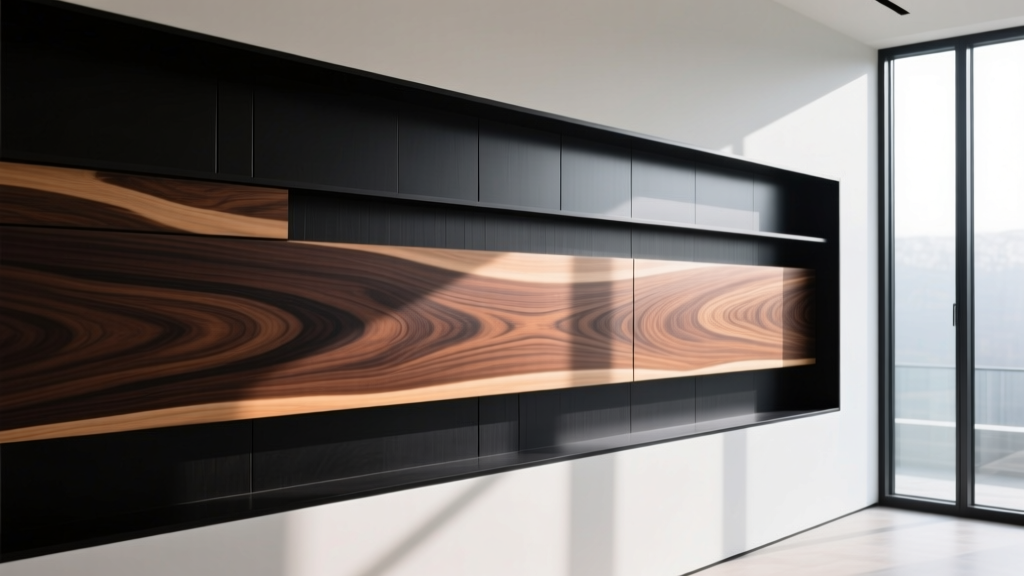
Architectural Applications and Finishing Protocols
Specifying dark types of wood requires specialized fabrication and finishing protocols. The natural extractives that provide the rich coloration often interfere with standard adhesives and film-forming finishes.
Expert Gluing Protocol: When edge-gluing or laminating highly oily dark woods like Santos Mahogany or Ziricote, fabricators must wipe the joint surfaces with acetone or denatured alcohol immediately before applying adhesive. This removes surface extractives that would otherwise cause the glue line to fail under shear stress.
Finishing Best Practices for Dark Timbers
- Preventing Blotchiness: While dark woods are typically finished clear to showcase their natural hue, if a tinted stain is required (particularly on Walnut), always apply a 1-lb cut of dewaxed shellac as a wash coat to prevent uneven pigment absorption.
- UV Inhibitors are Mandatory: For any dark timber installed near south-facing glazing, specify a topcoat containing advanced HALS (Hindered Amine Light Stabilizers) and UV absorbers. Without this, Black Walnut will bleach to a pale gray-brown within 18 months of direct sun exposure.
- Pore Filling for Open-Grain Species: Wenge and Ziricote have massive, open pores. To achieve a Level 4 or Level 5 architectural finish (mirror-smooth), use a contrasting or matching epoxy grain filler rather than traditional silica-based pastes, which can shrink and crack over time.
CITES Compliance and Ethical Sourcing
The procurement of exotic dark timbers is heavily regulated. According to the CITES Appendices, several dark wood species face strict international trade restrictions due to overharvesting. Macassar Ebony (Diospyros celebica) and various Rosewood species (Dalbergia) are listed under CITES Appendix II, requiring rigorous export permits and chain-of-custody documentation.
For commercial projects pursuing LEED v4.1 or WELL Building Standard certifications, sourcing FSC (Forest Stewardship Council) certified dark timber is mandatory. Builders should demand FSC-100% or FSC-Mix documentation at the point of purchase. If a supplier cannot provide verifiable chain-of-custody certificates for exotic dark woods, the material should be rejected to avoid severe compliance penalties and project delays at customs.
Frequently Asked Questions
Can I use dark woods like Wenge or Ebony for structural load-bearing beams?
No. While species like Wenge possess immense compressive and bending strength, they are classified as specialty millwork and flooring timbers. The USDA Forest Products Laboratory does not provide structural design values (allowable stress grades) for exotic dark hardwoods. Structural framing must utilize graded softwoods (like Douglas Fir or Southern Yellow Pine) or engineered lumber (LVL/Glulam). Dark woods are strictly for architectural cladding, flooring, and decorative millwork.
How do I maintain dark hardwood floors in high-traffic commercial spaces?
Dark woods show micro-scratches and dust far more readily than lighter species. For commercial dark wood floors, specify a matte or satin polyurethane finish (15-30 sheen) rather than high-gloss. Implement a strict maintenance protocol using pH-neutral cleaners and microfibre dust mops. Avoid wax-based cleaners, which will create a cloudy, uneven buildup on the dark surface over time.
Is American Black Walnut sustainable for large-scale commercial projects?
Yes, when sourced correctly. Unlike many tropical dark woods, North American Black Walnut is heavily managed and widely cultivated. The US hardwood forest inventory shows continuous growth exceeding harvest rates for Walnut. Specifying domestically sourced, FSC-certified Black Walnut is one of the most environmentally responsible ways to achieve a dark timber aesthetic in large-scale architectural projects.
Written by
Marcus ChenMarcus Chen is a licensed structural engineer (PE) and building materials analyst with over 12 years of experience across residential, commercial, and industrial construction. He holds a Master of Science in Civil Engineering from UC Berkeley and spent six years at Thornton Tomasetti before transitioning to independent consulting and technical writing. Marcus specializes in material selection for seismic-prone regions, concrete reinforcement strategies, and lifecycle cost analysis. His work has been cited by the American Concrete Institute (ACI) and the Structural Engineers Association of California (SEAOC). When he is not on a job site or at his desk, you will find him hiking the Sierra Nevada or restoring a 1920s craftsman bungalow in Oakland, CA.
More from Marcus Chen
View all
Construction Cost
How Much Did the Eiffel Tower Cost to Build?
How much did the Eiffel Tower cost to build in 1889? We adjust for inflation and compare its budget to modern skyscraper construction.
Aug 4, 2026

Fire Resistance
What Is a Fire Resistant Material? Testing & Certification Guide
Discover what is a fire resistant material through ASTM and UL testing. Learn how fire ratings, certifications, and assemblies work in construction.
Aug 4, 2026

Construction Cost
How Much Did the Burj Khalifa Cost to Build?
How much did the Burj Khalifa cost to build? We break down the $1.5B project and extract 5 money-saving strategies for your next build.
Jul 30, 2026