Best Type of Wood for Raised Bed Gardens: Complete Species Guide
Discover the best type of wood for raised bed gardens. Compare cedar, redwood, and treated lumber lifespans, costs, and safety for growing food.

The Rot-Resistance Spectrum: Species Lifespan Data
Selecting the correct type of wood for raised bed construction dictates the lifespan of your garden, the safety of your soil microbiome, and your long-term maintenance costs. When lumber is in direct contact with damp soil, it faces constant assault from fungi, bacteria, and moisture wicking. While a cheap untreated pine box might collapse after three seasons, a properly milled heartwood cedar or black locust bed can endure for decades without chemical treatments.
The table below outlines the structural and biological realities of common lumber species used in garden construction, reflecting market conditions and material availability in 2026.
| Wood Species | Janka Hardness (lbf) | Natural Rot Resistance | Soil Contact Lifespan | 2026 Avg Cost (2x6 per LF) |
|---|---|---|---|---|
| Black Locust (Heartwood) | 1,700 | Exceptional | 40–50+ years | $11.00 – $15.00 |
| Coast Redwood (Heartwood) | 450 | Very High | 15–25 years | $6.50 – $9.50 |
| Western Red Cedar (Heartwood) | 350 | High | 10–20 years | $3.80 – $5.50 |
| Modern Treated Pine (MCA/ACQ) | 380 | High (Chemical) | 15–20 years | $2.20 – $3.50 |
| Untreated Pine/Spruce/Fir | 380 – 490 | None/Low | 3–5 years | $1.50 – $2.50 |
Premium Naturally Rot-Resistant Species
For organic gardeners and those seeking a natural aesthetic without chemical leaching, naturally rot-resistant hardwoods and softwoods are the gold standard. However, the specific grade of lumber you purchase is just as critical as the species itself.
Western Red Cedar (Thuja plicata)
Western Red Cedar is the most widely available premium option for garden beds. Its rot resistance comes from thujaplicins, natural water-soluble fungicides present in the wood. Critical purchasing rule: You must buy grades that specify 'Heartwood' (such as Clear Heart or Select Heart). The outer sapwood of a cedar tree contains almost no thujaplicins and will rot in direct soil contact within 24 to 36 months. As of 2026, expect to pay a 20% premium for guaranteed heartwood grades compared to standard 'Construction' grade cedar, which often includes sapwood edges.
Coast Redwood (Sequoia sempervirens)
Redwood relies on high concentrations of tannins and extractives to repel insects and decay. For raised beds, look for 'Construction Heart' or 'Architectural Heart' grades. Redwood is dimensionally more stable than cedar, meaning it will warp, twist, and bow less as it undergoes wet-dry cycles from soil moisture and summer heat. It is also denser, providing better structural resistance to the hydrostatic pressure of heavy, wet soil.
Black Locust (Robinia pseudoacacia)
Often called the 'ironwood' of North America, Black Locust is the ultimate type of wood for raised bed longevity. It is so dense and naturally impervious to rot that it is frequently used for ground-contact fence posts without any treatment. The primary drawback is availability and workability; its extreme hardness (1,700 lbf on the Janka scale) requires pre-drilling every single fastener hole to prevent splitting and to avoid breaking drill bits. It is a premium, specialized investment best suited for permanent, multi-generational garden installations.
Budget-Friendly & Treated Lumber Options
Not every garden project justifies the expense of premium heartwood. Here is a breakdown of budget alternatives, including modern chemical treatments and natural preservation techniques.
Modern Pressure-Treated Lumber (MCA & ACQ)
Pros: Highly affordable, widely available at any big-box store, structurally strong, and resistant to both rot and carpenter ants. Modern treatments like Micronized Copper Azole (MCA) and Alkaline Copper Quaternary (ACQ) are approved for use in food gardens.
Cons: Can warp significantly as it dries. Some organic certification bodies (like the USDA National Organic Program) prohibit the use of treated lumber in certified commercial organic operations, though it remains perfectly safe for residential backyard food production according to the EPA guidelines on treated wood.
Untreated Pine, Spruce, or Fir (Whitewood)
Pros: The cheapest upfront option. Excellent for temporary beds, rental properties, or gardeners who plan to rotate their garden layout every few years.
Cons: Will inevitably succumb to fungal decay within 3 to 5 years in damp soil.
Pro-Tip for Extension: You can extend the life of untreated pine by applying the Shou Sugi Ban technique. Charring the exterior and interior faces of the boards with a propane torch creates a layer of carbon that is highly resistant to moisture and fungi. Alternatively, soaking the boards in raw, unboiled linseed oil (never boiled, as it contains toxic metallic drying agents) can add 2 to 3 years to the lifespan.
Critical Warning: Woods to Strictly Avoid
Do not use the following materials for raised beds where food will be grown:
- Railroad Ties: Historically treated with creosote, a toxic coal-tar derivative containing polycyclic aromatic hydrocarbons (PAHs) that will leach into your soil and accumulate in root vegetables.
- Vintage Pressure-Treated Wood (Pre-2004): Older lumber was treated with Chromated Copper Arsenate (CCA). The arsenic component is highly toxic and persists in the soil indefinitely. If you are reclaiming wood from an old deck built before 2004, assume it contains CCA.
- Shipping Pallets: Unless you can verify the pallet's history, avoid them. Pallets are frequently exposed to chemical spills, agricultural pesticides, and invasive pests during international shipping. Only use pallets stamped with 'HT' (Heat Treated), but even then, the risk of unknown surface contamination makes them a poor choice for edible soil containment.
Fastener & Hardware Pairing Matrix
A common failure point in raised bed construction is not the wood rotting, but the hardware corroding and snapping. Cedar and Redwood contain high levels of tannic acid, which aggressively corrodes standard metals. Furthermore, the copper in modern pressure-treated lumber reacts violently with aluminum and standard zinc.
| Wood Type | Required Fastener Material | Hardware to Avoid |
|---|---|---|
| Cedar & Redwood | Hot-Dipped Galvanized (HDG), 304 or 316 Stainless Steel | Standard electroplated zinc, aluminum, bare steel |
| Modern Treated (MCA/ACQ) | Hot-Dipped Galvanized (HDG), Polymer-coated deck screws | Aluminum, standard zinc, copper flashing |
| Untreated Pine/Spruce | Standard zinc-plated, ceramic-coated, or HDG | None (all standard exterior screws work) |
For corner joints, rely on structural timber screws (such as GRK RSS or Simpson Strong-Tie SDWS) rather than standard nails. Soil exerts immense outward pressure, and nails will slowly back out over seasonal freeze-thaw cycles.
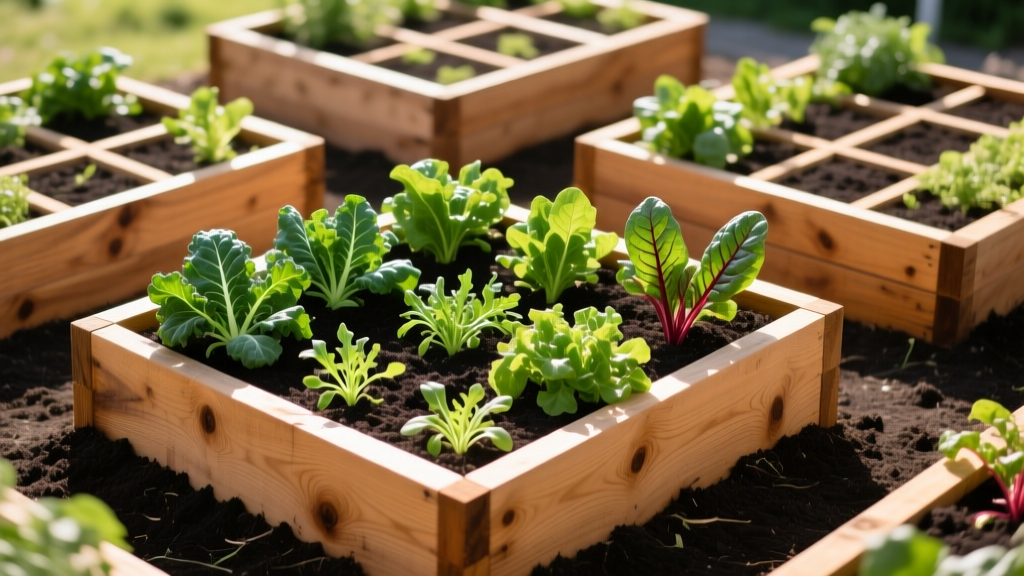
Sizing and Construction Framework
When deciding on the dimensional lumber for your beds, consider both the root depth of your crops and the structural integrity required to hold back wet soil. According to University of Minnesota Extension guidelines on raised bed construction, proper sizing prevents bowing and ensures adequate root development.
- 2x6 Lumber (Actual 1.5' x 5.5'): The minimum standard for raised beds. Suitable for shallow-rooted crops like lettuce, spinach, radishes, and most herbs. Requires cross-bracing or mid-span stakes if the bed exceeds 6 feet in length.
- 2x8 or 2x10 Lumber (Stacked or Single): Ideal for deep-rooted crops like carrots, parsnips, potatoes, and tomatoes. A 2x10 bed (9.25 inches deep) provides excellent moisture retention and reduces the frequency of watering during peak summer heat.
- Structural Staking: For any bed longer than 4 feet, drive 2x4 wooden stakes or 1/2-inch rebar into the ground on the outside of the long boards every 3 to 4 feet. Screw the bed walls into these stakes to prevent the hydrostatic pressure of the soil from pushing the boards outward and snapping your corner screws.
Final Decision Matrix
Choosing the right type of wood for raised bed gardens ultimately comes down to balancing your budget, your commitment to organic principles, and how long you plan to stay in your current home. If you are building a permanent homestead garden and have the budget, Black Locust or Coast Redwood Heartwood are unmatched in longevity. For the average homeowner seeking a balance of natural beauty, safety, and cost, Western Red Cedar (heartwood grade) paired with stainless steel fasteners remains the premier choice for edible landscaping.
Written by
Sarah WhitfieldSarah Whitfield is a chartered quantity surveyor (MRICS) and construction cost analyst with 15 years of experience in material pricing, procurement strategy, and project budgeting. She earned her degree in Construction Management from the University of Reading (UK) and has worked on projects ranging from $2M custom homes to $180M mixed-use developments across North America and Europe. Sarah currently leads cost estimating for BuildMat Insight, maintaining a proprietary database of 4,000+ material price points updated quarterly. She is a frequent contributor to RSMeans cost data panels and has presented at the International Cost Engineering Council (ICEC) congress. Based in Denver, CO, Sarah is an avid trail runner and volunteer mentor for Women in Construction.
More from Sarah Whitfield
View all
Wood & Lumber
What Are the Different Types of Wood? A Builder's Guide
Compare structural softwoods, finish hardwoods, and engineered lumber. Analyze Janka ratings, MOE values, and 2026 pricing for construction.
Aug 4, 2026

Walls & Panels
Steel Framing vs Wood Framing: Corrosion and Moisture Defense
Compare steel framing vs wood framing for moisture resistance. Learn about galvanized coatings, condensation risks, and corrosion protection strategies.
Jul 21, 2026

Stone & Masonry
How to Cut Stone Veneer: Wet Saw vs Grinder Comparison
Compare the best tools for cutting stone veneer. We review wet saws, angle grinders, and chop saws to help you achieve clean, chip-free cuts.
Jul 21, 2026