Types of Wood Joints by Species: A Complete Guide
Discover which types of wood joints work best for specific timber species. Expert guide matching hardwoods and softwoods to ideal joinery techniques.

The Physics of Joinery: Why Species Dictates Joint Choice
Selecting the correct joinery method requires more than aesthetic preference; it demands a strict understanding of wood anatomy. The structural integrity of any assembly relies on the intersection of mechanical interlock, glue adhesion, and the specific cellular structure of the timber. When evaluating different types of wood joints, a master craftsman must account for the species' Janka hardness, modulus of rupture (MOR), and grain orientation. According to the USDA Forest Products Laboratory, the shear strength of a glued joint is ultimately limited by the wood's shear strength parallel to the grain. If you cut a delicate dovetail pin into a highly brittle, high-density exotic hardwood, the pin will snap under assembly pressure. Conversely, cutting a wide mortise into a low-density softwood will result in severe crushing and joint failure under load.
Open-grained species like Red Oak possess large earlywood pores that can starve a glue line of adhesive if not properly managed, while closed-grained species like Hard Maple offer uniform density but require precise machining to prevent burnishing, which blocks glue penetration. Understanding these variables is the foundation of advanced woodworking and structural timber framing.
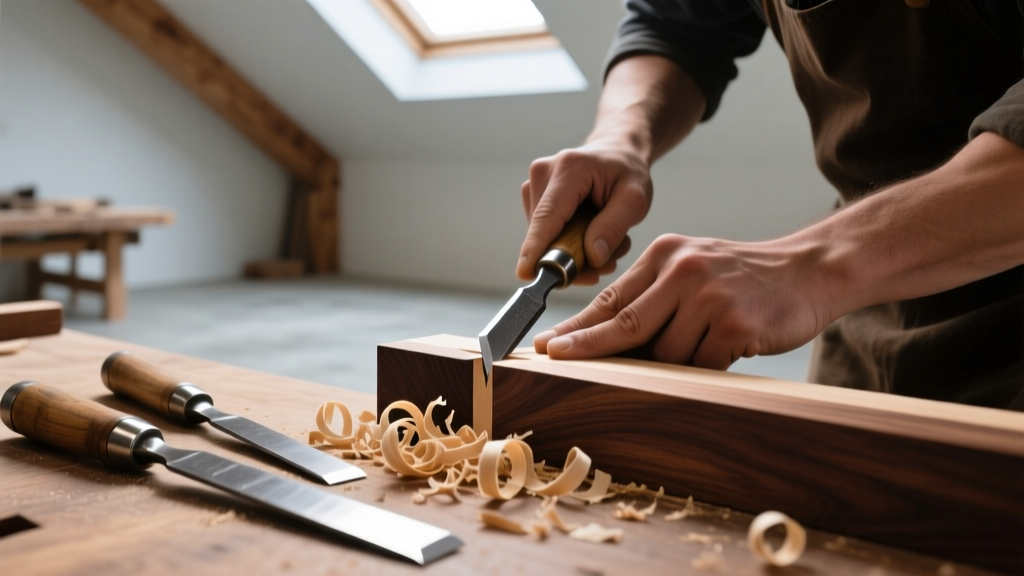
Hardwood vs. Softwood Joinery Matrix
The following matrix outlines the optimal joint selection based on timber classification, highlighting the primary mechanical risks associated with each pairing.
| Joint Type | Ideal Hardwoods | Ideal Softwoods | Primary Failure Risk |
|---|---|---|---|
| Hand-Cut Dovetail | Cherry, Walnut, Mahogany | Eastern White Pine | Pin crushing (softwoods) or cheek shearing (brittle hardwoods) |
| Mortise & Tenon | White Oak, Ash, Hickory | Douglas Fir, Southern Yellow Pine | Mortise wall blowout in ring-porous woods |
| Biscuit / Dowel | Maple, Birch, Poplar | SPF (Spruce-Pine-Fir) | Dowel splitting along the grain in softwoods |
| Pocket Hole | Not recommended for fine furniture | Pine, Cedar, Fir | Screw thread stripping in low-density fibers |
Matching Specific Types of Wood Joints to Timber Species
Dovetail Joints: Best for Fine-Grained, Medium-Density Hardwoods
Dovetails rely on the tensile strength of the wood fibers to resist mechanical pull-apart. The ideal species for hand-cut dovetails possess a Janka hardness between 800 and 1,100 lbf, such as Black Walnut (1,010 lbf) or Black Cherry (950 lbf). These species cut cleanly with chisels without excessive tear-out.
Critical Specification: The slope ratio of the dovetail must adapt to the species. For softwoods like Pine (380-420 lbf), use a steep 1:6 ratio to maximize the mechanical shoulder and prevent the soft pins from shearing. For hardwoods like Maple (1,450 lbf), a shallower 1:8 ratio is required; a steeper angle in dense maple will cause the short-grain at the base of the tail to snap off during assembly. Always reference the Wood Database to verify the exact Janka rating and crushing strength before setting your sliding bevel.
Mortise and Tenon: Best for High-Density Structural Hardwoods
The mortise and tenon is the undisputed king of structural framing and heavy-duty furniture. It excels in species with high modulus of elasticity and high shear strength, such as White Oak (1,360 lbf) and Hard Maple. The joint's strength comes from the long-grain to long-grain glue surface area inside the mortise.
The 1/3 Rule: The tenon thickness must be exactly one-third the thickness of the stock. If you are milling 3/4-inch White Oak, the tenon must be 1/4-inch thick. Cutting a tenon thicker than 1/3 leaves the mortise cheeks too thin, leading to catastrophic blowout when the chisel leverages against the dense, unyielding oak fibers.
Biscuit and Dowel Joints: Best for Brittle Exotics and Panel Glue-Ups
When working with highly figured woods (like Curly Maple or Quilted Mahogany) where the interlocked grain causes severe tear-out during routing or chiseling, dowels and biscuits provide a safe, machined alternative. Dowels are also superior when joining end-grain to long-grain in species that are prone to splitting, as the pre-drilled hole removes the wedge-action of the fastener.
Fluted vs. Grooved Dowels: For softwoods, use spiral-grooved hardwood dowels (like birch or beech) to create a mechanical bite in the soft fibers. For dense hardwoods, use fluted dowels to allow excess PVA glue to escape; trapped hydraulic pressure in a tight hardwood hole will split the board before the glue cures.
Pocket Hole Joinery: Best for Softwoods and Sheet Goods
Pocket screws are highly effective for utility cabinetry and softwood framing but are generally unsuitable for fine hardwood furniture due to the visible hole and reliance on coarse threads. In softwoods like Douglas Fir (660 lbf) and Cedar, the coarse threads of standard pocket screws bite aggressively into the low-density earlywood.
Thread Selection: Never use coarse-thread pocket screws in hardwoods over 1,000 Janka. The aggressive threads will act like a wedge, splitting the dense fibers. For hardwoods, you must use fine-thread pocket screws and drill a precise pilot hole to prevent catastrophic splitting.
Species with high natural extractive and oil content—such as Teak, Ipe, Rosewood, and Cocobolo—actively resist standard aliphatic resin (PVA) glues like Titebond I or II. The oils create a chemical barrier that prevents the adhesive from penetrating the wood cells, resulting in a joint that fails under minimal stress.
The Fix: Wipe the mating surfaces with acetone or denatured alcohol immediately before applying glue to strip the surface oils. For maximum reliability, bypass PVA entirely and use a high-quality structural epoxy (like West System 105/206) or a polyurethane adhesive (like Gorilla Wood Glue), which chemically bonds to the oily surface and requires moisture to cure. For exterior applications, ensure the adhesive meets ANSI/HPVA Type I waterproof standards.
Janka Hardness and Fastener Shear Limits
When mechanical fasteners (screws or nails) supplement a wood joint, the Janka hardness dictates the withdrawal resistance and the required pilot hole diameter. Driving a #8 wood screw directly into Hard Maple without a pilot hole will snap the screw shaft due to the immense radial pressure of the dense fibers.
- Softwoods (Under 800 lbf): Pilot hole diameter should match the screw's root (minor) diameter. The threads will cut into the soft fibers, providing 100% of the holding power.
- Medium Hardwoods (800 - 1,300 lbf): Pilot hole must match the root diameter, but the clearance hole (shank hole) must be exactly the diameter of the screw's unthreaded shank to prevent the threads from jacking the top board away from the bottom board.
- Ultra-Hard Exotics (Over 1,500 lbf): In species like Hickory (1,820 lbf) or Ipe (3,510 lbf), the pilot hole must be slightly larger than the root diameter—often up to 90% of the thread diameter—to prevent shear failure of the fastener and reduce heat buildup that can scorch the wood and ruin the threads.
Expert Troubleshooting: Common Joint Failures by Species
Even experienced woodworkers encounter joint failures when they misjudge a species' unique characteristics. Use this diagnostic guide to identify and correct species-specific joint failures.
Symptom: Tenon shears off inside the mortise during dry-fit.
Cause: You are likely working with a highly figured or interlocked-grain wood (like Sapele or Curly Maple). The short-grain at the base of the tenon is exceptionally weak. Fix: Transition to a twin-tenon design. By splitting a single wide tenon into two narrower tenons, you reduce the continuous short-grain span and increase the total long-grain glue surface area inside the mortise.
Symptom: Dovetail pins crush and deform when malleting the joint home.
Cause: The wood species is too soft for the chosen pin width. Eastern White Pine (380 lbf) and Basswood (410 lbf) lack the compressive strength to withstand the wedging action of a tight dovetail. Fix: Increase the pin width and decrease the tail width. Alternatively, switch to a through-dowel or sliding dovetail joint, which relies on shear strength rather than compressive edge strength.
Symptom: Glue line delaminates cleanly, with wood fibers remaining intact on both sides.
Cause: Glue starvation due to open-pore structure (common in Red Oak and Ash) or surface burnishing from dull tooling on closed-grain woods (Maple). Fix: For open-pore woods, apply a thin 'sizing coat' of glue thinned with 10% water, let it tack up, then apply the full glue coat. For burnished hardwoods, make a final pass with a freshly sharpened hand plane or a cabinet scraper to open the cellular structure immediately before gluing. Always consult Woodworkers Guild of America resources for species-specific clamp pressure guidelines; over-clamping Maple will squeeze out all adhesive, resulting in a starved, brittle joint.
Mastering the intersection of timber species and joinery mechanics elevates a project from a simple assembly to a lasting structural achievement. By respecting the Janka hardness, grain morphology, and extractive chemistry of your chosen wood, you ensure that every joint performs flawlessly for generations.
Written by
Priya KapoorPriya Kapoor is a real estate market analyst and construction economics researcher with expertise in housing affordability, development feasibility, and infrastructure investment. She holds a Master of Regional Planning from Cornell University and previously worked as a senior analyst at CBRE's Investment Properties group, where she modeled returns for $4B in mixed-use development pipelines. Priya now runs an independent research practice advising developers, municipalities, and REITs on construction cost forecasting and market timing. She publishes the quarterly "BuildMat Market Pulse" report tracking material price indices across 12 commodity categories. Based in Austin, TX, Priya serves on the board of Habitat for Humanity Austin and is a marathon runner.
More from Priya Kapoor
View all
Construction Cost
Cost to Build a 1600 Sq Ft Home in 2026: Full Breakdown
Accurate 2026 cost to build a 1600 sq ft home—material, labor, and regional pricing breakdowns included. Plan your budget with real-time estimates.
Aug 11, 2026

Wood & Lumber
Name the Types of Wood for Pressure Treatment and Preservation
Learn how to name the types of wood best suited for pressure treatment. Compare species treatability, chemical retention levels, and 2026 preservation costs.
Aug 4, 2026

Stone & Masonry
Stone Veneer Suppliers Lindenhurst: 2026 Cost Analysis
Analyze 2026 stone veneer costs in Lindenhurst, NY. Compare local supplier pricing, delivery fees, and Suffolk County installation labor rates.
Aug 4, 2026