Matching Treated Lumber 4x4 Posts to Structural & Outdoor Scenarios
Learn how to match treated lumber 4x4 posts to specific outdoor and structural scenarios, comparing retention levels, species, and ground contact needs.
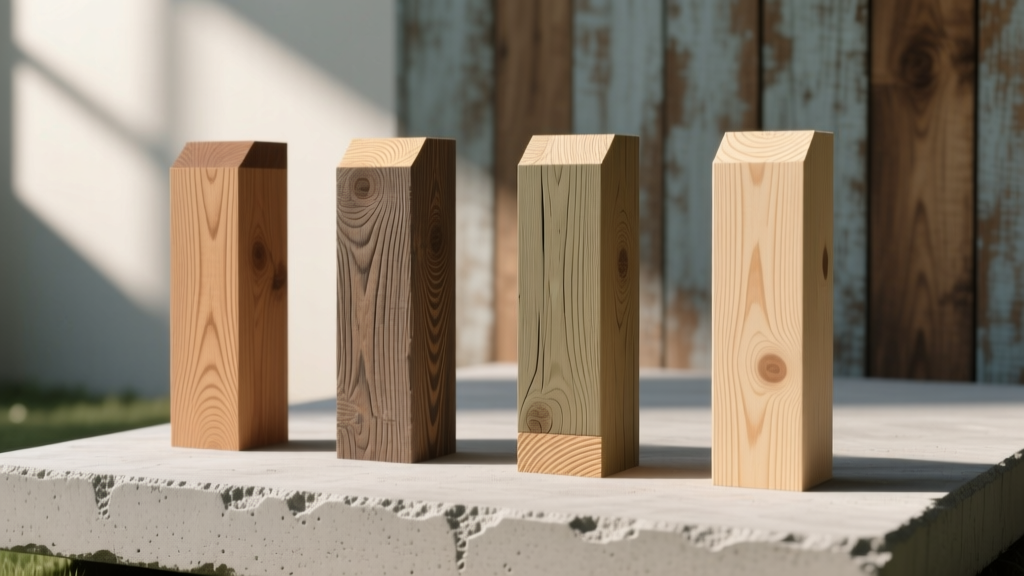
The Hidden Complexity of Selecting Treated Lumber 4x4 Posts
Walking into a lumberyard and grabbing a stack of green-stamped 4x4s is a recipe for premature structural failure. While a nominal 4x4 (which actually measures 3.5 inches by 3.5 inches) is a staple for outdoor construction, not all pressure-treated wood is created equal. The preservative retention levels, wood species, and treatment processes vary drastically based on the intended application. Matching the exact specifications of treated lumber 4x4 posts to your specific scenario is the difference between a structure that lasts 40 years and one that rots at the base in five.
This guide breaks down the application-fit framework for selecting, specifying, and installing treated 4x4 posts across diverse structural scenarios, adhering to current building codes and American Wood Protection Association (AWPA) standards.
Decoding AWPA Use Categories for Post Selection
The AWPA Use Category (UC) system is the definitive standard for specifying treated wood. The tag on the end of a 4x4 post will list a UC code and a preservative retention level measured in pounds per cubic foot (pcf). Selecting the wrong UC for your scenario is the most common cause of warranty voidance and structural decay.
| Use Category | Scenario Definition | Typical Retention (pcf)* | Best Application Fit |
|---|---|---|---|
| UC2 | Interior, dry service | 0.15 - 0.25 | Interior framing, sill plates on concrete |
| UC3B | Above ground, uncoated | 0.25 | Deck railings, pergola uprights on elevated bases |
| UC4A | Ground contact, general | 0.40 | Deck support posts, fence posts, mailbox stands |
| UC4B | Ground contact, heavy duty | 0.60 | Retaining walls, critical structural earth anchors |
| UC4C | Ground contact, extreme duty | 0.80+ | Permanent wood foundations, agricultural posts |
*Retention levels shown are typical for Micronized Copper Azole (MCA-C) or Copper Azole (CA-C) preservatives. Always verify the end-tag for exact pcf.
Pro-Tip on Moisture Wicking: Even if a 4x4 post rests on a concrete pier above the soil line, it must be rated for UC4A (Ground Contact). Concrete is highly porous and wicks ground moisture directly into the wood end-grain. Using UC3B (Above Ground) lumber on a concrete pier is a frequent code violation that leads to hidden base rot.
Species Selection: Refractory vs. Permeable Woods
The preservative chemicals used today (primarily MCA and CA-C) do not penetrate all wood species equally. Understanding the species of your 4x4 posts is critical for ensuring the treatment actually reached the core.
Southern Yellow Pine (SYP)
SYP is highly permeable. When treated, the preservative chemicals easily penetrate deep into the sapwood and core. If you are buying 4x4 posts in the Eastern or Southern United States, you are likely getting SYP. It is the gold standard for ground-contact applications because of its reliable treatment penetration and high structural bending strength.
Douglas Fir and Hem-Fir
Common in the Western U.S., these species are "refractory," meaning they naturally resist liquid penetration. To achieve AWPA ground-contact standards, refractory 4x4s must be incised—mechanically punctured with thousands of tiny needle marks along the surface to force chemicals deeper. If you are specifying Douglas Fir 4x4 posts for a UC4A ground-contact scenario, physically inspect the lumber for incising marks and verify the end-tag explicitly states it meets AWPA UC4A. Non-incised Fir treated only to UC3B will fail rapidly if buried.
Scenario Matching Framework
Apply this decision matrix to match your specific project requirements to the correct treated lumber 4x4 post specifications.
Scenario 1: Deck Support Posts (Elevated on Concrete Piers)
- Required Rating: UC4A (0.40 pcf minimum).
- Hardware Pairing: Must be elevated using a stand-off post base (e.g., Simpson Strong-Tie ABA44Z) that keeps the wood 1 inch above the concrete to allow airflow.
- Structural Note: A 3.5" x 3.5" SYP #2 4x4 post can typically support up to 10,000 lbs of axial compressive load at an 8-foot unbraced height, which is more than sufficient for standard residential deck joist spans.
Scenario 2: Pergola & Pavilion Uprights (Anchored to Slabs)
- Required Rating: UC3B (0.25 pcf) is acceptable only if the post is elevated off the slab with a galvanized base and the structure is fully exposed to rapid drying. If the pergola is built over a low-slope roof or in a heavily shaded, constantly damp microclimate, upgrade to UC4A.
- Wind Uplight: Pergolas act as sails. The 4x4 post connection to the concrete must resist severe uplift. Use heavy-duty tension ties (like the Simpson DTT2Z) anchored with wedge anchors into the concrete, rather than relying solely on the shear strength of the post base screws.
Scenario 3: Earth-Retaining Walls & Critical Anchors
- Required Rating: UC4B (0.60 pcf) or higher.
- Installation: Direct burial in compacted gravel drainage beds. Do not encase UC4B posts in solid concrete collars, as this traps water against the wood and accelerates decay. Instead, use a gravel backfill that allows water to drain away from the post base.
Never notch a treated 4x4 post to accept a beam or joist. Notching a 3.5" post by even 1.5 inches reduces its cross-sectional load-bearing area by over 40% and creates a massive stress concentration point. Furthermore, notching exposes untreated inner wood to the elements. Always use approved steel post caps (e.g., BC40Z) or structural screws to mount beams to the side or top of an uncut 4x4.
Fastener and Hardware Corrosion Matrix
Modern wood preservatives rely on copper as the primary fungicide. While older treatments like CCA (Chromated Copper Arsenate) were highly corrosive to steel, modern MCA and CA-C treatments still demand specific hardware ratings to prevent galvanic corrosion. According to Simpson Strong-Tie's corrosion guidelines, pairing the wrong fastener with treated lumber will cause the hardware to fail long before the wood rots.
| Preservative Type | Minimum Hardware Requirement | Optimal Hardware (High Moisture) |
|---|---|---|
| MCA-C / MCA | G185 Hot-Dipped Galvanized (ASTM A153) | 304 Stainless Steel |
| CA-C (Copper Azole) | G185 Hot-Dipped Galvanized (ASTM A153) | 316 Stainless Steel |
| Borate (Interior Only) | Standard Zinc-Plated | Standard Zinc-Plated |
Note: Electroplated galvanized fasteners (the shiny, silver screws found in standard boxes) are strictly prohibited for use with any ground-contact or exterior treated lumber. They will corrode within 24 months.
End-Grain Sealing and Field Cuts
Pressure treatment is a factory process. When you cut a 4x4 post to length on the job site, you expose raw, untreated end-grain. The American Wood Protection Association mandates that all field cuts, drill holes, and notches must be treated in the field according to AWPA Standard M4.
For MCA and CA-C treated lumber, apply a copper-based end-cut preservative (such as Copper-Green or a generic equivalent containing a minimum of 0.67% copper naphthenate) to all exposed cuts. Brush it on heavily until the wood stops absorbing it. This step is especially critical on the bottom cut of a post that will rest on a concrete pier, as end-grain acts like a bundle of straws, wicking moisture directly into the core of the post.
Managing Checking and Dimensional Stability
Treated lumber 4x4 posts are often installed while still wet from the treatment process. As the wood dries in place, it will develop longitudinal cracks known as "checks."
- Structural Impact: Surface checking that does not penetrate completely through the post is a natural release of drying stresses and does not compromise the structural integrity or the AWPA warranty.
- Aesthetic Mitigation: If the appearance of checks is unacceptable for a high-end pergola, specify KDAT (Kiln-Dried After Treatment) 4x4 posts. KDAT lumber is dried in a kiln after treatment, stabilizing the moisture content before it reaches the job site, drastically reducing post-installation checking and shrinkage.
- Fastener Timing: Because wet treated wood shrinks as it dries, connections can loosen over time. Use structural screws with continuous threads or through-bolts with washers, and plan to re-torque bolted connections 6 to 12 months after initial installation.
By rigorously matching the AWPA Use Category, wood species, and hardware to your specific environmental scenario, you ensure that your treated lumber 4x4 posts provide a safe, code-compliant, and permanent foundation for your structure.