Evaluating Types of Ebony Wood for Structural Applications
Explore the mechanical properties, specialized load-bearing uses, and CITES constraints of different types of ebony wood in structural applications.
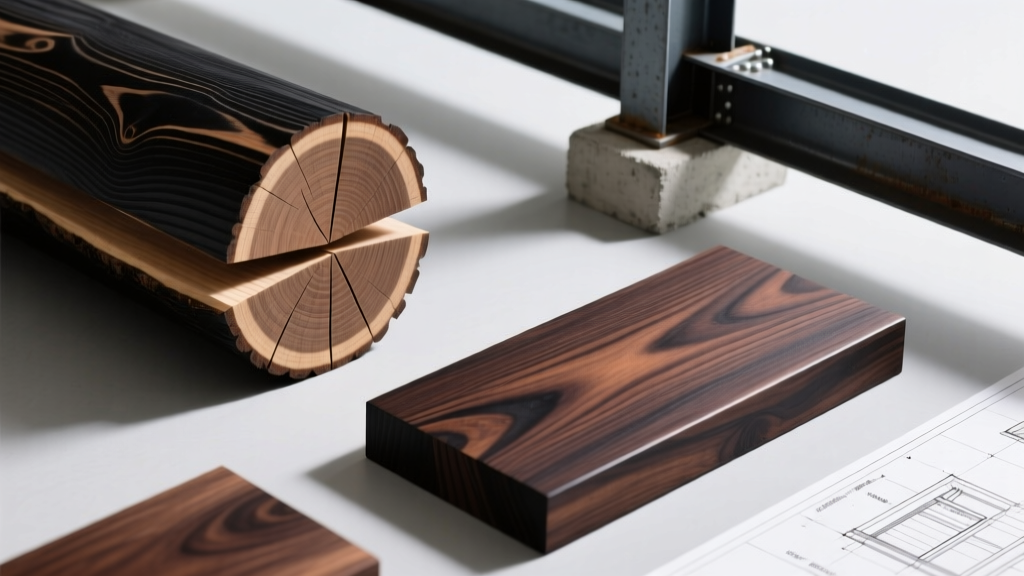
The Engineering Reality of Ebony in Load-Bearing Design
When architects and structural engineers specify timber for load-bearing frameworks, species like Douglas Fir, Southern Yellow Pine, or Glulam dominate the conversation. Ebony (genus Diospyros) is almost never used for primary structural framing due to its extreme cost, ecological restrictions, and dimensional limitations. However, dismissing ebony entirely from structural engineering ignores its highly specialized applications in heavy-duty wear surfaces, acoustic structural damping, and high-impact kinetic transfer nodes.
Ebony is an ultra-dense, fine-textured hardwood. Its structural value lies not in spanning long distances as a beam, but in absorbing immense compressive loads, resisting severe abrasion, and dampening vibrational frequencies. Understanding the different types of ebony wood is critical for specifying this material in niche architectural and industrial applications where standard hardwoods fail under extreme localized stress.
Mechanical Properties and Load-Bearing Metrics
To evaluate ebony for structural roles, we must look at its mechanical performance data. The most commonly referenced structural ebony, Gaboon Ebony (Diospyros crassiflora), exhibits physical properties that rival or exceed many industrial synthetic materials.
Gaboon Ebony Structural Data Highlights
- Janka Hardness: 3,080 lbf (13,700 N) — Roughly three times harder than Red Oak.
- Modulus of Rupture (MOR): 15,300 lbf/in² (105.5 MPa) — Indicates high bending strength before failure.
- Modulus of Elasticity (MOE): 1.30 Mpsi (8.97 GPa) — Demonstrates exceptional stiffness and resistance to deflection.
- Crushing Strength: 8,320 lbf/in² (57.4 MPa) — Ideal for localized high-compression bearing plates.
- Specific Gravity (Basic, 12% MC): 0.96 to 1.12 — Sinks in water; provides massive dead-load for acoustic damping.
According to the USDA Forest Products Laboratory Wood Handbook, woods with a specific gravity approaching or exceeding 1.0 exhibit minimal cellular collapse under vertical compression, making them ideal for structural bearing blocks in heavy machinery foundations or luxury commercial flooring where point-loads from steel stiletto heels or heavy equipment are a concern.
Breakdown of Ebony Types for Heavy-Duty Applications
Not all ebony species possess the same structural integrity or availability. Specifying the correct type of ebony wood requires balancing mechanical needs with international trade laws.
| Species / Type | Average Dry Weight | Primary Structural Use | CITES Status (2026) |
|---|---|---|---|
| Gaboon Ebony (D. crassiflora) |
67 lbs/ft³ (1,075 kg/m³) | Precision bearing blocks, high-impact mallet heads | Appendix II (Strictly regulated) |
| Macassar Ebony (D. celebica) |
68 lbs/ft³ (1,090 kg/m³) | Heavy-duty commercial flooring, architectural inlays | Not listed (But vulnerable) |
| Ceylon Ebony (D. ebenum) |
72 lbs/ft³ (1,150 kg/m³) | Historical structural uses; largely unavailable today | Appendix II |
| Muninga / African Ebony (D. mespiliformis) |
58 lbs/ft³ (930 kg/m³) | Turnery, tool handles, moderate-load flooring | Not listed |
For comprehensive data on species-specific gravity and shrinkage rates, the Wood Database entry on Gaboon Ebony and the Macassar Ebony profile provide essential baseline metrics for structural calculations.

Specialized Structural Applications in Modern Architecture
While you will not find ebony used as a load-bearing stud or joist, it excels in three highly specialized structural niches where its density and damping coefficients are irreplaceable.
1. High-Traffic Commercial Flooring and Load Distribution
In luxury retail spaces, airport lounges, and high-end commercial lobbies, flooring must withstand immense point-loads and continuous abrasive traffic. Macassar ebony, milled into thick tongue-and-groove planks (typically 3/4' to 1' thick), acts as a structural wear layer. Its high modulus of elasticity prevents the localized crushing that ruins softer hardwoods like Walnut or Cherry under heavy static loads (e.g., grand pianos, massive stone sculptures, or heavy retail fixtures).
2. Acoustic Decoupling and Mass-Loaded Damping
In the construction of high-fidelity recording studios and concert halls, structural vibration transfer is a primary enemy. Ebony’s extreme density (approaching 70 lbs/ft³) makes it an excellent material for structural isolation blocks. Placed beneath floating floor joists or heavy acoustic isolation mounts, ebony blocks provide the necessary dead mass to lower the resonant frequency of the structural node, effectively dampening low-frequency structural vibration transfer.
3. High-Impact Tooling and Kinetic Transfer
In industrial and specialized construction settings, ebony is used to manufacture structural mallets and dead-blow tool heads. Because the wood is so dense and lacks large open pores, it transfers kinetic energy with minimal rebound and absorbs shock without splintering, protecting the structural integrity of delicate mechanical components during assembly.
Fastening, Machining, and Installation Protocols
Working with types of ebony wood in a structural capacity requires strict adherence to specialized machining protocols. The wood's density and high silica content in some variants will rapidly destroy standard tooling.
⚠️ Warning: Tooling and Fastener Degradation
Standard HSS (High-Speed Steel) router bits and drill bits will dull within minutes of cutting Gaboon Ebony. Furthermore, the natural oils and tannins in ebony can react with standard galvanized or zinc-plated fasteners, causing severe black staining and localized corrosion. Always specify 316-grade stainless steel fasteners for structural ebony installations.
- Carbide Tooling Mandatory: Use only tungsten carbide-tipped (TCT) or polycrystalline diamond (PCD) saw blades and router bits. Maintain a slow feed rate to prevent burning.
- Mandatory Pre-Drilling: Ebony will split if nailed or screwed directly. Pre-drill all fastener holes to 90% of the fastener's shank diameter. Countersink bits must be carbide.
- Moisture Stabilization: Ebony is highly prone to checking (cracking) if moisture content fluctuates. Acclimate structural blocks or flooring in the installation environment for a minimum of 14 days until the wood reaches an equilibrium moisture content (EMC) of 6% to 8%.
- Adhesive Selection: Standard PVA wood glues often fail to penetrate the dense, oily pores of ebony. Use a high-quality, slow-cure epoxy or resorcinol-formaldehyde adhesive for structural bonding.
2026 Cost Analysis and Viable Structural Alternatives
The economic reality of specifying ebony for structural applications is steep. Due to CITES Appendix II restrictions on Gaboon and Ceylon ebony, legal, sustainably harvested structural-sized blanks command premium pricing. For projects where the aesthetic of black wood is required but the budget or ecological footprint of true ebony is unfeasible, structural alternatives are highly recommended.
| Material | Approx. 2026 Price (per Board Foot) | Structural Viability |
|---|---|---|
| Gaboon Ebony (Small Blanks) | $100.00 - $150.00+ | Limited to small bearing blocks / inlays |
| Macassar Ebony | $35.00 - $60.00 | Viable for luxury flooring and paneling |
| Ipe (Brazilian Walnut) | $15.00 - $25.00 | Excellent structural alternative; Janka 3,510 lbf |
| Ebonized White Oak | $12.00 - $18.00 | Chemically stained; ideal for large structural beams |
The Ebonizing Alternative for Primary Framing
If a design calls for the visual impact of black timber in primary structural framing (such as exposed ceiling beams or architectural columns), specifying true ebony is structurally and economically illogical. Instead, specify structural-grade White Oak or Ash and utilize an iron acetate ebonizing process. This chemical reaction with the wood's natural tannins turns the timber jet-black to the core of the cellular structure without compromising the wood's structural grading, modulus of elasticity, or load-bearing capacity, at a fraction of the cost and ecological impact.
Sourcing and Compliance Directives
When procuring any types of ebony wood for architectural projects in 2026, strict chain-of-custody documentation is non-negotiable. Ensure your supplier provides verifiable CITES export permits for Appendix II species. For structural components where large dimensions are required, consider laminating thinner, legally sourced Macassar ebony veneers over a structural plywood or MDF core, reserving solid ebony only for the high-wear structural nodes and bearing surfaces where its unique mechanical properties are strictly necessary.
Written by
Priya KapoorPriya Kapoor is a real estate market analyst and construction economics researcher with expertise in housing affordability, development feasibility, and infrastructure investment. She holds a Master of Regional Planning from Cornell University and previously worked as a senior analyst at CBRE's Investment Properties group, where she modeled returns for $4B in mixed-use development pipelines. Priya now runs an independent research practice advising developers, municipalities, and REITs on construction cost forecasting and market timing. She publishes the quarterly "BuildMat Market Pulse" report tracking material price indices across 12 commodity categories. Based in Austin, TX, Priya serves on the board of Habitat for Humanity Austin and is a marathon runner.
More from Priya Kapoor
View all
Construction Cost
Cost to Build a 1600 Sq Ft Home in 2026: Full Breakdown
Accurate 2026 cost to build a 1600 sq ft home—material, labor, and regional pricing breakdowns included. Plan your budget with real-time estimates.
Aug 11, 2026

Wood & Lumber
Name the Types of Wood for Pressure Treatment and Preservation
Learn how to name the types of wood best suited for pressure treatment. Compare species treatability, chemical retention levels, and 2026 preservation costs.
Aug 4, 2026

Stone & Masonry
Stone Veneer Suppliers Lindenhurst: 2026 Cost Analysis
Analyze 2026 stone veneer costs in Lindenhurst, NY. Compare local supplier pricing, delivery fees, and Suffolk County installation labor rates.
Aug 4, 2026