What Is the Most Expensive Type of Wood? A Complete Species Guide
Discover the most expensive type of wood for luxury construction. Explore pricing, Janka hardness, and applications for African Blackwood and more.
Defining the Pinnacle of Timber Valuation
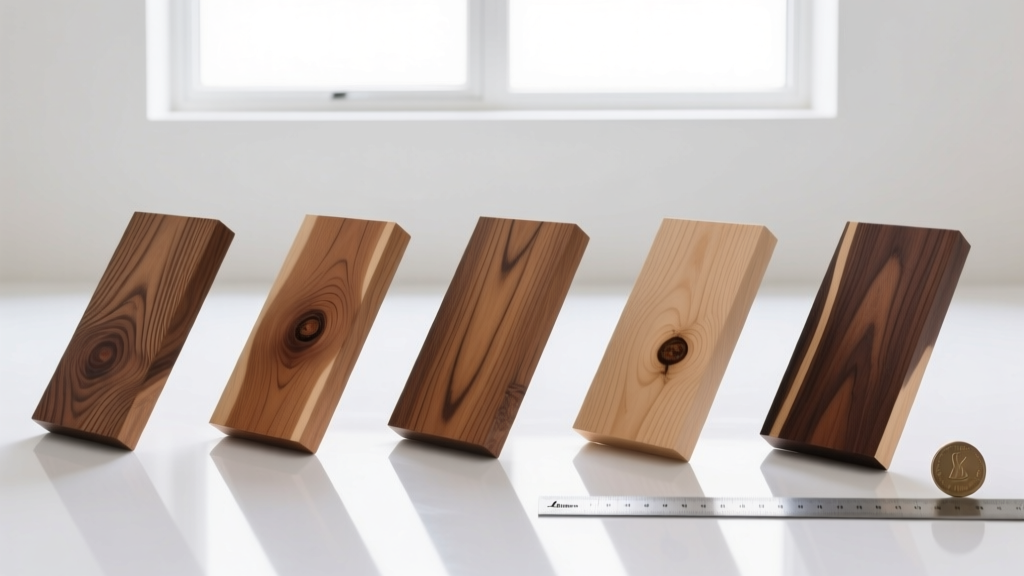
When architects, bespoke millworkers, and luxury yacht builders ask what the most expensive type of wood is, the answer extends far beyond standard hardwoods like walnut or mahogany. The upper echelon of timber pricing is driven by extreme scarcity, slow growth rates, severe harvesting restrictions, and unique physical or aromatic properties. In 2026, the market for ultra-premium woods is heavily influenced by international conservation treaties and a surge in demand for hyper-custom architectural accents.
Unlike structural framing lumber or standard flooring, these species are rarely sold by the truckload. They are traded in small turning blanks, by the pound, or as highly figured veneers. Understanding the exact cost drivers, mechanical properties, and legal procurement channels for these species is critical for any professional specifying them in high-end projects.
The Ultra-Premium Species Matrix
The table below outlines the top tier of the world's most expensive woods, comparing their market rates, mechanical hardness, and primary luxury applications. Pricing reflects early 2026 market averages for clear, kiln-dried heartwood.
| Species | Scientific Name | Avg. Price (Per Board Foot / lb) | Janka Hardness | Primary Luxury Application |
|---|---|---|---|---|
| African Blackwood | Dalbergia melanoxylon | $120 - $160+ / BF | 3,670 lbf | Musical instruments, cue sticks |
| Agarwood | Aquilaria spp. | $10,000 - $100,000+ / kg | N/A (Resinous) | Incense, bespoke carving, perfume |
| Pink Ivory | Berchemia zeyheri | $40 - $60 / BF | 2,720 lbf | Billiard cues, custom inlays |
| Lignum Vitae | Guaiacum officinale | $80 - $120 / lb | 4,500 lbf | Marine bearings, mallets |
| Sandalwood | Santalum album | $30 - $50 / BF (Heartwood) | 1,200 lbf | Ornate boxes, oil extraction |
Deep Dive: The Most Expensive Wood Species
African Blackwood (Dalbergia melanoxylon)
Often cited as the most expensive type of wood used in actual woodworking and manufacturing, African Blackwood is a dense, nearly black timber native to the dry savannas of sub-Saharan Africa. Its extreme cost is a direct result of its growth habit: the trees are small, heavily branched, and grow incredibly slowly, yielding very little usable heartwood per tree. Furthermore, the wood is notorious for hiding internal voids and cracks, leading to a massive waste factor during milling.
Machining & Finishing: With a Janka hardness of 3,670 lbf, African Blackwood will rapidly blunt standard carbide cutters. Millworkers must use high-speed steel (HSS) or specialized carbide tooling. Because its pores are exceptionally small, it requires no pore filler and can be sanded to a glass-like, mirror finish using only fine abrasives and a light wax or oil coat. According to the USDA Forest Products Laboratory, its dimensional stability is among the highest of any hardwood, making it the undisputed standard for orchestral woodwinds like clarinets and oboes.
Agarwood (Aquilaria spp.)
Agarwood occupies a unique space: it is technically the most expensive wood on earth by weight, but it is almost never used for construction or standard milling. The astronomical price (frequently exceeding $30,000 per kilogram for high-grade material) applies to the dark, resin-saturated heartwood that forms only when the Aquilaria tree is infected by a specific type of mold (Phialophora parasitica). The tree produces a dense, aromatic resin as an immune response.
Market Reality: In 2026, wild-harvested Agarwood is virtually non-existent due to severe overharvesting. The market is supplied by cultivated plantations in Vietnam and Malaysia, where trees are intentionally inoculated. It is carved into high-end sculptural art, distilled into oud oil for luxury perfumery, or burned as premium incense. Specifying Agarwood for architectural paneling is financially unfeasible; instead, luxury interiors utilize Agarwood-scented finishes or highly controlled display cases for raw resinous chunks.
Pink Ivory (Berchemia zeyheri)
Historically reserved for Zulu royalty in Southern Africa, Pink Ivory is prized for its striking, vibrant pink-to-red coloration and extreme density. The color deepens and matures with age and exposure to light, though prolonged UV exposure can eventually cause it to darken to a deep brownish-red. It is primarily sourced from South Africa and Zimbabwe.
Working Characteristics: Pink Ivory features an interlocked grain that makes it highly susceptible to tearout during planing. It requires extremely sharp tools and very light, skewed passes. Its high natural oil content can interfere with certain water-based glues, necessitating the use of epoxy or polyurethane adhesives for structural joinery. It is a premier choice for luxury billiard cues, custom tool handles, and high-contrast stringing in architectural marquetry.
Lignum Vitae (Guaiacum officinale)
True Lignum Vitae is legendary for being one of the heaviest and hardest woods in the world, boasting a Janka rating of 4,500 lbf. Its most defining characteristic is its incredibly high natural oil and resin content, which makes the wood self-lubricating. Historically, this made it the premier material for ship propeller shaft bearings and submarine bearings before the advent of advanced synthetic polymers.
Procurement Note: True Lignum Vitae is heavily restricted. In modern luxury applications, it is used for heavy-duty mallets, bowling balls, and bespoke mechanical clock gears. Because of its waxy surface, gluing is nearly impossible without first wiping the joint surfaces with a strong solvent like acetone immediately before applying a specialized epoxy.
⚠️ Regulatory Warning: CITES and Import Restrictions
Many of the most expensive wood species are listed under the Convention on International Trade in Endangered Species (CITES). African Blackwood and true Lignum Vitae are listed in CITES Appendix II, meaning international trade requires strict export permits and proof of sustainable harvesting. Agarwood is listed in Appendix II, while some Dalbergia species (Rosewoods) face even stricter controls. Always verify the current CITES species database before attempting to import these materials across borders to avoid severe fines and confiscation.
Procurement Framework for Luxury Millwork
Sourcing the most expensive type of wood requires a fundamentally different procurement strategy than ordering standard oak or maple. Architects and lead carpenters should follow this framework to ensure legal compliance and material integrity:
- Demand FSC Certification: For any CITES-listed species, insist on Forest Stewardship Council (FSC) chain-of-custody documentation. The FSC certification ensures the timber was harvested legally and sustainably, protecting your firm from liability.
- Specify Veneer Over Solid Stock: For large architectural surfaces like elevator cabs or boardroom wall paneling, specify quarter-sawn or book-matched veneers pressed onto high-grade MDF or marine plywood substrates. This reduces the cost by up to 80% compared to solid lumber while maximizing the visual impact of the rare figure.
- Acclimate Exotics Slowly: Ultra-dense woods like African Blackwood and Pink Ivory are highly stable, but they are often shipped in sealed, wax-coated blanks to prevent checking. Once milled, allow the wood to acclimate in the installation environment (maintained at 35-45% relative humidity) for a minimum of 14 days before final finishing.
- Factor in the Waste Multiplier: When estimating costs for solid exotic woods, apply a 30% to 50% waste multiplier. Hidden checks, sapwood intrusion, and irregular bark pockets are common in these small-diameter species.
Frequently Asked Questions
Is there a less expensive alternative to African Blackwood?
Yes. For applications where the deep black color and high density are required but the exact acoustic properties of African Blackwood are not, Wenge (Millettia laurentii) or Ebony (Diospyros spp.) are common alternatives. While still expensive ($25–$45 per board foot), they are significantly more affordable and available in larger, more usable dimensions. Another option is to use a dense, closed-pore domestic wood like Hard Maple and apply a professional-grade aniline dye and pore-filling finish to mimic the aesthetic.
Why is Sandalwood so expensive if it is relatively soft?
Sandalwood (Santalum album) commands high prices not for its structural integrity or Janka hardness (which is a modest 1,200 lbf), but for its essential oil content. The heartwood contains high concentrations of santalol, which is heavily demanded by the global perfumery and aromatherapy markets. In luxury construction, Sandalwood is strictly used for small, highly detailed accent pieces, jewelry boxes, or custom humidors where its permanent, natural fragrance adds experiential value to the space.
Can I use Lignum Vitae for exterior decking or structural beams?
No. Beyond the prohibitive cost (often exceeding $100 per pound), true Lignum Vitae is only available in very small, turning-sized blanks. It is physically impossible to source it in dimensional lumber sizes suitable for decking or structural beams. For exterior applications requiring extreme rot resistance and density, specify Ipe (Handroanthus spp.) or Cumaru (Dipteryx odorata), which offer excellent weathering properties at a fraction of the cost and in standard dimensional sizes.
Written by
James ThorntonJames Thornton is a construction industry veteran with 25 years of hands-on experience in wood framing, lumber grading, and residential building codes. He started as a framing carpenter in rural Oregon, earned his ICC Residential Building Inspector certification, and eventually became a senior plan reviewer for the City of Portland Bureau of Development Services. James holds a B.S. in Wood Science & Technology from Oregon State University and is a certified lumber grader through the West Coast Lumber Inspection Bureau (WCLIB). He has inspected over 3,000 residential construction sites and authored the city's internal guide on advanced framing techniques (2x6 at 24" O.C.). James lives in Bend, OR, where he builds custom timber-frame cabins and competes in lumberjack sports.
More from James Thornton
View all
Insulation
Best Home Insulation Materials: Complete 2026 Guide
Compare top home insulation materials for 2026. Find R-values, installed costs per square foot, and best uses for fiberglass, spray foam, and mineral wool.
Aug 4, 2026

Sustainable Building
Certify Your Green Building Material for LEED and WELL
Step-by-step guide to certifying a green building material for LEED v5 and WELL v2. Master EPDs, HPDs, and VOC limits for 2026 project specifications.
Aug 4, 2026

Stone & Masonry
Veneer Stacked Stone Panels: Interior Design & Style Showcase
Discover how veneer stacked stone panels transform interiors. Explore modern design profiles, material pairings, and technical installation specs.
Aug 4, 2026