Top Types of Wooden Fencing Compared: Costs & Lifespans
Compare the top types of wooden fencing in 2026. We break down installed costs, lifespans, wood grades, and failure modes for pine, cedar, and redwood.

The 2026 Cost & Lifespan Matrix for Wooden Fencing
Selecting the right wood species for a fence requires balancing immediate budget constraints against long-term maintenance and replacement costs. The table below outlines the baseline metrics for the four most common types of wooden fencing used in residential and commercial construction today. All pricing reflects 2026 national averages for a standard 6-foot-tall privacy fence, including materials, labor, and standard post-setting.
| Wood Species | 2026 Installed Cost (per linear ft) | Expected Lifespan | Natural Rot/Insect Resistance | Dimensional Stability |
|---|---|---|---|---|
| Pressure-Treated Southern Yellow Pine | $28 - $42 | 15 - 20 Years | High (Chemically Induced) | Poor (Prone to warping/twisting) |
| Western Red Cedar | $45 - $65 | 15 - 25 Years | Moderate-High (Natural Tannins) | Excellent (Low shrinkage) |
| California Redwood | $65 - $95 | 20 - 30 Years | Very High (Heartwood Extractives) | Excellent |
| Spruce-Pine-Fir (SPF) Stockade | $18 - $26 | 5 - 8 Years | None | Moderate |
Pressure-Treated Southern Yellow Pine: The Budget Workhorse
Pressure-treated (PT) Southern Yellow Pine dominates the fencing market due to its aggressive price point and structural rigidity. The wood is infused with chemical preservatives—most commonly Micronized Copper Azole (MCA) or Copper Quaternary (CQ)—which protect against fungal decay and termite damage. According to the American Wood Protection Association, fence posts must meet the UC4B (Ground Contact) use category standard, while above-ground rails and pickets only require UC4A.
Modern MCA-treated pine is less corrosive than legacy CCA treatments, but the copper content will still rapidly destroy standard electroplated galvanized nails. You must use Hot-Dipped Galvanized (HDG) G185 fasteners or Type 304 Stainless Steel. In coastal environments (within 5 miles of saltwater), Type 316 Stainless Steel is mandatory to prevent catastrophic galvanic corrosion and black streaking on the pickets.
Pros and Cons of Pressure-Treated Pine
- Pros: Lowest upfront cost; widely available; structural posts are highly resistant to ground rot when rated UC4B.
- Cons: High initial moisture content leads to significant shrinking, checking, and warping as it dries over the first 6-12 months; requires annual sealing once fully cured to prevent UV graying and splitting.
Western Red Cedar: The Dimensional Stability Champion
Western Red Cedar is the premium standard for wooden fencing, prized for its rich color, aromatic scent, and exceptional resistance to warping. The wood contains natural extractives called thujaplicins, which act as built-in fungicides and insect repellents. The USDA Forest Products Laboratory notes that old-growth cedar heartwood offers superior decay resistance compared to second-growth sapwood, though true old-growth is increasingly rare and expensive.
Understanding Cedar Grades: Clear vs. Select Tight Knot
When ordering cedar fencing, the grade dictates both the aesthetic and the structural longevity:
- Clear Heart / Clear Vertical: 100% heartwood, zero knots. Extremely stable but prohibitively expensive for most residential fencing ($8+ per picket).
- Select Tight Knot (STK): The industry sweet spot. Contains sound, tight knots that will not fall out. Offers 90% of the rot resistance of clear cedar at roughly half the cost.
- #2 Common / Utility: Contains loose knots, sapwood, and wane. Highly susceptible to localized rot around the knot holes. Avoid for long-term privacy fences.
California Redwood: Luxury, Longevity, and Heartwood
Redwood remains the undisputed luxury choice for wooden fencing. Its deep reddish-brown hue and massive cellular structure make it highly resistant to moisture penetration and fire. However, the rot resistance of redwood is entirely dependent on the presence of heartwood. Sapwood (the lighter outer rings of the tree) has virtually no natural decay resistance.
For fencing, specify Construction Heart or B-Grade Heart. Because redwood forests are heavily regulated, ensure your supplier provides Forest Stewardship Council (FSC) certification to verify the timber was harvested from sustainably managed, second-growth forests rather than protected old-growth reserves.
While redwood can be left to weather to a silvery-gray, UV exposure will degrade the surface lignin, causing superficial checking. To maintain the original red hue, apply a penetrating, semi-transparent oil-based stain containing UV inhibitors within 30 days of installation, and reapply every 3 to 4 years.
Spruce-Pine-Fir (SPF): The Short-Term Stockade
SPF stockade fencing—often sold in pre-assembled 8-foot panels at big-box retailers—is the cheapest wooden fencing option available. It is typically constructed from untreated Spruce, Pine, or Fir. Without chemical treatment or natural extractives, SPF wood will begin to rot at the ground line within 3 to 5 years in damp climates and is highly vulnerable to carpenter ants and termites. Use SPF only for temporary boundary marking, short-term construction screening, or budget-constrained rental properties where a 20-year lifespan is not required.
Decision Framework: Matching Wood Species to Your Climate
Do not select a wood species based solely on national averages; local microclimates dictate failure rates.
- High Humidity / Heavy Clay Soils (e.g., US Southeast): Avoid Cedar pickets in direct ground contact. Use UC4B Pressure-Treated Pine for posts and structural rails, with Cedar or Redwood pickets kept 2 inches above the soil grade to prevent wicking.
- High Termite Pressure (e.g., Gulf Coast, Southern California): Borate-treated pine or Redwood Heartwood are mandatory. Standard MCA-treated pine can still suffer surface termite grazing in extreme pressure zones.
- Arid / High UV (e.g., US Southwest): Cedar and Redwood excel here. The low ambient humidity prevents rot, allowing the natural UV weathering process to occur without fungal degradation. PT Pine will severely warp and twist in dry heat due to rapid, uneven moisture loss.
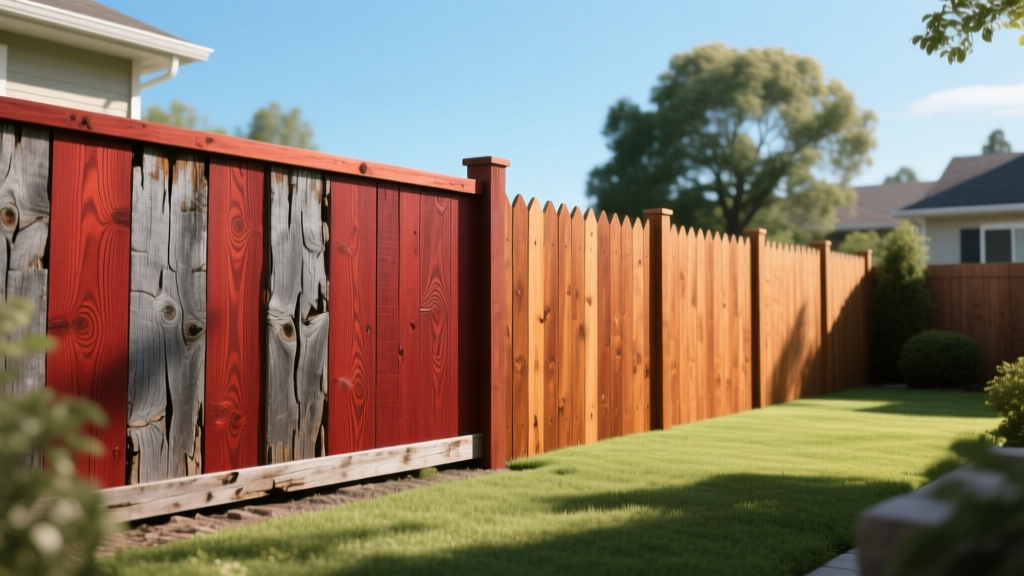
The Hidden Lifespan Killers: Post Setting and Ground Contact
The most expensive cedar or redwood pickets will be rendered useless if the structural posts fail. The number one cause of premature wooden fence failure is improper post-setting, specifically the 'concrete collar' mistake.
Why Concrete Collars Rot Fence Posts
Pouring concrete flush with the topsoil creates a saucer effect. Rainwater pools on top of the concrete, trapping moisture directly against the end-grain of the wooden post. Combined with soil microbes, this accelerates rot at the exact ground-line stress point where wind loads are highest.
The Gravel French Drain Method
For a 25+ year post lifespan, utilize a drained gravel base:
- Dig a post hole 6 inches deeper than the required frost line.
- Fill the bottom 6 inches with 3/4-inch crushed angular gravel and tamp it solid. This creates a drainage plane for water escaping the post.
- Set the UC4B rated post on the gravel.
- Backfill with concrete, but stop 3 inches below grade.
- Slope the top of the concrete away from the post (a 'crown') and backfill the remaining 3 inches with native soil and turf to shed surface water away from the wood-concrete interface.
Frequently Asked Questions
How long should I wait to stain a new pressure-treated pine fence?
Traditional wet-treated PT pine requires 3 to 6 months of weathering to dry out before it can accept a penetrating stain. If water beads up on the wood surface, it is still too wet. However, many modern suppliers now offer 'KDAT' (Kiln-Dried After Treatment) pine, which can be stained immediately upon installation. Check your lumber tags for the KDAT designation.
Why do wooden fence gates sag, and how do I prevent it?
Gate sag is caused by the sheer weight of the wood pulling the rectangular frame out of square, turning it into a parallelogram. To prevent this, build the gate frame using 2x4s with a continuous diagonal cross-brace running from the bottom hinge corner to the top latch corner. This transfers the weight down into the bottom hinge. For gates wider than 48 inches, install a steel turnbuckle cable system (like the Adjust-A-Gate kit) to allow for future tension adjustments.
Is it better to use nails or screws for wooden fence pickets?
Ring-shank hot-dipped galvanized nails are superior for attaching pickets to rails. Nails possess higher shear strength than screws and will bend under wind loads or wood movement, whereas standard exterior screws are brittle and will snap. Reserve structural exterior screws (like Simpson Strong-Tie SDWS) exclusively for attaching heavy 2x4 rails to the 4x4 posts.
Written by
James ThorntonJames Thornton is a construction industry veteran with 25 years of hands-on experience in wood framing, lumber grading, and residential building codes. He started as a framing carpenter in rural Oregon, earned his ICC Residential Building Inspector certification, and eventually became a senior plan reviewer for the City of Portland Bureau of Development Services. James holds a B.S. in Wood Science & Technology from Oregon State University and is a certified lumber grader through the West Coast Lumber Inspection Bureau (WCLIB). He has inspected over 3,000 residential construction sites and authored the city's internal guide on advanced framing techniques (2x6 at 24" O.C.). James lives in Bend, OR, where he builds custom timber-frame cabins and competes in lumberjack sports.
More from James Thornton
View all
Insulation
Best Home Insulation Materials: Complete 2026 Guide
Compare top home insulation materials for 2026. Find R-values, installed costs per square foot, and best uses for fiberglass, spray foam, and mineral wool.
Aug 4, 2026

Sustainable Building
Certify Your Green Building Material for LEED and WELL
Step-by-step guide to certifying a green building material for LEED v5 and WELL v2. Master EPDs, HPDs, and VOC limits for 2026 project specifications.
Aug 4, 2026

Stone & Masonry
Veneer Stacked Stone Panels: Interior Design & Style Showcase
Discover how veneer stacked stone panels transform interiors. Explore modern design profiles, material pairings, and technical installation specs.
Aug 4, 2026