Types of Cutting Board Wood: Treatment and Preservation Guide
Explore the best types of cutting board wood for butcher block counters, focusing on food-safe treatments, Janka hardness, and long-term preservation.

Lumber Selection: Grain Structure and Janka Hardness
When specifying wood for culinary surfaces, butcher block countertops, or heavy-duty commercial prep stations, the intersection of material science and food safety dictates the selection process. The structural integrity of the wood and its cellular porosity determine how it will absorb treatments, resist bacterial ingress, and withstand mechanical abrasion from cutlery. Understanding the specific properties of different types of cutting board wood is the foundational step before any chemical preservation can occur.
Wood hardness, measured on the Janka scale, indicates a species' resistance to denting and wear. However, harder is not universally better. Woods exceeding 1,500 lbf on the Janka scale (like Hickory or Ipe) are too dense to properly absorb penetrating oils and will dull high-carbon steel knives. Conversely, softwoods and low-hardness hardwoods (below 800 lbf) score easily, creating deep grooves where moisture and anaerobic bacteria thrive. The optimal Janka range for cutting surfaces is between 900 lbf and 1,450 lbf.
Comparative Matrix of Primary Cutting Board Species
| Wood Species | Janka Hardness | Grain Structure | Preservation Characteristics |
|---|---|---|---|
| Hard Maple (Acer saccharum) | 1,450 lbf | Closed, diffuse-porous | Industry standard. Tight grain limits deep bacterial penetration; requires standard oiling schedules. |
| Black Walnut (Juglans nigra) | 1,010 lbf | Semi-ring porous | Excellent dimensional stability. Darkens with UV exposure. Slightly more porous than maple, requiring heavier initial sealing. |
| Cherry (Prunus serotina) | 950 lbf | Fine, closed grain | Soother on knife edges. Prone to photo-oxidation (darkening). Absorbs polymerizing oils very evenly. |
| Teak (Tectona grandis) | 1,070 lbf | Coarse, uneven texture | High natural silica and tectonaquinone content repels water inherently but aggressively dulls knives and complicates PVA glue joints. |
Grain orientation is equally critical. End-grain boards (where the wood is cut perpendicular to the growth rings) expose the ends of the wood fibers, acting like a bundle of microscopic straws. This allows for deep penetration of preserving oils but also requires more frequent maintenance. Edge-grain and face-grain boards present the lateral walls of the fibers, offering a more hydrophobic surface out of the box but limiting the depth of oil penetration. For commercial applications, the FDA Food Code mandates that wood used as a food-contact surface must be smooth, easily cleanable, and free of open seams—making edge-grain maple the most common choice for health-department compliance.
The Chemistry of Food-Safe Wood Treatments
Raw lumber is highly hygroscopic. Without treatment, a butcher block surface will rapidly absorb ambient humidity, meat juices, and cleaning solvents, leading to catastrophic dimensional changes (cupping, checking, and warping). Preservation relies on occupying the cellular voids with hydrophobic compounds. These compounds fall into two distinct chemical categories: non-drying and polymerizing.
Non-Drying Oils (Aliphatic Hydrocarbons)
Food-grade mineral oil (a highly refined aliphatic hydrocarbon) is the most prevalent treatment for types of cutting board wood. It is chemically inert, odorless, and will never undergo oxidative cross-linking (curing). Because it remains a liquid, it does not form a hard surface film. Instead, it saturates the wood fibers, creating a hydrophobic barrier through displacement.
- Pros: NSF H1 registered for incidental food contact; infinite shelf life; easy to reapply; never flakes or peels.
- Cons: Offers no mechanical protection against knife scarring; easily washed away by harsh detergents; requires monthly maintenance.
Polymerizing Oils (Drying Oils)
Pure Tung oil (extracted from the nut of the Aleurites fordii tree) and raw Linseed oil (flaxseed) are polymerizing oils. When exposed to oxygen, their triglyceride molecules undergo cross-linking, transforming from a liquid into a solid, plastic-like polymer matrix within the wood cellular structure.
Wax Blends for Surface Barrier Enhancement
Because mineral oil lacks surface tension and easily migrates out of end-grain wood, it is frequently compounded with natural waxes. A blend of 80% mineral oil and 20% beeswax or carnauba wax (by volume) raises the melting point of the treatment. When applied warm, the wax penetrates the upper millimeter of the wood and solidifies upon cooling, providing a physical, water-repellent barrier that resists washing away better than oil alone.
Initial Sealing Protocol for Raw Butcher Block
Proper initial treatment of newly milled lumber dictates the lifespan of the cutting surface. According to research from the USDA Forest Products Laboratory, the moisture content (MC) of the wood must be stabilized to the interior environment (typically 6% to 8% MC) before any sealing begins.
- Abrasive Preparation: Sand the surface progressively through 80, 120, 180, and 220 grits. Stop at 220 grit. Sanding to 320 or higher burnishes the wood fibers, collapsing the cellular pores and preventing deep oil penetration.
- Solvent Wipe: Wipe the bare wood with a lint-free cloth dampened with food-grade denatured alcohol to remove microscopic dust and raise the grain slightly. Allow to flash off (15 minutes).
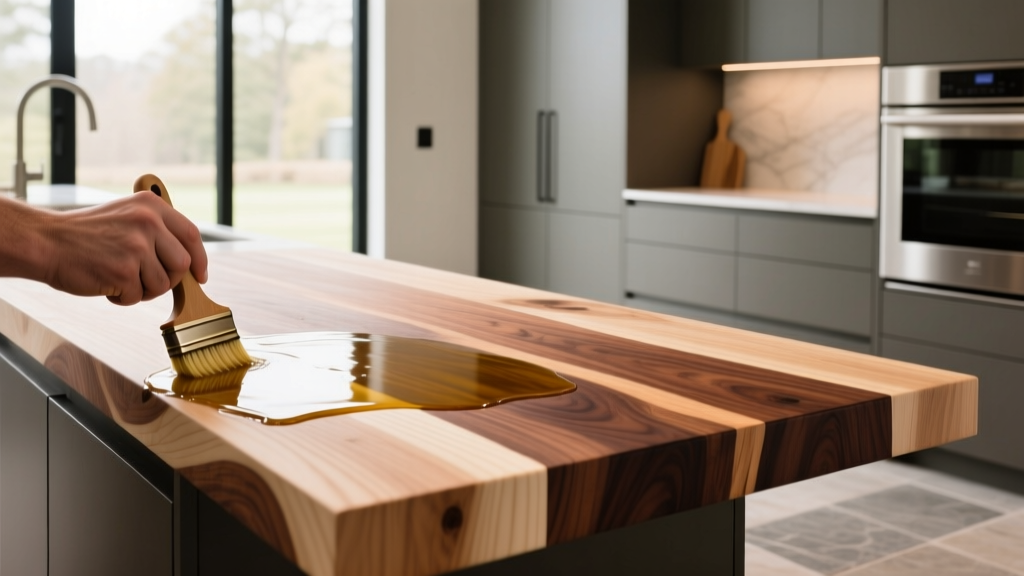
- The Flood Coat: Apply a generous, pooling layer of your chosen treatment (e.g., 80/20 mineral oil/beeswax blend warmed to 140°F). Allow it to sit for 30 minutes. The end-grain will wick the oil deeply; edge-grain will absorb it laterally.
- Extraction: Using a clean, dry microfiber cloth, aggressively wipe away all unabsorbed surface oil. Leaving excess oil on the surface will result in a tacky, gummy residue that attracts dust and harbor bacteria.
- Curing and Repetition: Allow the board to rest for 12 hours in a climate-controlled room (68°F - 72°F). Repeat steps 3 and 4 a minimum of four times for end-grain boards, and three times for edge-grain boards.
Long-Term Preservation and Sanitization
Maintaining the hydrophobic barrier requires understanding the chemical interaction between the wood treatment and cleaning agents. The most common failure mode in cutting board preservation is the use of alkaline degreasers or dish soaps containing surfactants (like sodium lauryl sulfate), which emulsify and strip the mineral oil from the wood pores.
Sanitization Without Stripping
When dealing with raw poultry or high-risk food pathogens, sanitization is mandatory. Bleach (sodium hypochlorite) is highly discouraged for end-grain wood; it degrades the lignin structure, causing the wood fibers to become brittle and gray, while trapping chemical residues deep in the pores.
Expert Protocol: For heavy sanitization, use a 3% hydrogen peroxide solution. Apply via spray bottle, allow it to bubble and react for 5 minutes, then wipe dry. Hydrogen peroxide breaks down into water and oxygen, leaving no toxic residue and causing minimal disruption to the oil barrier. For routine daily cleaning, use a dilute solution of white vinegar (acetic acid), but ensure the board is neutralized and dried immediately, as prolonged acid exposure can degrade wax topcoats.
Rehydration and Mechanical Resurfacing
Even with rigorous maintenance, types of cutting board wood will eventually suffer mechanical wear. Knife scarring creates micro-fissures that bypass the oil barrier. Every 12 to 18 months, commercial butcher blocks should be mechanically resurfaced. This involves using a cabinet scraper or a drum sander with 80-grit paper to remove the top 1/32nd of an inch of the wood, excising embedded bacteria, oxidized oils, and stained fibers, followed by a complete re-application of the 4-step flood coat protocol. Detailed species-specific hardness and working properties can be verified via The Wood Database prior to selecting your abrasive tools, as highly siliceous woods like Teak will rapidly degrade standard aluminum oxide sandpaper, necessitating silicon carbide alternatives.
Written by
Marcus ChenMarcus Chen is a licensed structural engineer (PE) and building materials analyst with over 12 years of experience across residential, commercial, and industrial construction. He holds a Master of Science in Civil Engineering from UC Berkeley and spent six years at Thornton Tomasetti before transitioning to independent consulting and technical writing. Marcus specializes in material selection for seismic-prone regions, concrete reinforcement strategies, and lifecycle cost analysis. His work has been cited by the American Concrete Institute (ACI) and the Structural Engineers Association of California (SEAOC). When he is not on a job site or at his desk, you will find him hiking the Sierra Nevada or restoring a 1920s craftsman bungalow in Oakland, CA.
More from Marcus Chen
View all
Construction Cost
How Much Did the Eiffel Tower Cost to Build?
How much did the Eiffel Tower cost to build in 1889? We adjust for inflation and compare its budget to modern skyscraper construction.
Aug 4, 2026

Fire Resistance
What Is a Fire Resistant Material? Testing & Certification Guide
Discover what is a fire resistant material through ASTM and UL testing. Learn how fire ratings, certifications, and assemblies work in construction.
Aug 4, 2026

Construction Cost
How Much Did the Burj Khalifa Cost to Build?
How much did the Burj Khalifa cost to build? We break down the $1.5B project and extract 5 money-saving strategies for your next build.
Jul 30, 2026