Types of Wooden Panels: 2026 Cost and Value Analysis
Compare types of wooden panels for 2026 construction. Analyze OSB, plywood, MDF, and particleboard costs, structural value, and lifecycle ROI.

The 2026 Engineered Panel Landscape: Beyond Upfront Pricing
Selecting the correct engineered wood products requires looking past the initial per-sheet price tag. When evaluating the various types of wooden panels for structural sheathing, subflooring, or interior millwork, the true cost of ownership encompasses material waste, fastener compatibility, moisture resilience, and lifecycle degradation. In 2026, supply chain stabilization has normalized baseline lumber prices, but manufacturing shifts toward stricter formaldehyde emissions and advanced moisture-resistant resins have altered the value proposition of traditional panel categories.
This analysis breaks down the cost-to-value ratio of the primary wooden panels used in modern construction and cabinetry, providing exact pricing benchmarks, failure modes, and a practical decision framework for builders and architects.
Structural Sheathing: OSB vs. CDX Plywood
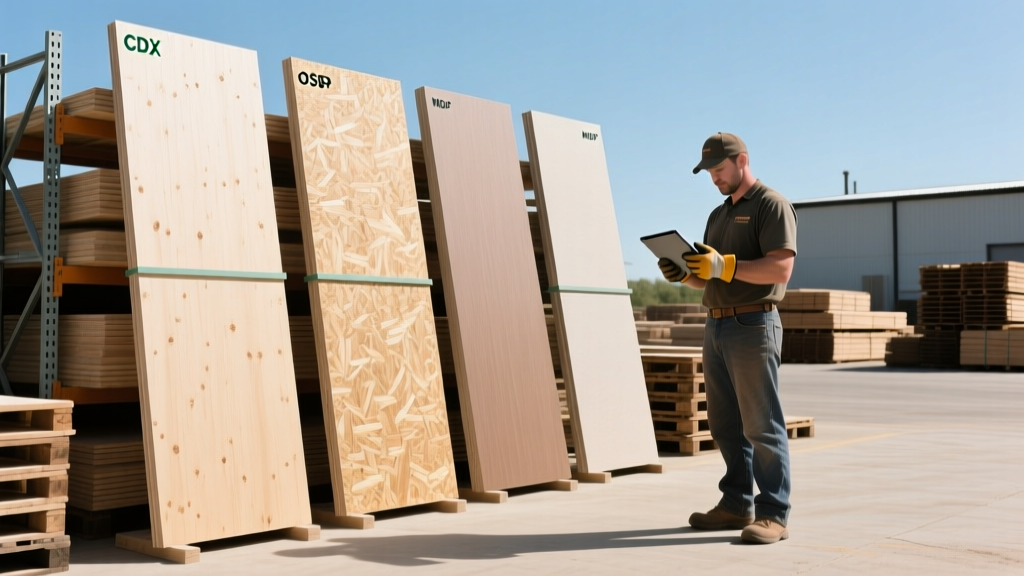
For wall sheathing, roof decking, and subflooring, the market is dominated by Oriented Strand Board (OSB) and CDX (C-grade/D-grade, Exterior glue) Plywood. While OSB captures roughly 75% of the structural panel market due to its lower upfront cost, plywood offers distinct performance advantages in high-moisture environments.
| Metric | 7/16-inch OSB (Exposure 1) | 1/2-inch CDX Plywood |
|---|---|---|
| Average 2026 Cost (4x8 Sheet) | $38.00 - $46.00 | $62.00 - $78.00 |
| Fastener Withdrawal Strength | Moderate (Requires specific nailing schedules) | High (Superior cross-grain holding) |
| Moisture Edge Swelling | High (Prone to 'thick edge' if rained on) | Low (Dries flat, minimal edge degradation) |
| Weight per Sheet | ~54 lbs | ~48 lbs |
| Primary Value Proposition | Cost efficiency, consistent density, no core voids | Stiffness, moisture recovery, lighter weight |
When OSB is exposed to rain during the framing stage, the compressed wood strands at the cut edges absorb moisture and swell, creating a 'thick edge.' This requires sanding or planing before installing vinyl or hardwood flooring, adding $0.40 to $0.75 per square foot in labor remediation. If your region experiences unpredictable spring weather, the $20 premium per sheet for CDX plywood often pays for itself by eliminating edge-sanding labor.
According to APA - The Engineered Wood Association, both OSB and Plywood rated under PS 1-09 and PS 2-10 standards provide identical structural span ratings. The value divergence occurs strictly in moisture management and fastener holding under shear loads.
Interior & Cabinetry: MDF, Particleboard, and Hardwood Plywood
For interior applications, the types of wooden panels shift from structural integrity to surface finish, dimensional stability, and machinability. The 2026 market heavily favors composite panels for painted cabinetry, while hardwood plywood remains the standard for clear-coated architectural millwork.
Medium-Density Fiberboard (MDF)
- Cost (3/4-inch, 4x8): $52.00 - $68.00
- Best Use: Painted cabinet doors, router-profiled baseboards, acoustic paneling.
- Failure Mode: Severe sagging on horizontal shelves spanning more than 32 inches. MDF lacks the internal tensile strength of veneer-core plywood and will deflect under a load of just 20 pounds per square foot over a 36-inch span.
- Value Insight: MDF provides a perfectly smooth, grain-free surface for paint, eliminating the need for expensive grain-filling primers required on raw wood.
Industrial Particleboard
- Cost (3/4-inch, 4x8): $35.00 - $45.00
- Best Use: Melamine-finished closet systems, budget casework, substrate for plastic laminates.
- Failure Mode: Screw stripping. Standard wood screws will strip out of particleboard if over-torqued or removed and reinserted. Builders must use specialized Confirmat screws or knock-down cam-lock fittings to ensure joint longevity.
Hardwood Veneer-Core Plywood
- Cost (3/4-inch, Maple/Oak, 4x8): $105.00 - $145.00
- Best Use: Stained cabinetry, high-end built-in shelving, architectural wall panels.
- Value Insight: Despite being 2.5x the cost of MDF, hardwood plywood offers superior screw-holding capability and structural rigidity, allowing for wider shelving spans (up to 48 inches) without visible deflection.
When sourcing MDF and Particleboard in 2026, verify compliance with EPA TSCA Title VI regulations. All composite panels sold in the U.S. must carry a TSCA Title VI label. For high-value residential or healthcare projects, specify NAF (No Added Formaldehyde) or ULEF (Ultra-Low Emitting Formaldehyde) resins, which typically add a 12% to 15% premium to the base sheet cost but are critical for LEED and WELL building certifications.
Hidden Costs: Installation, Waste, and Tool Wear
A pure material-cost analysis obscures the secondary expenses associated with different types of wooden panels. Project estimators must factor in the following operational variables:
- Blade and Bit Degradation: The high glue density and silica content in MDF and OSB dull standard carbide saw blades and router bits up to three times faster than solid lumber or veneer-core plywood. Budget an additional $0.15 per cut for tooling replacement when machining large volumes of MDF.
- Edge Banding Requirements: Particleboard and MDF require edge banding (PVC or wood veneer) to conceal the raw core. Applying pre-glued edge banding via hot-air machinery adds approximately $1.50 to $2.50 per linear foot in labor and material costs, which must be included in cabinetry estimates.
- Moisture Acclimation: The USDA Forest Products Laboratory emphasizes that composite panels must be acclimated to the interior humidity of the building (typically 30-50% RH) for 48 to 72 hours before installation. Failing to acclimate MDF baseboards can result in joint separation when the winter heating season drops indoor humidity.
Cost-to-Value Decision Framework
Use this conditional logic to specify the correct panel type, optimizing the balance between budget constraints and performance requirements:
- Scenario A: Roof Sheathing in a Humid/Coastal Climate
Decision: Specify 1/2-inch CDX Plywood or specialized edge-sealed OSB (e.g., Zip System). The premium prevents edge swelling and maintains structural shear values during prolonged rain exposure before the roof is dried in. - Scenario B: Painted Kitchen Cabinet Doors
Decision: Specify 3/4-inch Ultralight MDF. The reduced weight (approximately 30% lighter than standard MDF) decreases stress on European concealed hinges, preventing door sag over a 10-year lifecycle, while providing a flawless painted finish. - Scenario C: High-Load Garage Shelving
Decision: Specify 3/4-inch Sande Plywood or Fir Veneer-Core Plywood. Particleboard and MDF will catastrophically fail under the point-loads of heavy tools and seasonal storage bins, whereas plywood provides the necessary cross-band tensile strength.
By aligning the specific mechanical and environmental properties of these engineered materials with the exact demands of the application, builders can eliminate premature callbacks, reduce material waste, and deliver superior long-term value to the client.
Written by
Sarah WhitfieldSarah Whitfield is a chartered quantity surveyor (MRICS) and construction cost analyst with 15 years of experience in material pricing, procurement strategy, and project budgeting. She earned her degree in Construction Management from the University of Reading (UK) and has worked on projects ranging from $2M custom homes to $180M mixed-use developments across North America and Europe. Sarah currently leads cost estimating for BuildMat Insight, maintaining a proprietary database of 4,000+ material price points updated quarterly. She is a frequent contributor to RSMeans cost data panels and has presented at the International Cost Engineering Council (ICEC) congress. Based in Denver, CO, Sarah is an avid trail runner and volunteer mentor for Women in Construction.
More from Sarah Whitfield
View all
Wood & Lumber
What Are the Different Types of Wood? A Builder's Guide
Compare structural softwoods, finish hardwoods, and engineered lumber. Analyze Janka ratings, MOE values, and 2026 pricing for construction.
Aug 4, 2026

Walls & Panels
Steel Framing vs Wood Framing: Corrosion and Moisture Defense
Compare steel framing vs wood framing for moisture resistance. Learn about galvanized coatings, condensation risks, and corrosion protection strategies.
Jul 21, 2026

Stone & Masonry
How to Cut Stone Veneer: Wet Saw vs Grinder Comparison
Compare the best tools for cutting stone veneer. We review wet saws, angle grinders, and chop saws to help you achieve clean, chip-free cuts.
Jul 21, 2026