Wood Burning Types of Wood Compared: BTU Ratings & Burn Times
Compare the top wood burning types of wood for heating. Discover BTU ratings, burn times, moisture targets, and the best hardwoods vs softwoods for stoves.
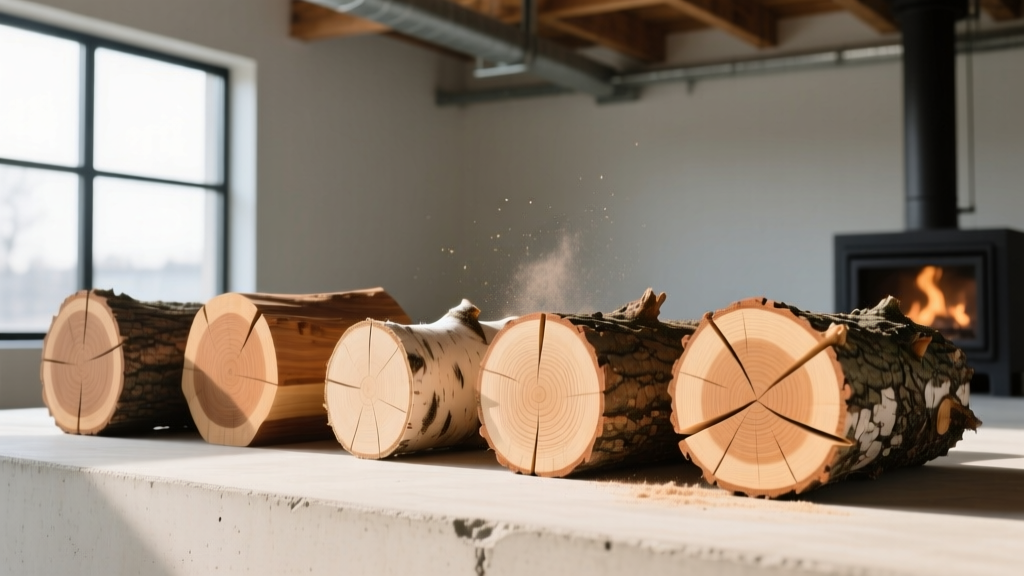
The Thermodynamics of Firewood: Why Species Dictates Performance
When evaluating wood burning types of wood for residential heating, the fundamental metric is not weight or volume, but density. A cord of seasoned hickory and a cord of seasoned white pine occupy the exact same physical space (128 cubic feet), but their thermal output differs by nearly 100%. This disparity is driven by the cellular structure of the wood; hardwoods possess tightly packed, thick-walled cells rich in lignin, while softwoods contain more air space and volatile resins.
According to the PennState Extension, the maximum potential heat value of wood is roughly 8,600 BTUs per pound of completely dry, ash-free wood fiber. Therefore, the primary difference between wood species is how much of that dense fiber you can pack into a stove. Choosing the correct wood burning types of wood requires balancing British Thermal Unit (BTU) density, coal bed longevity, and the operational characteristics of your specific heating appliance.
Comprehensive Comparison Matrix: Wood Burning Types of Wood
The following matrix evaluates the most common wood burning types of wood across critical performance metrics. BTU ratings are calculated per full cord (128 cu. ft.) of wood seasoned to 20% moisture content.
| Wood Species | BTU per Cord (Millions) | Coal Quality | Sparking / Popping | Min. Seasoning Time |
|---|---|---|---|---|
| Osage Orange | 32.9 | Excellent | High | 12-18 Months |
| Hickory | 28.6 | Excellent | Moderate | 12 Months |
| White Oak | 29.1 | Excellent | Low | 18-24 Months |
| Red Oak | 24.6 | Good | Low | 12-18 Months |
| Sugar Maple | 25.5 | Good | Low | 12 Months |
| Yellow Birch | 23.6 | Fair | Low | 9-12 Months |
| Douglas Fir | 18.1 | Poor | High | 6-9 Months |
| White Pine | 15.9 | Poor | Very High | 6 Months |
Tier 1: The Premium High-BTU Hardwoods
For primary, overnight heating in airtight wood stoves, dense hardwoods are mandatory. These wood burning types of wood form long-lasting coal beds that sustain radiant heat output for 8 to 12 hours without reloading.
White Oak and Red Oak
White oak is the industry benchmark for firewood. With a specific gravity of 0.68 (dry), it yields roughly 29.1 million BTUs per cord. Its cellular structure allows it to burn slowly and evenly. Red oak is slightly less dense (specific gravity 0.63) and burns marginally faster, but remains a top-tier choice. Edge Case: White oak is highly resistant to rot due to its closed-cell tyloses structure. While this makes it excellent for outdoor storage, it also means white oak requires a minimum of 18 to 24 months to season properly. If you burn white oak at 30% moisture, you will lose up to 25% of your potential BTU output to steam vaporization.
Hickory and Osage Orange
Hickory (28.6 million BTUs) burns exceptionally hot and produces a highly stable coal bed. However, it is notoriously difficult to split by hand due to its interlocking grain; hydraulic splitters are often required. Osage Orange (32.9 million BTUs) is the hottest burning wood native to North America. Warning: Osage Orange burns so intensely that it can warp the steel baffles or crack the firebricks in standard residential wood stoves. It should only be used in heavy-duty, cast-iron or thick-steel stoves, or mixed 50/50 with a lower-BTU wood like ash or maple to moderate the firebox temperature.
Tier 2: The Reliable Mid-Tier & Fruit Woods
Maple, Ash, and Birch
Sugar Maple and Ash are the workhorses of the firewood industry. Ash is unique among hardwoods; it has a naturally low moisture content when felled (often around 35%) and a porous grain structure, allowing it to season in as little as 6 to 9 months. Yellow Birch offers excellent heat (23.6 million BTUs) and features bark rich in volatile oils. Birch bark can be peeled and used as a highly effective, chemical-free fire starter that catches immediately from a single match.
Apple and Cherry
Fruit woods are moderately dense but are prized for their aromatic smoke. Apple (26.5 million BTUs) burns very slowly and produces a lasting coal bed. Cherry (20.4 million BTUs) burns slightly cooler but emits a distinct, sweet fragrance. These are premium woods often reserved for milder shoulder seasons (autumn and spring) when maximum BTU output is not required, or for culinary smoking applications.
Tier 3: Softwoods & The Creosote Hazard
Softwoods like Pine, Spruce, and Fir are frequently misunderstood. A pervasive myth suggests that burning pine causes excessive creosote buildup due to its pitch content. According to the Chimney Safety Institute of America (CSIA), creosote is primarily caused by incomplete combustion and burning wood with high moisture content, not the species itself.
Softwoods should be restricted to kindling, shoulder-season fires, or open-hearth fireplaces where high draft rates ensure complete combustion. Douglas Fir is the exception among softwoods; it is relatively dense for a conifer and can be used effectively in wood stoves if mixed with hardwoods to maintain firebox temperature.
Moisture Content: The Hidden BTU Killer
The species of wood is irrelevant if the moisture content (MC) is too high. Water requires roughly 970 BTUs per pound to vaporize. If you burn a cord of oak at 40% MC, nearly 1,500 pounds of that cord is water. You will waste millions of BTUs simply boiling water out of the wood before it can release usable heat.
- The 20% Threshold: The US EPA mandates that wood must be seasoned to 20% moisture content or less for certified stoves to achieve their stated efficiency and emission ratings.
- Testing Protocol: Do not rely on visual checks or the "clunk" sound test. Use a calibrated pin-type moisture meter. Split a log in half and drive the pins into the freshly exposed center of the wood, not the end grain, for an accurate reading.
- Stacking Geometry: Wood dries via solar radiation and wind, not ground contact. Stack wood on pallets or pressure-treated rails in single rows, oriented perpendicular to prevailing winds. Cover only the top 18 inches with a tarp to shield from rain while allowing the sides to breathe.
FAQ: Wood Burning Types of Wood
Can I burn construction lumber scraps in my wood stove?
No. Kiln-dried dimensional lumber (like 2x4s) burns extremely fast and hot, which can overfire and damage catalytic combustors or steel baffles. More critically, pressure-treated wood, painted wood, and engineered products (plywood, OSB, MDF) contain copper azole, arsenic, or urea-formaldehyde resins. Burning these releases highly toxic heavy metals and carcinogenic gases into your home and environment.
Which wood burning types of wood produce the least ash?
Hardwoods grown in slow-growth, northern climates generally produce less ash than fast-growth southern species. Hickory, White Oak, and Sugar Maple are known for low ash volume. Conversely, Elm, Sycamore, and softwoods like Pine leave behind significantly more mineral ash, requiring more frequent firebox cleanouts.
How do I mix wood species for optimal overnight burns?
The most effective strategy is the "Hardwood Sandwich." Start your fire with dry softwood kindling (cedar or pine) to rapidly raise the flue temperature and establish a strong draft. Add medium-density wood (birch or maple) to build a base heat layer. Finally, load the firebox to the ceiling with large, unsplit rounds of dense White Oak or Hickory, and close the air intake. The dense hardwood will carbonize slowly, providing a steady 8-hour coal bed.
Written by
Priya KapoorPriya Kapoor is a real estate market analyst and construction economics researcher with expertise in housing affordability, development feasibility, and infrastructure investment. She holds a Master of Regional Planning from Cornell University and previously worked as a senior analyst at CBRE's Investment Properties group, where she modeled returns for $4B in mixed-use development pipelines. Priya now runs an independent research practice advising developers, municipalities, and REITs on construction cost forecasting and market timing. She publishes the quarterly "BuildMat Market Pulse" report tracking material price indices across 12 commodity categories. Based in Austin, TX, Priya serves on the board of Habitat for Humanity Austin and is a marathon runner.
More from Priya Kapoor
View all
Construction Cost
Cost to Build a 1600 Sq Ft Home in 2026: Full Breakdown
Accurate 2026 cost to build a 1600 sq ft home—material, labor, and regional pricing breakdowns included. Plan your budget with real-time estimates.
Aug 11, 2026

Wood & Lumber
Name the Types of Wood for Pressure Treatment and Preservation
Learn how to name the types of wood best suited for pressure treatment. Compare species treatability, chemical retention levels, and 2026 preservation costs.
Aug 4, 2026

Stone & Masonry
Stone Veneer Suppliers Lindenhurst: 2026 Cost Analysis
Analyze 2026 stone veneer costs in Lindenhurst, NY. Compare local supplier pricing, delivery fees, and Suffolk County installation labor rates.
Aug 4, 2026