Performance Specs for Different Types of Treated Lumber
Master the performance specs for different types of treated lumber. Learn AWPA use categories, chemical retention rates, and fastener compatibility.
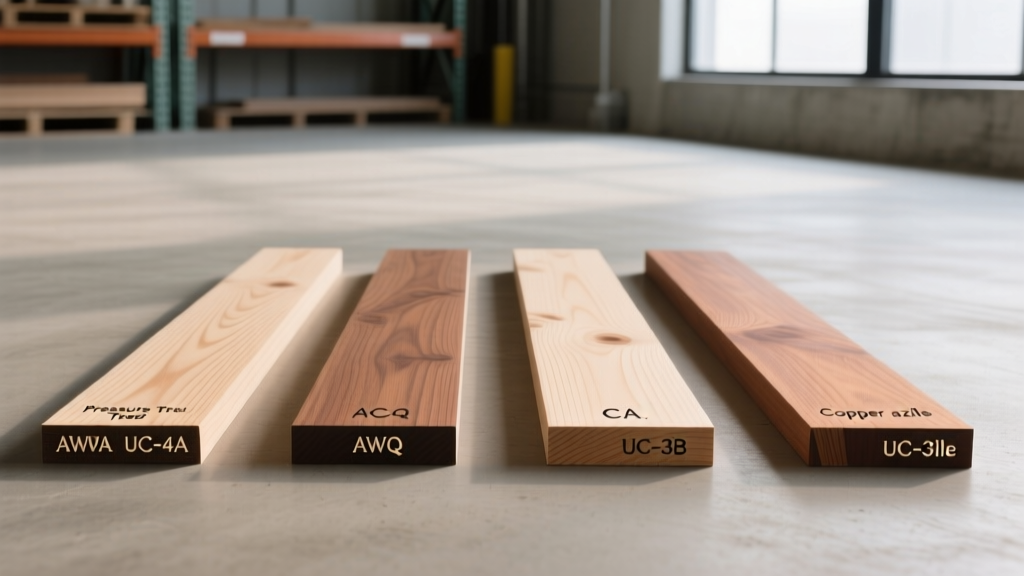
The AWPA Use Category (UC) System: Decoding the End-Tag
When evaluating the different types of treated lumber for structural or exterior applications, the most critical performance metric is the American Wood Protection Association (AWPA) Use Category. Mandated by AWPA Standard U1, every piece of compliant pressure-treated lumber must bear an end-tag specifying its UC rating, chemical preservative, and retention level. Misinterpreting these tags is the leading cause of premature structural decay in modern construction.
The UC system classifies exposure conditions from interior dry to extreme ground contact. Selecting a UC3B rated board for a ground-contact post hole will result in fungal failure within 3 to 5 years, regardless of the wood species.
| Use Category | Exposure Condition | Typical Applications | Moisture & Decay Risk |
|---|---|---|---|
| UC1 | Interior Dry | Interior framing, flooring, furniture | Very Low (Protected from weather) |
| UC2 | Interior Damp | Bathroom framing, unvented crawlspaces | Low (Occasional moisture, no liquid water) |
| UC3A | Above Ground (Coated) | Painted/stained decking, covered porch framing | Moderate (Rapid water runoff, coated) |
| UC3B | Above Ground (Uncoated) | Uncoated deck boards, railing, fence pickets | High (Exposed to weather, uncoated) |
| UC4A | Ground Contact (General) | Deck posts, fence posts, landscaping timbers | Very High (Direct soil contact, freshwater) |
| UC4B | Ground Contact (Heavy Duty) | Retaining walls, critical structural posts | Extreme (High decay hazard, difficult to replace) |
| UC4C | Ground Contact (Foundation) | Permanent wood foundations, sill plates on concrete | Extreme (Continuous soil/water exposure) |
Chemical Preservatives and Minimum Retention Levels
The efficacy of treated lumber is dictated by the preservative chemistry and its retention level, measured in pounds per cubic foot (pcf). The AWPA regularly updates these minimums based on long-term field testing. Understanding the different types of treated lumber requires looking past the brand names and examining the active chemical matrix.
Copper Azole (CA-C) and Micronized Copper Azole (MCA)
CA-C and MCA are currently the dominant residential preservatives. MCA utilizes finely ground, insoluble copper particles suspended in the wood cell walls, which reduces copper leaching compared to soluble systems. Both rely on tebuconazole as a co-biocide to protect against copper-tolerant fungi (like Poria placenta).
- UC3B Retention (CA-C / MCA): 0.15 pcf
- UC4A Retention (CA-C / MCA): 0.31 pcf
- UC4B Retention (CA-C / MCA): 0.60 pcf
Alkaline Copper Quaternary (ACQ)
ACQ uses soluble copper combined with a quaternary ammonium compound (quat). While highly effective against decay and insects, the high alkalinity (pH 8.0-8.5) and soluble copper make ACQ significantly more corrosive to metal fasteners than MCA or CA-C. It is less common in standard retail yards today but still specified for heavy-duty industrial and agricultural applications.
- UC3B Retention (ACQ-D): 0.25 pcf
- UC4A Retention (ACQ-D): 0.40 pcf
- UC4B Retention (ACQ-D): 0.60 pcf
For a comprehensive breakdown of preservative standards and environmental testing, the American Wood Protection Association (AWPA) Standards database remains the definitive technical resource for engineers and architects.
Fastener Corrosion Specs: Matching Metal to Chemical
The shift from Chromated Copper Arsenate (CCA) to copper-heavy alkaline preservatives fundamentally changed fastener specifications. The soluble copper and high pH in treatments like ACQ act as an electrolyte, rapidly corroding standard zinc galvanizing. If you are building with the different types of treated lumber available today, fastener failure will precede wood decay if mismatched.
| Preservative Type | Minimum Fastener Requirement | ASTM Standard | Corrosion Risk Profile |
|---|---|---|---|
| MCA / CA-C | G90 Hot-Dipped Galvanized (HDG) | ASTM A153 Class D | Moderate (Safe for standard deck screws) |
| ACQ-D / ACQ-C | G185 HDG or 304 Stainless Steel | ASTM A153 Class C / ASTM A276 | High (G90 will fail in 2-4 years) |
| PTI (Propiconazole-Tebuconazole-Imidacloprid) | Standard Zinc / G60 | ASTM A164 | Very Low (Non-corrosive, copper-free) |
| All Types (Marine/Saltwater) | 316 Stainless Steel Only | ASTM A276 Type 316 | Extreme (Galvanic corrosion risk) |
Moisture Content: Green vs. KDAT Specifications
Pressure treatment forces thousands of gallons of water-based chemical solutions into the wood cellular structure. Freshly treated lumber, often labeled as "Green" or "Wet," exits the cylinder with a moisture content (MC) ranging from 35% to over 50%. Framing a structure with green treated lumber guarantees severe warping, checking, and shrinkage as the wood equalizes to the ambient 12-15% equilibrium moisture content (EMC).
Kiln-Dried After Treatment (KDAT) Performance
KDAT lumber is re-dried in a kiln after the pressure treatment process to an MC of 19% or less. The specifications for KDAT offer distinct structural advantages:
- Dimensional Stability: Shrinkage is reduced by up to 70% compared to green lumber, preventing drywall cracking and fastener back-out in interior/exterior transitions.
- Weight Reduction: KDAT lumber is approximately 15% to 20% lighter than green treated lumber, reducing labor fatigue and structural dead-load calculations.
- Immediate Coating: While green lumber requires 30 to 90 days of weathering before accepting water-repellent stains, KDAT lumber can be sealed immediately upon installation.
Incision and Penetration Depths for Dense Species
Not all wood species accept preservatives equally. Southern Yellow Pine (SYP) is highly permeable, allowing the sapwood to achieve 100% chemical penetration without mechanical assistance. However, dense species like Douglas Fir, Hem-Fir, and Spruce-Pine-Fir (SPF) possess impermeable heartwood and tight cellular structures that resist liquid penetration.
To meet AWPA U1 specifications for structural framing in Douglas Fir, the lumber must undergo incising prior to treatment. Incising involves running the boards through heavy steel rollers equipped with thousands of small teeth, creating micro-fissures in the wood.
"AWPA Standard U1 mandates that for incised Douglas Fir used in UC4A ground contact, the preservative must penetrate to a minimum depth of 0.4 inches from the incised surface, or 100% of the sapwood, whichever is less. If you are sourcing heavy timber beams for ground contact, verify the end-tag specifically notes 'Incised' and check the physical penetration depth on a core sample."
Project Selection Framework: Which Treatment Do You Need?
Use this decision matrix to specify the correct treated lumber for your next project, ensuring both code compliance and maximum lifespan.
Scenario 1: Elevated Residential Decking (Above Ground)
- Required UC Rating: UC3B (Uncoated) or UC3A (if painting/staining immediately).
- Preferred Chemistry: MCA (Micronized Copper Azole) at 0.15 pcf. MCA provides a more natural wood color compared to the dark brown/green of ACQ, and is highly compatible with standard polymer-coated or G90 deck screws.
- Moisture Spec: Specify KDAT to prevent board cupping and gap-closure after installation.
Scenario 2: Structural Retaining Wall (Under 4 Feet)
- Required UC Rating: UC4B (Heavy Duty Ground Contact). Do not accept UC4A for retaining walls, as the constant hydrostatic pressure and soil microbes accelerate decay.
- Preferred Chemistry: CA-C or ACQ at 0.60 pcf.
- Hardware Spec: 316 Stainless Steel lag bolts and structural screws. The continuous moisture in the backfill will destroy G185 galvanized hardware within a decade.
Scenario 3: Sill Plates on Concrete Foundations
- Required UC Rating: UC4A (Ground Contact) minimum, per IRC Section R317.1.
- Preferred Chemistry: MCA or CA-C at 0.31 pcf.
- Installation Spec: Always pair with a closed-cell foam sill sealer or 10-mil polyethylene barrier between the concrete and the lumber to prevent capillary wicking, which can locally exceed the UC4A moisture threshold.
Specifying the correct treated lumber goes far beyond simply asking the lumber yard for "pressure-treated wood." By mandating specific AWPA Use Categories, verifying chemical retention rates on the end-tags, and pairing the wood with the correct ASTM-rated fasteners, builders can eliminate the most common points of failure in modern wood-frame construction.