Types of Wood Routers: Matching Tools to Lumber Species
Discover how to match different types of wood routers to specific lumber species based on Janka hardness, grain structure, and torque needs.

The Intersection of Tool Torque and Timber Density
Selecting the correct router is not a one-size-fits-all decision; it is a direct function of the lumber species you intend to mill. Routing Eastern White Pine (Janka hardness: 380 lbf) requires entirely different tool dynamics than milling Ipe (Janka hardness: 3,680 lbf). When the torque output of the router motor fails to match the shear strength of the wood fibers, the result is bit deflection, severe tear-out, or motor burnout. Understanding the distinct types of wood routers and mapping their capabilities to specific wood species is critical for achieving precision joinery, clean edge profiles, and efficient material removal in professional millwork.
Primary Types of Wood Routers for Millwork
Wood routers are categorized by their base configuration, motor horsepower (HP), and collet capacity. Each class excels in specific applications depending on the density and grain structure of the target lumber.
1. Trim and Palm Routers (1.0 to 1.25 HP)
Equipped with a 1/4-inch collet, trim routers are designed for light edge profiling, chamfering, and round-overs. They excel on softwoods and low-density hardwoods like Cedar, Pine, and Poplar. Models like the DeWalt DWP611 or the Makita XTR02Z (18V cordless) offer high RPMs (up to 30,000 RPM) necessary for small-diameter bits, but they lack the torque to drive large panel-raising bits or deep mortising cutters through dense hardwoods without stalling.
2. Fixed-Base Routers (2.0 to 2.5 HP)
The workhorse of the professional shop, fixed-base routers accept both 1/4-inch and 1/2-inch shank bits. The 1/2-inch collet provides superior grip and reduces bit vibration, which is essential when routing medium-to-hard species like Red Oak, Hard Maple, and Ash. The Bosch 1617EVSPK is an industry standard in this category. Fixed bases are ideal for table-mounting, where the wood is pushed past the bit, allowing for consistent depth control when cutting dovetails or box joints in structural hardwoods.
3. Plunge Routers (3.0 to 3.5 HP)
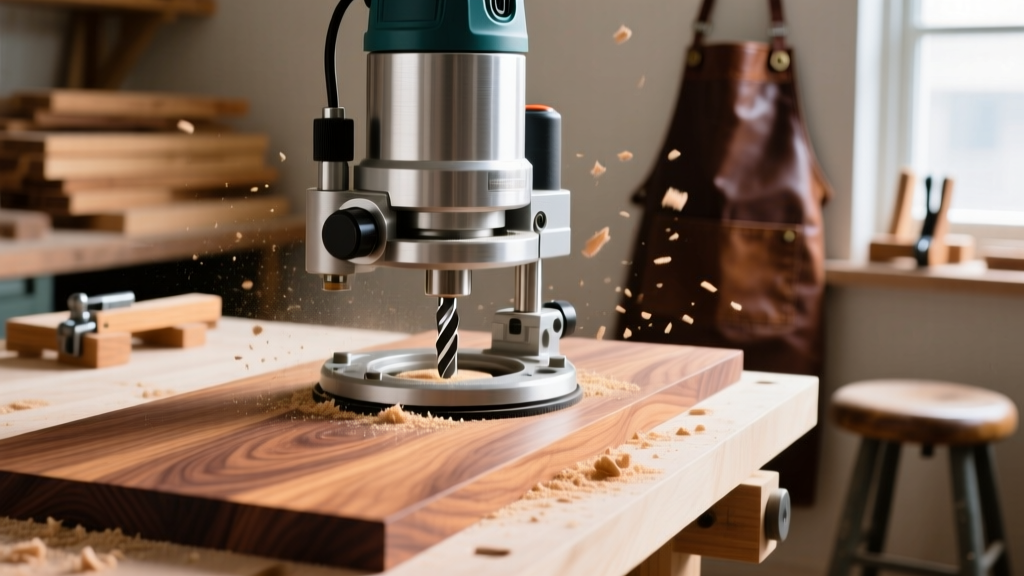
Plunge routers feature a motor housing that slides on spring-loaded columns, allowing the bit to be lowered directly into the workpiece. This is mandatory for deep mortises, inlay work, and stopped dadoes in dense exotics like Ebony, Rosewood, and Hickory. The Makita RP2301FC (3.25 HP) delivers the sustained torque required to clear chips from deep cuts in high-density timber without bogging down.
4. CNC Spindle Routers (Variable HP / High Frequency)
For production environments, CNC spindles (often 3kW to 9kW) operate at constant torque across a wide RPM range. They are the only viable option for nesting and profiling engineered sheet goods (MDF, plywood) and abrasive composite lumbers at scale, utilizing specialized compression bits to eliminate top and bottom tear-out.
Matching Router Power to the Janka Hardness Scale
The Janka hardness test measures the force required to embed a 0.444-inch steel ball halfway into the wood. This metric directly dictates the minimum router horsepower and collet size required to machine the species cleanly.
| Lumber Species | Janka Hardness (lbf) | Minimum Router HP | Required Collet | Recommended Bit Type |
|---|---|---|---|---|
| Eastern White Pine | 380 | 1.0 - 1.25 HP | 1/4 inch | Straight / Roundover |
| Black Cherry | 950 | 2.0 HP | 1/4 or 1/2 inch | Spiral Upcut (to prevent burning) |
| Hard Maple | 1,450 | 2.25 - 3.0 HP | 1/2 inch | Carbide Compression |
| Hickory / Pecan | 1,820 | 3.0+ HP | 1/2 inch | Helical Shear Cutter |
| Ipe (Brazilian Walnut) | 3,680 | 3.25+ HP | 1/2 inch | Solid Carbide Spiral |
RPM Calibration and Feed Rate by Species
According to the USDA Forest Products Laboratory, the cellular structure of wood dictates how it fractures under a cutting edge. A common mistake is running the router at maximum RPM regardless of the species or bit diameter. The correct approach requires balancing bit diameter, wood density, and feed rate.
The RPM-to-Diameter Rule
- Bits under 1 inch: 24,000 - 28,000 RPM (Ideal for softwoods and edge detailing).
- Bits 1 to 2 inches: 18,000 - 22,000 RPM (Standard for hardwoods and joinery).
- Bits over 2 inches (e.g., panel raisers): 10,000 - 14,000 RPM (Mandatory to prevent catastrophic bit failure and wood scorching).
Species-Specific Speed Adjustments
Black Cherry and Mahogany: These species are highly susceptible to friction burns due to their resin and oil content. When routing Cherry, reduce the router speed to 16,000 RPM for 1/2-inch bits and maintain a fast, consistent feed rate. Stopping for even a fraction of a second will leave permanent black scorch marks that require heavy sanding to remove.
Hard Maple and Hickory: These dense, closed-grain species require high RPMs (22,000+) to slice the fibers cleanly rather than crushing them. However, the feed rate must be slow enough to allow the router motor to maintain torque. If you hear the motor pitch drop significantly, you are feeding too fast or taking too deep of a pass.
Troubleshooting Tear-Out in Interlocked Grain
Tropical hardwoods like Sapele, Ribbon Mahogany, and Bubinga frequently feature interlocked or wavy grain. When a standard straight bit encounters grain that changes direction, it acts as a wedge, lifting and tearing the fibers ahead of the cut. To mitigate this when routing these specific species, implement the following techniques:
- Switch to a Shear or Spiral Bit: Spiral bits slice the wood fibers at an angle rather than striking them perpendicularly. An upcut spiral bit clears chips efficiently from deep mortises, while a downcut spiral bit compresses the surface fibers to prevent top-side tear-out on plywood veneers.
- Utilize Climb Routing (With Extreme Caution): Conventional routing feeds the wood against the rotation of the bit. Climb routing feeds the wood in the same direction as the bit rotation. This shears the interlocked grain cleanly before it can lift. Warning: Climb routing causes the router to pull itself forward aggressively. Only attempt this on a router table with a power feeder, or with a handheld router taking passes no deeper than 1/32 inch.
- Reduce Depth of Cut: When profiling interlocked grain, never take a full-depth pass. Remove material in 1/8-inch increments. The final pass should be a mere 1/64 inch to cleanly shear the surface fibers.
Cordless vs. Corded Routers for Hardwood Milling
The proliferation of 18V and 36V lithium-ion cordless routers has changed shop dynamics, but battery voltage directly impacts torque delivery in dense species. An 18V cordless trim router will easily flush-trim 3/4-inch Pine or Cedar. However, when routing a 1-inch dado through 8/4 Hard Maple, the battery voltage will sag under the amperage draw, causing a drop in RPM and resulting in a rough, burned cut. For structural hardwoods exceeding 1,200 lbf on the Janka scale, a corded 3+ HP router remains the mandatory choice to ensure uninterrupted torque delivery throughout the cut.
Dust Extraction and Toxicity Protocols
Routing generates fine particulate matter that varies drastically in toxicity depending on the lumber species. The Occupational Safety and Health Administration (OSHA) strictly regulates wood dust exposure, noting that fine dust from certain exotics and engineered woods poses severe respiratory and carcinogenic risks.
Warning: MDF and Exotic Hardwood Dust
Routing Medium Density Fiberboard (MDF) releases urea-formaldehyde resins and ultra-fine dust that requires a HEPA-filtered dust extractor with a minimum of 100 CFM capture velocity at the bit guard. Similarly, routing exotic species like Rosewood, Cocobolo, and Wenge can trigger severe allergic reactions and respiratory sensitization. Always use a router with an integrated dust port connected to a cyclone extractor when milling these materials, and wear a NIOSH-approved N95 or P100 respirator.
Summary Framework for Router Selection
Matching the tool to the timber is an exercise in physics and material science. Use this quick framework for your next project:
- Softwoods & Edge Profiling: 1.25 HP Trim Router, 1/4-inch collet, high RPM.
- Domestic Hardwoods & Joinery: 2.25 HP Fixed-Base, 1/2-inch collet, table-mounted.
- Deep Mortises & Dense Exotics: 3.25 HP Plunge Router, 1/2-inch collet, slow feed rate.
- Interlocked Grain: Helical shear bits, shallow incremental passes, climb routing where safe.
By aligning your router's horsepower, collet stability, and RPM curve with the specific Janka hardness and grain structure of your lumber, you eliminate tear-out, extend bit life, and achieve factory-grade millwork tolerances.
Written by
Marcus ChenMarcus Chen is a licensed structural engineer (PE) and building materials analyst with over 12 years of experience across residential, commercial, and industrial construction. He holds a Master of Science in Civil Engineering from UC Berkeley and spent six years at Thornton Tomasetti before transitioning to independent consulting and technical writing. Marcus specializes in material selection for seismic-prone regions, concrete reinforcement strategies, and lifecycle cost analysis. His work has been cited by the American Concrete Institute (ACI) and the Structural Engineers Association of California (SEAOC). When he is not on a job site or at his desk, you will find him hiking the Sierra Nevada or restoring a 1920s craftsman bungalow in Oakland, CA.
More from Marcus Chen
View all
Construction Cost
How Much Did the Eiffel Tower Cost to Build?
How much did the Eiffel Tower cost to build in 1889? We adjust for inflation and compare its budget to modern skyscraper construction.
Aug 4, 2026

Fire Resistance
What Is a Fire Resistant Material? Testing & Certification Guide
Discover what is a fire resistant material through ASTM and UL testing. Learn how fire ratings, certifications, and assemblies work in construction.
Aug 4, 2026

Construction Cost
How Much Did the Burj Khalifa Cost to Build?
How much did the Burj Khalifa cost to build? We break down the $1.5B project and extract 5 money-saving strategies for your next build.
Jul 30, 2026