Vinyl Hardwood Flooring Specs: Decoding Wear Layers and Core Ratings
Master vinyl hardwood flooring specifications. Compare SPC vs WPC cores, decode wear layer mil thicknesses, and understand ASTM performance ratings.
The 'Vinyl Hardwood' Terminology: What You Are Actually Buying
The term 'vinyl hardwood flooring' is a retail hybrid that causes significant confusion in procurement. True hardwood is governed by the National Wood Flooring Association (NWFA) and consists of solid or engineered timber. When suppliers and consumers use 'vinyl hardwood,' they are referring to Luxury Vinyl Plank (LVP) or rigid core flooring engineered to mimic the visual depth, texture, and dimensionality of real timber.
Understanding this distinction is critical because the performance ratings, testing standards, and failure modes of vinyl plank are entirely different from organic wood. While hardwood is graded by the NHLA (National Hardwood Lumber Association) based on visual defects, vinyl hardwood is evaluated by the Resilient Floor Covering Institute (RFCI) and tested under specific ASTM standards for synthetic resiliency, dimensional stability, and wear resistance.
Core Composition Specifications: SPC vs. WPC vs. Flexible LVP
The structural integrity of vinyl hardwood flooring is dictated by its core layer. The industry has largely moved away from flexible PVC cores toward rigid core technologies, which allow for floating installations over imperfect subfloors without telegraphing imperfections.
| Core Type | Material Composition | Density (g/cm³) | Dent Resistance | Subfloor Forgiveness |
|---|---|---|---|---|
| SPC (Stone Polymer Composite) | Limestone powder (60-70%) + PVC stabilizers | 1.9 - 2.1 | Exceptional (High impact tolerance) | Low (Requires flat subfloor, 3/16' over 10') |
| WPC (Wood Polymer Composite) | Wood flour/plastic + foaming agents | 1.0 - 1.2 | Moderate (Susceptible to point loads) | High (Foamed core absorbs minor deviations) |
| Flexible LVP | Solid PVC + plasticizers | 1.3 - 1.5 | Poor (Telegraphs subfloor flaws) | None (Requires perfectly smooth, level substrate) |
Decoding the Wear Layer: Mils vs. Millimeters
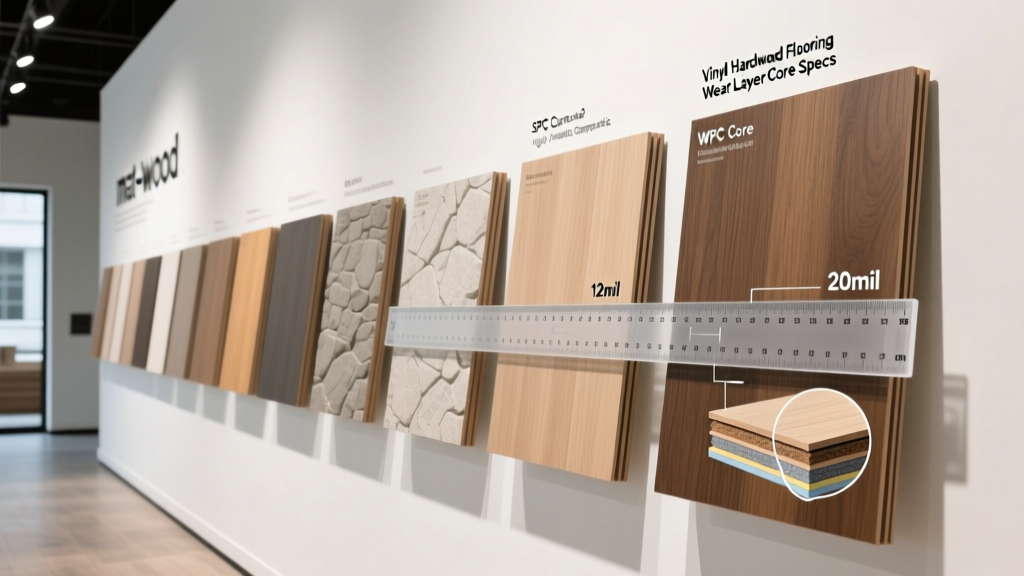
The wear layer is the transparent, protective top coating that dictates the floor's lifespan. A common specification error is confusing mils with millimeters. The industry standard for measuring the wear layer is mils (one-thousandth of an inch).
- 6 to 8 Mils (0.15 - 0.20 mm): Light residential. Suitable for low-traffic bedrooms. Will show micro-scratches within 2-3 years under pet traffic.
- 12 Mils (0.30 mm): Standard residential. The baseline for living rooms and kitchens. Often coated with a standard polyurethane finish.
- 20 Mils (0.50 mm): Heavy residential / Light commercial. The critical threshold for commercial warranties. Usually features enhanced coatings like ceramic bead or aluminum oxide infusions for slip and scratch resistance.
- 22 to 30 Mils (0.55 - 0.75 mm): Heavy commercial. Required for high-traffic retail and hospitality. Features thick, multi-stage UV-cured urethane topcoats.
The Role of Topcoat Additives
Thickness alone does not guarantee scratch resistance. A 20-mil wear layer infused with aluminum oxide particles will outperform a 22-mil standard urethane layer in Taber abrasion tests. When reviewing technical data sheets (TDS), look for proprietary coating names (e.g., Diamond Guard, Ceramic Bead) and verify the Taber Abrasion (ASTM D4060) results. A high-quality commercial vinyl hardwood should withstand 10,000+ cycles on a CS-17 wheel with a 1000g load before showing wear-through to the printed decorative film.
Critical ASTM Performance Tests for Rigid Core Vinyl
To verify manufacturer claims, specifiers must reference ASTM International standards. For rigid core vinyl hardwood, the governing standard is ASTM F3261 (Standard Specification for Resilient Flooring in Plank and Tile Format with Rigid Core). Ensure the product TDS explicitly cites compliance with the following tests:
- ASTM F1914 (Residual Indentation): Measures how well the floor recovers from heavy static loads. SPC should show less than 0.15mm residual indentation after 24 hours of a 250lb load on a 0.25-inch diameter indenter.
- ASTM F2199 (Dimensional Stability): Crucial for floating floors. Measures expansion and contraction under temperature extremes (from 68°F to 150°F). SPC typically exhibits less than 0.05% linear change, allowing for larger continuous installation areas (up to 5,000 sq ft) without transition moldings.
- ASTM F1515 (Lightfastness): Measures color shift when exposed to UV light. Look for a Delta E (ΔE) value of less than 8.0 after 256 hours of xenon arc exposure. This is vital for rooms with expansive southern-facing windows.
- ASTM D2047 (Slip Resistance): Measures the Static Coefficient of Friction (SCOF). For ADA compliance in commercial spaces, the SCOF must be ≥ 0.50 on a dry surface.
Acoustic Ratings: IIC and STC Explained
In multi-family residential and commercial office builds, acoustic performance is a strict code requirement. Vinyl hardwood flooring is tested for two distinct metrics:
- IIC (Impact Insulation Class): Measures impact noise (footsteps, dropped objects) transferring to the room below. Building codes typically require an IIC of 50 or higher (tested in a field setting, denoted as FIIC). WPC cores naturally score higher (IIC 55-65) due to their foamed, air-filled cellular structure, which absorbs kinetic energy. SPC cores are dense and transmit more impact noise unless paired with a high-density acoustic underlayment (like 1.5mm IXPE foam).
- STC (Sound Transmission Class): Measures airborne noise (voices, music) transferring through the floor-ceiling assembly. An attached cork or rubber backing pad significantly boosts STC ratings compared to bare-back planks.
Locking Mechanism Tolerances and Edge Case Failures
The mechanical locking system is the most common point of failure in vinyl hardwood flooring. The two dominant patented systems are Välinge 5G (drop-lock) and Uniclic (angle-angle).
When specifying for environments with high thermal fluctuation (e.g., sunrooms, spaces over radiant heat), the locking mechanism must withstand high sheer stress. SPC cores can be brittle; if the milled locking lip is too thin (under 1mm), it will snap during installation or seasonal contraction. Always request a physical sample and perform a sheer-stress test on the long-edge lock before approving a product for large-scale procurement.
Buyer's Decision Matrix: Matching Specs to Room Requirements
Use this framework to align vinyl hardwood specifications with specific environmental demands, ensuring you do not overpay for unnecessary commercial grades in residential zones, or under-specify for high-traffic corridors.
| Application Environment | Recommended Core | Minimum Wear Layer | Required Attached Pad | Max Continuous Run (No Transitions) |
|---|---|---|---|---|
| Residential Bedrooms / Low Traffic | WPC or Flexible LVP | 12 Mils (Standard Urethane) | 1mm EVA Foam (Optional) | 1,500 sq ft |
| Residential Kitchens / Mudrooms | SPC (Waterproof priority) | 16 to 20 Mils (Ceramic Bead) | 1mm IXPE (Moisture resistant) | 2,500 sq ft |
| Multi-Family / Condo (Over living space) | WPC or SPC + Acoustic Mat | 20 Mils (Aluminum Oxide) | 1.5mm to 2mm Cork/Rubber (IIC > 55) | 2,000 sq ft |
| Commercial Retail / Light Healthcare | SPC (High density, >2.0 g/cm³) | 22+ Mils (Heavy Commercial Urethane) | Bare back + separate commercial underlayment | 5,000+ sq ft (Verify ASTM F2199) |