Types of Red Wood: A Complete Species Guide for Builders & Woodworkers
Explore the best types of red wood for construction and woodworking. Compare redwood, mahogany, cedar, and more for durability, cost, and uses.
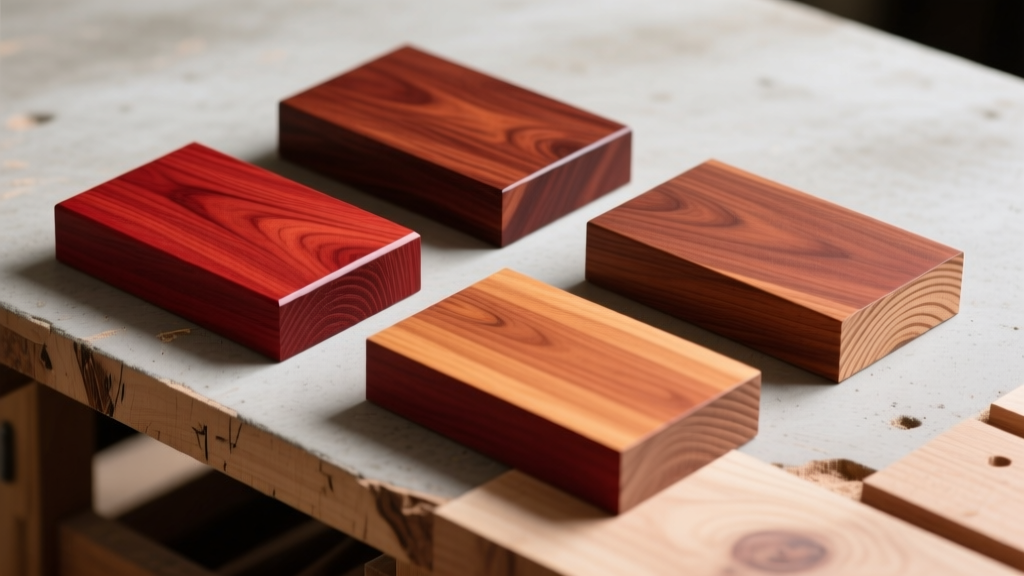
The Spectrum of Red Timber: Beyond the Basics
When builders and woodworkers specify 'red wood,' they are rarely referring to a single species. The term encompasses a diverse botanical range from soft conifers prized for exterior durability to dense tropical hardwoods selected for high-end flooring. Understanding the distinct mechanical properties, Janka hardness ratings, and natural extractive content of these species is critical for preventing premature structural failure or aesthetic degradation. This guide dissects the primary types of red wood available in the 2026 market, providing exact specifications for architectural and structural applications.
Master Comparison Matrix: Red Wood Species
| Species | Janka Hardness (lbf) | Specific Gravity | Rot Resistance | 2026 Avg. Cost (per bd. ft.) |
|---|---|---|---|---|
| Coast Redwood | 420 | 0.40 | Exceptional | $8.00 - $22.00 |
| Western Red Cedar | 350 | 0.32 | Exceptional | $5.50 - $14.00 |
| African Mahogany | 830 | 0.53 | Moderate | $9.00 - $16.00 |
| Northern Red Oak | 1,290 | 0.63 | Poor | $4.50 - $8.00 |
| Jarrah | 1,910 | 0.67 | Exceptional | $14.00 - $24.00 |
| Bloodwood | 2,900 | 0.85 | Exceptional | $12.00 - $18.00 |
Exterior & Structural Heavyweights
For exterior cladding, decking, and landscape architecture, softwoods with high concentrations of natural extractives (tannins and phenols) dominate the market. These compounds act as natural biocides, deterring fungal decay and insect infestation without the need for chemical pressure treatment.
Coast Redwood (Sequoia sempervirens)
Coast Redwood remains the benchmark for premium exterior applications in North America. Its dimensional stability is unmatched among softwoods; it exhibits minimal shrinkage and swelling compared to pressure-treated pine. For decking, specify Construction Heart grade (approximately $8–$11 per board foot), which contains knots but retains the decay-resistant heartwood. For high-visibility architectural millwork or pergolas, upgrade to Clear All Heart ($18–$25 per board foot), which is entirely free of sapwood and knots. According to the Wood Database, the heartwood contains high levels of thujaplicins, giving it a decay resistance rating that rivals synthetic composites.
Crucially, the high tannin content in Redwood will cause severe black bleeding around standard zinc or electroplated fasteners. You must specify Type 304 or 316 stainless steel, or heavily hot-dipped galvanized fasteners (ASTM A153) to prevent aesthetic ruin and localized corrosion.
Western Red Cedar (Thuja plicata)
While slightly softer and less dense than Redwood (Specific Gravity of 0.32), Western Red Cedar offers superior acoustic dampening and a distinctive aromatic profile. It is the premier choice for exterior siding and saunas. When specifying cedar for siding, opt for Select Tight Knot (STK) grades to balance cost ($6–$9/bd. ft.) with structural integrity. Avoid sapwood-heavy grades for ground-contact applications, as the sapwood lacks the natural rot resistance of the dark red heartwood. Cedar's low density makes it prone to mechanical denting, so avoid it for high-traffic decking where furniture dragging is expected.
Interior Millwork & Fine Woodworking
When the application shifts indoors, the focus moves from rot resistance to grain aesthetics, machining properties, and finishing behavior. The 'red' woods in this category are primarily hardwoods prized for their chatoyancy and workability.
African Mahogany (Khaya spp.)
With genuine Honduran Mahogany (Swietenia macrophylla) heavily restricted by CITES appendices, African Mahogany has become the industry standard for high-end interior doors, cabinetry, and architectural paneling. It machines exceptionally well and takes oil-based finishes beautifully, deepening its reddish-brown hue over time. However, it possesses interlocked grain, which can cause tear-out during planing. Pro Tip: Always use a helical cutterhead or reduce the cutting angle to 15 degrees when milling Khaya to prevent surface tearing.
Northern Red Oak (Quercus rubra)
Red Oak is the most heavily harvested hardwood in the United States, serving as the baseline for interior flooring and stair treads. Its prominent open-grain structure requires the use of a pore filler if a glass-smooth, modern finish is desired. While its Janka rating of 1,290 lbf makes it highly resistant to denting, it is completely unsuitable for exterior use or ground contact. The high tannin content in Red Oak reacts with moisture and iron to create severe black staining, a critical failure mode to avoid in wet areas. When installing Red Oak flooring over radiant heating systems, ensure the moisture content is acclimated to 6-8% and use a quarter-sawn cut to minimize cupping and gapping caused by thermal cycling.
High-Density Exotics for Flooring & Accents
For commercial flooring, heavy-duty workbenches, and striking visual accents, ultra-dense tropical red woods offer unparalleled longevity. These species require specialized tooling—specifically carbide-tipped blades and bits—due to their extreme hardness and silica content.
Jarrah (Eucalyptus marginata)
Native to Western Australia, Jarrah is renowned for its deep burgundy color and exceptional fire resistance, a rare trait among timber species. With a Janka hardness of 1,910 lbf, it is heavily utilized in commercial parquet flooring and heavy-duty structural beams. Because it is highly resistant to marine borers, it is also specified for coastal boardwalks. Sourcing must be strictly verified through the Forest Stewardship Council (FSC) to ensure it is harvested from sustainably managed regrowth forests rather than old-growth reserves.
Bloodwood (Satyria rubra)
Bloodwood is astonishingly dense (2,900 lbf) and features a vivid, almost neon-red heartwood that slowly oxidizes to a darker brownish-red if exposed to UV light. It is primarily used for inlays, cutting boards, and small architectural accents. Due to its extreme density and interlocked grain, it is notoriously difficult to glue; surface preparation with solvent wipes immediately before applying a two-part epoxy is mandatory for a lasting bond.
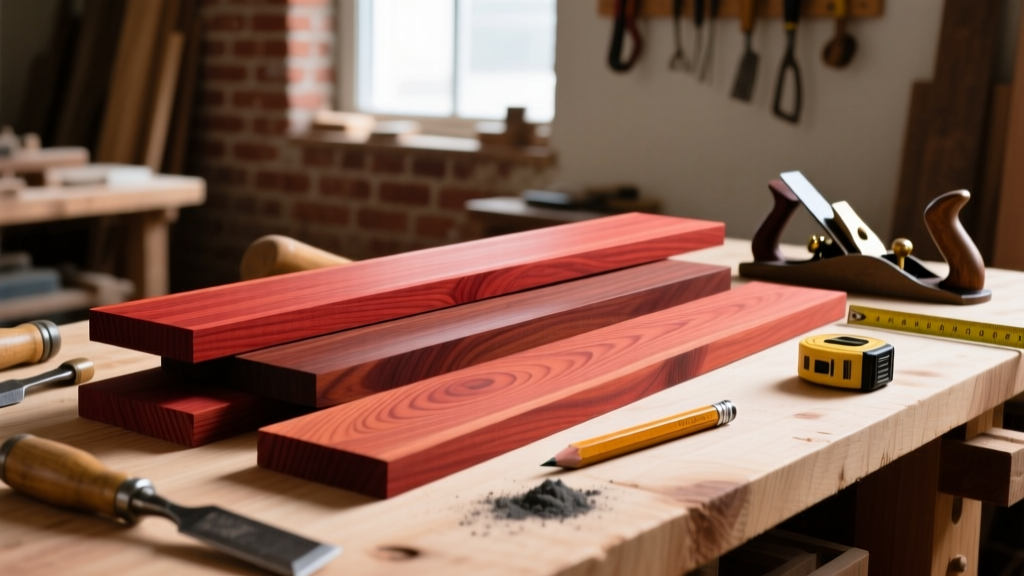
Decision Framework: Matching Species to Application
Application-Specific Selection Guide
- Exterior Decking & Ground Contact: Coast Redwood (Construction Heart) or Jarrah. Avoid Red Oak and African Mahogany.
- Exterior Siding & Fencing: Western Red Cedar (STK grade) for the best balance of weight, cost, and natural insulation.
- Interior Flooring (Residential): Northern Red Oak for cost-efficiency and classic grain; Jarrah for luxury and extreme dent resistance.
- Custom Cabinetry & Millwork: African Mahogany for its superior stability, machining, and rich finish.
- High-Traffic Commercial Accents: Bloodwood or Jarrah to withstand severe mechanical wear without showing dents.
Sustainable Sourcing and 2026 Market Dynamics
The availability of premium red woods is increasingly tied to stringent environmental regulations and climate impacts. Wildfire management in the Pacific Northwest has constrained old-growth Redwood supplies, pushing the market heavily toward second-growth plantation timber. While second-growth Redwood is structurally sound, it typically contains a higher percentage of sapwood, necessitating careful grade selection for exterior durability.
For all tropical and exotic red woods, specifying FSC-certified lumber is no longer just an ethical choice but a requirement for many commercial LEED v4.1 building certifications. Always demand chain-of-custody documentation from your supplier to verify the botanical origin and harvest legality, particularly for African Mahogany and Jarrah, which are frequent targets for illicit logging and mislabeling in the global supply chain.
For comprehensive mechanical data and specific gravity metrics across all timber species, consult the USDA Forest Service Wood Handbook, which remains the definitive engineering reference for structural timber design in North America.
Written by
James ThorntonJames Thornton is a construction industry veteran with 25 years of hands-on experience in wood framing, lumber grading, and residential building codes. He started as a framing carpenter in rural Oregon, earned his ICC Residential Building Inspector certification, and eventually became a senior plan reviewer for the City of Portland Bureau of Development Services. James holds a B.S. in Wood Science & Technology from Oregon State University and is a certified lumber grader through the West Coast Lumber Inspection Bureau (WCLIB). He has inspected over 3,000 residential construction sites and authored the city's internal guide on advanced framing techniques (2x6 at 24" O.C.). James lives in Bend, OR, where he builds custom timber-frame cabins and competes in lumberjack sports.
More from James Thornton
View all
Insulation
Best Home Insulation Materials: Complete 2026 Guide
Compare top home insulation materials for 2026. Find R-values, installed costs per square foot, and best uses for fiberglass, spray foam, and mineral wool.
Aug 4, 2026

Sustainable Building
Certify Your Green Building Material for LEED and WELL
Step-by-step guide to certifying a green building material for LEED v5 and WELL v2. Master EPDs, HPDs, and VOC limits for 2026 project specifications.
Aug 4, 2026

Stone & Masonry
Veneer Stacked Stone Panels: Interior Design & Style Showcase
Discover how veneer stacked stone panels transform interiors. Explore modern design profiles, material pairings, and technical installation specs.
Aug 4, 2026