What Is OSB Board? A Deep Dive Into Top Brand Product Lines
Discover what is OSB board and compare top brand product lines like ZIP System, AdvanTech, and Edge Gold for structural and subfloor applications.
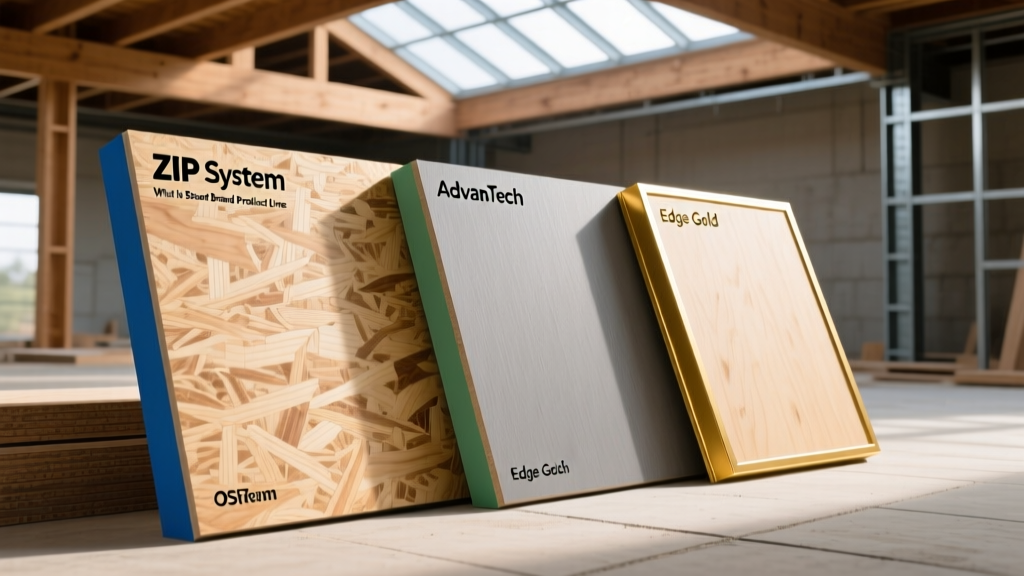
The Core Anatomy: What Is OSB Board Exactly?
Oriented Strand Board (OSB) is an engineered wood structural panel manufactured by compressing and bonding rectangular wood strands with waterproof, heat-cured adhesives. Unlike plywood, which uses continuous veneer sheets, OSB utilizes fast-growing, small-diameter trees (like aspen, pine, and poplar) sliced into strands typically 2.5 to 4.5 inches long. According to APA - The Engineered Wood Association, these strands are arranged in three to five distinct layers, with the face and back layers oriented parallel to the panel's long axis, and the core layers oriented perpendicularly. This cross-directional geometry provides exceptional dimensional stability and shear strength, allowing OSB to meet the same structural performance standards as plywood under the PS-2 certification.
Resin Chemistry: The Hidden Differentiator
When evaluating what is OSB board at a chemical level, the adhesive resin dictates the panel's moisture tolerance and structural longevity. Manufacturers primarily use two resin types:
- Phenol-Formaldehyde (PF): The industry standard for commodity OSB. PF resins are highly durable and water-resistant once fully cured under heat and pressure. However, the cut edges remain vulnerable to capillary water absorption.
- Polymeric Methylene Diphenyl Diisocyanate (pMDI): A premium resin used in high-end brand lines. pMDI reacts chemically with the natural moisture in the wood strands to form a polyurea linkage. This creates a bond that is inherently more hydrophobic than PF, resulting in significantly lower thickness swell rates when exposed to liquid water.
Brand Deep-Dive: Huber Engineered Woods
Huber has positioned itself as a premium alternative to commodity OSB by focusing heavily on pMDI resin technology and integrated weather barriers.
AdvanTech Subflooring
AdvanTech is Huber's flagship subfloor panel, manufactured using 100% pMDI resin. Because the resin chemically binds to the wood fibers, AdvanTech resists edge swelling and flaking far better than standard PF-bonded OSB. Huber backs this with a 500-day no-sand guarantee, meaning the panels can be exposed to weather during prolonged construction delays without requiring surface sanding before hardwood installation. The panels feature a micro-beveled edge to create a slight recess at the seams, minimizing the visibility of any minor expansion.
ZIP System Sheathing
The ZIP System revolutionized wall and roof sheathing by integrating a weather-resistant barrier (WRB) directly into the OSB panel. The face of the OSB is laminated with a proprietary, engineered polyolefin coating that acts as an air and water barrier. This eliminates the need to hang traditional housewrap, saving significant labor time. The system requires all panel seams to be sealed with ZIP System tape, which uses an aggressive acrylic adhesive that bonds directly to the panel's coated surface.
Brand Deep-Dive: Weyerhaeuser
Weyerhaeuser approaches OSB innovation through mechanical edge treatments and specialized structural grading.
Edge Gold Subfloor
Weyerhaeuser's Edge Gold line tackles the historical weakness of OSB: edge swelling from rain exposure during framing. The panels feature a proprietary hydrophobic edge coating that repels liquid water. More importantly, the tongue-and-groove (T&G) profile includes a patented 'Down Pore' notch. If water pools on the subfloor, this notch drains it through the joist bay rather than allowing it to wick into the end-grain of the adjacent panel. Edge Gold utilizes a blend of PF and MDI resins to balance cost with premium moisture resistance.
Structwood
Structwood is Weyerhaeuser's standard structural OSB line, optimized for high-volume residential framing. While it lacks the premium edge coatings of Edge Gold, it is manufactured to strict PS-2 tolerances and is available in specialized wind-rated thicknesses (such as 7/16-inch rated for high-wind shear wall applications).
Brand Deep-Dive: LP Building Solutions
LP focuses on integrating radiant barriers and specialized weatherproofing into their OSB substrates.
LP WeatherLogic Air & Water Barrier
Similar to the ZIP System, WeatherLogic features an integrated overlay that functions as a continuous air and water barrier. LP's proprietary overlay is designed to be highly vapor-permeable, allowing the wall assembly to dry to the exterior if moisture becomes trapped inside the stud cavity. It requires LP's specific acrylic tape for seam sealing to maintain the warranty.
LP TechShield Radiant Barrier
TechShield integrates a sheet of aluminum foil to the OSB face, blocking up to 97% of radiant heat transfer from the roof into the attic space. The foil is laminated using a specialized adhesive that allows it to withstand the high temperatures of a roof deck in summer without delaminating.
Comparative Matrix: Premium OSB Product Lines (2026 Pricing)
| Brand | Product Line | Primary Application | Key Technology | Approx. Cost (4x8 Sheet) |
|---|---|---|---|---|
| Huber | AdvanTech (3/4") | Premium Subfloor | 100% pMDI Resin | $65 - $75 |
| Huber | ZIP System (7/16") | Wall / Roof Sheathing | Integrated Polyolefin WRB | $45 - $55 |
| Weyerhaeuser | Edge Gold (3/4") | Subfloor | Down Pore Edge Drainage | $55 - $65 |
| LP | TechShield (7/16") | Roof Decking | Foil Radiant Barrier | $38 - $46 |
| Generic | Commodity OSB (7/16") | General Sheathing | Standard PF Resin | $28 - $35 |
Note: Pricing reflects early 2026 regional averages for the US South and Midwest. Lumber commodity markets fluctuate; always verify current local distributor quotes.
Real-World Failure Modes & Edge Cases
Even premium OSB product lines will fail if installed outside their engineered parameters. Framing crews and site supervisors must watch for these specific failure modes:
1. The 'Ridge' Effect (Edge Swelling)
When the unsealed, cut edge of commodity OSB is exposed to standing water, the compressed strands absorb moisture and expand. Because the face veneers restrict lateral expansion, the panel pushes upward at the seams, creating a visible 'ridge' under vinyl or laminate flooring. Fix: Always specify Edge Gold or AdvanTech for subfloors in regions with high rain exposure during framing, and sweep standing water daily.
2. Fastener Tear-Out in Shear Walls
OSB has a different fastener withdrawal capacity compared to plywood. In high-wind zones (HVHZ), relying on standard smooth-shank nails for shear wall nailing schedules can lead to panel tear-out under cyclic wind loads. Fix: Use 8d or 10d ring-shank nails for all OSB shear wall applications, and strictly adhere to the 3-inch on-center edge nailing schedule specified by the engineer.
3. Incompatible Tape Adhesives on WRB Panels
A common site error with ZIP System and WeatherLogic panels is the use of third-party, generic housewrap tapes. The acrylic adhesives on generic tapes often fail to bond to the specific polyolefin or engineered overlays used by these brands, leading to air leakage and voided warranties. Fix: Mandate the use of brand-specific, manufacturer-approved tape and primer (if required for cold-weather application below 25°F).
Sourcing and Specification Strategy
When deciding which OSB line to specify, base the decision on the construction timeline and local climate. If you are building in the Pacific Northwest or the Southeast during the rainy season, the 15% to 20% premium paid for pMDI-based subflooring (like AdvanTech) or mechanically drained panels (like Edge Gold) is easily offset by the elimination of sanding callbacks and flooring warranty disputes. For vertical wall sheathing, integrated WRB panels like ZIP System remain the most labor-efficient choice, provided the crew is trained to properly roll and seal the seams to ensure continuous air-barrier integrity.