The Definitive List: Types of Wood for Construction & Framing
Explore our definitive list of wood types for construction. Compare softwoods, hardwoods, and engineered timber with 2026 pricing and structural data.
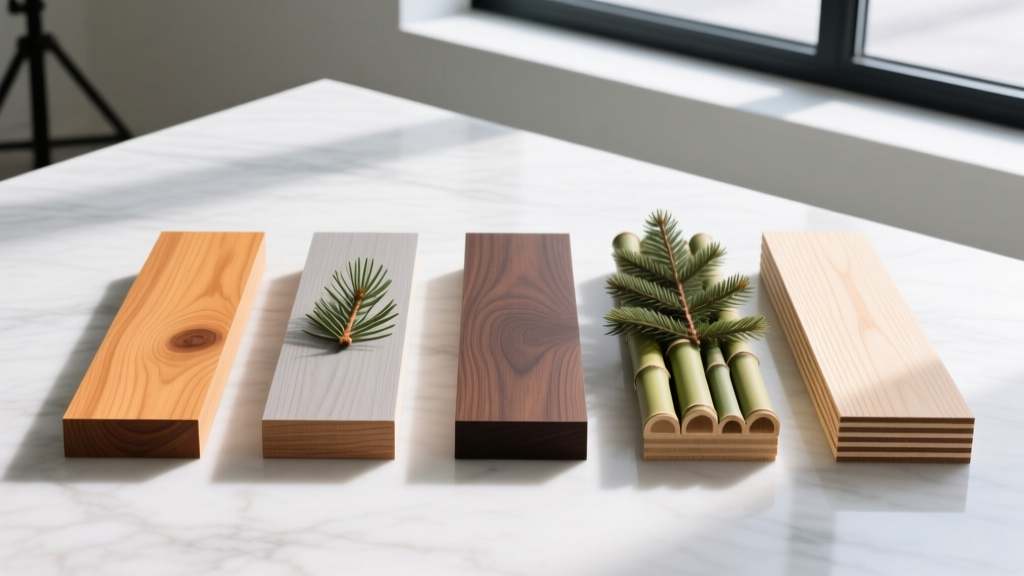
The Structural Softwoods: Framing and Load-Bearing
When evaluating the structural skeleton of a building, softwoods dominate the market due to their rapid growth cycles, favorable strength-to-weight ratios, and predictable engineering properties. In North America, structural softwoods are graded by agencies like the Western Wood Products Association (WWPA) based on visual characteristics and mechanical testing. Below is a breakdown of the primary framing species you will encounter on a 2026 job site.
Douglas Fir-Larch (DF-L)
Douglas Fir is the gold standard for dimensional lumber and heavy timber framing. It boasts the highest stiffness (Modulus of Elasticity, or MOE) among standard framing woods, meaning it resists deflection under heavy loads better than its peers. For a Select Structural grade 2x8, the allowable bending stress (Fb) is typically rated at 1,500 psi. It is the go-to species for roof rafters, floor joists, and exposed structural beams where minimizing bounce is critical.
Southern Yellow Pine (SYP)
Southern Yellow Pine is exceptionally dense and resinous, giving it superior fastener-holding capabilities. This makes it the undisputed choice for pressure-treated (PT) applications, such as sill plates, deck framing, and outdoor structural posts. SYP also carries high shear strength, but its density means it is more prone to splitting if nails or screws are not pre-drilled in hardwood-grade applications. In 2026, SYP remains highly price-competitive, though regional transport costs can inflate pricing in the Pacific Northwest.
Spruce-Pine-Fir (SPF)
SPF is a marketing grouping of several species (including White Spruce, Lodgepole Pine, and Alpine Fir) that share similar structural properties. It is the economy workhorse of the construction industry, widely used for interior wall studs and non-critical load-bearing partitions. While its MOE and bending strength are lower than DF-L, it is lightweight, easy to cut, and generally the most cost-effective option for standard 2x4 and 2x6 stud framing.
Never assume species based on visual inspection alone. Always check the ink grade stamp on the lumber. A stamp reading 'S-DRY' indicates the wood was surfaced at a moisture content (MC) of 19% or less, which is standard for interior framing. If you see 'MC-15', the wood was surfaced at 15% MC or less, offering greater dimensional stability for finish carpentry.
Structural Softwood Comparison Matrix
| Species Grouping | Avg. Modulus of Elasticity (MOE) | Janka Hardness (lbf) | Primary Application | Est. 2026 Cost (per BF) |
|---|---|---|---|---|
| Douglas Fir-Larch | 1,900,000 psi | 660 | Joists, rafters, exposed beams | $2.80 - $3.60 |
| Southern Yellow Pine | 1,700,000 psi | 870 | Pressure-treated sills, decking | $2.20 - $2.90 |
| Spruce-Pine-Fir (SPF) | 1,500,000 psi | 480 | Interior wall studs, blocking | $1.80 - $2.40 |
| Hem-Fir | 1,600,000 psi | 500 | General framing, subflooring | $2.10 - $2.70 |
Note: Pricing reflects wholesale 2026 market averages for #2 grade dimensional lumber and may fluctuate based on regional supply chains and tariffs.
Architectural Hardwoods: Flooring, Trim, and Millwork
While softwoods build the bones of a structure, hardwoods provide the skin and finish. Hardwoods are angiosperms, characterized by complex cellular structures that yield dense, durable material ideal for high-wear surfaces. When specifying hardwoods, the USDA Forest Products Laboratory Wood Handbook remains the definitive engineering reference for understanding shrinkage rates and mechanical limits.
White Oak (Quercus alba)
White Oak has surged in popularity for both interior flooring and exterior architectural accents. Its cellular structure contains tyloses—natural plug-like structures that block water penetration, making it highly rot-resistant compared to Red Oak. With a Janka hardness of 1,360 lbf, it withstands heavy foot traffic while accepting a wide variety of stains and hard-wax oils. In 2026, quarter-sawn White Oak commands a premium (often $12.00+ per board foot) due to its striking ray flake figure and superior dimensional stability.
Hard Maple (Acer saccharum)
Hard Maple is the benchmark for commercial and high-traffic residential flooring, as well as heavy-duty workbench tops. It boasts a Janka hardness of 1,450 lbf and a very tight, closed grain that resists dirt accumulation. However, its density makes it notoriously difficult to work with using hand tools, and it requires carbide-tipped router bits and saw blades to prevent burning. Hard Maple is also highly susceptible to moisture movement; it must be acclimated to a strict 6-8% moisture content before installation in climate-controlled environments.
Installing 8% MC hardwood flooring over a newly poured concrete slab or adjacent to 19% MC softwood framing is a recipe for catastrophic failure. As the surrounding materials dry, the differential shrinkage will cause the hardwood to cup, gap, or buckle. Always use a pinless moisture meter to verify that the subfloor and the finish material are within 2% MC of each other prior to fastening.
Engineered Mass Timber: Spanning the Modern Gap
The most significant shift in the 2026 construction landscape is the widespread adoption of engineered mass timber, driven by updated International Building Code (IBC) provisions allowing taller wood structures. Engineered wood products (EWPs) eliminate the natural defects of solid sawn lumber, offering predictable, high-capacity structural performance.
- Laminated Veneer Lumber (LVL): Created by peeling logs into thin veneers, drying them, and bonding them with structural adhesives under heat and pressure. LVLs are primarily used as headers, beams, and rim boards. They do not warp, twist, or shrink like solid timber, making them essential for maintaining tight building envelopes.
- Glued-Laminated Timber (Glulam): Composed of dimensional lumber laminations stacked and bonded together. Glulam can be manufactured in massive cross-sections and curved shapes, making it the premier choice for architectural exposed structures, long-span gymnasiums, and commercial roofs. The APA - The Engineered Wood Association provides extensive span tables for Glulam applications.
- Cross-Laminated Timber (CLT): A panelized system made of alternating layers of dimensional lumber glued at 90-degree angles. CLT acts as a massive structural diaphragm, replacing concrete in floor slabs and shear walls for mid-rise commercial and multi-family residential projects. It offers exceptional fire resistance through predictable charring rates (typically 1.5 inches per hour for heavy timber).
Specification Decision Framework
Selecting the correct wood type requires a systematic approach to load paths, environmental exposure, and budget. Follow this decision matrix to specify the right material:
- Define the Structural Demand: For high-bending applications (long-span floor joists), specify Douglas Fir-Larch or LVL. For high-shear and fastener-holding applications (deck ledgers, sill plates), specify pressure-treated Southern Yellow Pine.
- Assess Environmental Exposure: If the wood will be exposed to weather or ground contact, SYP treated to UC4A (above ground) or UC4B (ground contact) retention levels is mandatory. For exterior architectural elements without chemical treatment, specify White Oak, Western Red Cedar, or Black Locust.
- Evaluate Finish and Wear Requirements: For high-traffic commercial flooring, Hard Maple or Hickory (Janka 1,820) are required. For residential flooring where aesthetic character and staining are priorities, White Oak or Walnut are superior choices.
- Verify Fire and Code Compliance: If designing a Type IV (Heavy Timber) or mass timber structure, ensure the specified Glulam or CLT panels meet the minimum cross-sectional dimensions required by the 2026 IBC to achieve the necessary 1-hour or 2-hour fire-resistance ratings via char-layer calculations.
Frequently Asked Questions
Can I mix SPF and Douglas Fir in the same load-bearing wall?
While physically possible, it is an engineering violation to mix species within the same continuous load path without recalculating the structural capacity based on the weakest species in the group. If an inspector sees mixed studs in a shear wall, they will typically downgrade the entire wall's capacity to the SPF baseline, potentially requiring additional framing or hold-downs to meet the structural engineer's plans.
Why is Hem-Fir sometimes avoided in high-moisture areas?
Hem-Fir (Hemlock and True Firs) has a naturally low permeability, making it highly resistant to pressure treatment chemicals. If you need treated lumber for a damp environment, Hem-Fir is generally unsuitable because the preservatives cannot penetrate deeply into the wood core, leading to premature interior rot even if the exterior appears treated.
What is the difference between nominal and actual lumber dimensions?
Softwood dimensional lumber is sold by its 'nominal' size (e.g., 2x4), which represents the rough-sawn dimensions before drying and planing. The 'actual' size of a standard dry 2x4 is 1.5 inches by 3.5 inches. However, rough-sawn hardwoods and heavy timbers (like 4x4 or 6x6 posts) are often sold true-to-size or slightly oversized to allow for custom site milling. Always confirm actual dimensions with your supplier when calculating tight joinery or structural clearances.
Written by
Marcus ChenMarcus Chen is a licensed structural engineer (PE) and building materials analyst with over 12 years of experience across residential, commercial, and industrial construction. He holds a Master of Science in Civil Engineering from UC Berkeley and spent six years at Thornton Tomasetti before transitioning to independent consulting and technical writing. Marcus specializes in material selection for seismic-prone regions, concrete reinforcement strategies, and lifecycle cost analysis. His work has been cited by the American Concrete Institute (ACI) and the Structural Engineers Association of California (SEAOC). When he is not on a job site or at his desk, you will find him hiking the Sierra Nevada or restoring a 1920s craftsman bungalow in Oakland, CA.
More from Marcus Chen
View all
Construction Cost
How Much Did the Eiffel Tower Cost to Build?
How much did the Eiffel Tower cost to build in 1889? We adjust for inflation and compare its budget to modern skyscraper construction.
Aug 4, 2026

Fire Resistance
What Is a Fire Resistant Material? Testing & Certification Guide
Discover what is a fire resistant material through ASTM and UL testing. Learn how fire ratings, certifications, and assemblies work in construction.
Aug 4, 2026

Construction Cost
How Much Did the Burj Khalifa Cost to Build?
How much did the Burj Khalifa cost to build? We break down the $1.5B project and extract 5 money-saving strategies for your next build.
Jul 30, 2026