Choosing Different Types of Wood Screws for Pressure-Treated Lumber
Discover how different types of wood screws react with pressure-treated lumber. Learn which coatings prevent galvanic corrosion and extend deck life.

The Hidden Chemistry: Why Treated Lumber Destroys Standard Fasteners
When evaluating different types of wood screws for exterior construction, the chemical environment of the lumber is the primary determinant of fastener lifespan. Since the residential phase-out of Chromated Copper Arsenate (CCA) in 2004, the industry has shifted to alkaline copper quaternary (ACQ) and copper azole (CA-C) preservatives. These modern treatments rely on high concentrations of dissolved copper to deter fungal decay and termite infestation.
However, dissolved copper acts as a powerful cathode in the presence of moisture. When standard steel or zinc-plated screws are driven into ACQ or CA-C lumber, a galvanic cell is formed. The copper in the wood aggressively corrodes the zinc or steel anode, leading to rapid fastener degradation, structural weakening, and eventual pull-out failure. According to the USDA Forest Products Laboratory, the corrosion rate of standard galvanized steel in ACQ-treated wood can be up to three times faster than in untreated wood.
Never use standard electroplated (zinc-plated) drywall or wood screws in any chemically treated lumber. The microscopic zinc layer will be consumed by the alkaline copper environment within 12 to 24 months, leaving bare steel to rust and fail completely.
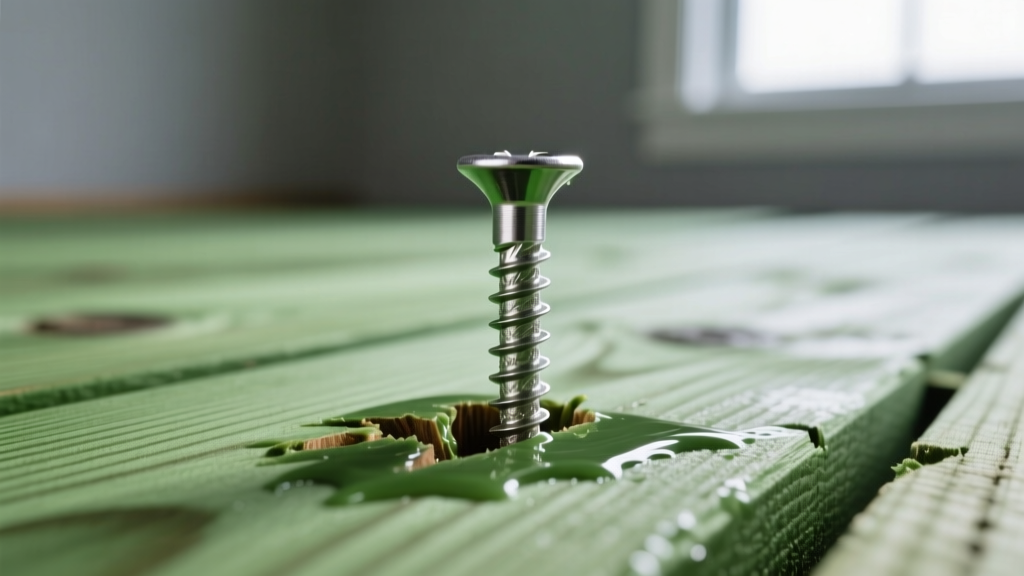
Evaluating Different Types of Wood Screws for Preserved Timber
To ensure structural longevity, builders must match the fastener metallurgy to the specific wood preservative. Below is a technical breakdown of the most common corrosion-resistant fasteners used in modern framing and decking.
Type 304 vs. Type 316 Stainless Steel
Stainless steel remains the gold standard for treated lumber applications. Type 304 stainless steel contains 18% chromium and 8% nickel, providing excellent resistance to the alkaline environment of ACQ and CA-C treatments. For a standard 3-inch #9 structural screw, 304 SS costs approximately $0.45 to $0.60 per unit in 2026.
Type 316 stainless steel includes an additional 2% to 3% molybdenum, which drastically increases resistance to pitting and crevice corrosion. If your project is located within 3,000 feet of a saltwater coastline, the combination of marine salt spray and copper-based wood treatments will overwhelm 304 SS. In these environments, 316 SS is mandatory, though it commands a premium price of $0.85 to $1.20 per screw. One installation caveat: stainless steel is softer than hardened steel and prone to galling (thread seizure) under high torque. Always use screws pre-lubricated with a proprietary wax coating to prevent bit cam-out and head stripping.
Hot-Dipped Galvanized (HDG) and ASTM Standards
Hot-dipped galvanized screws are the most cost-effective code-compliant option for treated lumber, typically pricing between $0.12 and $0.18 per unit. The screws are submerged in molten zinc, creating a thick, sacrificial metallurgical bond. To be compliant for use with ACQ and CA-C lumber, the American Wood Protection Association (AWPA) and building codes require HDG fasteners to meet ASTM A153 or ASTM F2329 standards, mandating a minimum zinc coating thickness of 1.0 oz per square foot (approximately 43 microns).
Do not confuse hot-dipped galvanized with mechanically galvanized (ASTM B695) or electrogalvanized screws. Mechanical galvanizing tumbles screws in zinc powder, resulting in a thinner, less uniform coating that often fails prematurely in highly alkaline treated wood.
Advanced Ceramic and Polymer-Coated Screws
Modern multi-layer polymer and ceramic-coated screws (often featuring an epoxy-polyester hybrid base with a ceramic topcoat) have captured significant market share. Brands utilizing advanced polymer matrices offer corrosion resistance that equals or exceeds HDG, while providing superior color-matching for composite and stained wood decking. These coatings are highly resistant to the alkaline copper environment and typically cost $0.25 to $0.35 per screw. However, builders must verify the manufacturer's specific ICC-ES evaluation report to ensure the coating is explicitly rated for the exact preservative (ACQ vs. MCQ) being used.
Fastener-to-Treatment Compatibility Matrix
The following matrix outlines the compatibility of different types of wood screws with various lumber treatments and natural wood species, based on 2026 industry standards and Simpson Strong-Tie Corrosion Guidelines.
| Fastener Type | ACQ / CA-C (Dissolved Copper) | MCQ (Micronized Copper) | Cedar / Redwood (Tannins) | Est. Cost (3" #9) |
|---|---|---|---|---|
| Type 316 Stainless Steel | Excellent | Excellent | Excellent | $0.85 - $1.20 |
| Type 304 Stainless Steel | Good / Excellent | Excellent | Excellent | $0.45 - $0.60 |
| Hot-Dipped Galv. (ASTM A153) | Good (Sacrificial) | Excellent | Poor (Streaking) | $0.12 - $0.18 |
| Ceramic / Polymer Coated | Good (Verify ICC-ES) | Excellent | Excellent | $0.25 - $0.35 |
| Electroplated Zinc | FAIL (Do Not Use) | FAIL (Do Not Use) | Poor (Streaking) | $0.05 - $0.08 |
Natural Preservatives: Cedar, Redwood, and Tannin Streaking
Chemical pressure-treatment is not the only wood preservation method that dictates fastener selection. Naturally durable species like Western Red Cedar and Redwood contain high levels of tannic acid and natural oils. When standard zinc or HDG screws react with these water-soluble tannins, a chemical reaction produces iron tannate—a dark, blue-black compound that bleeds down the face of the wood, causing severe aesthetic damage.
Furthermore, the acidic nature of cedar (pH typically between 4.5 and 5.5) accelerates the corrosion of uncoated carbon steel and zinc. For all cedar and redwood applications, regardless of whether the wood has received an additional surface sealant, builders must specify Type 304/316 stainless steel or specialized polymer-coated screws to prevent both structural degradation and unsightly tannin streaking.
Expert Installation Protocols for Maximum Lifespan
Selecting the correct metallurgy is only half the battle; improper installation can compromise the corrosion resistance of even the most expensive fasteners. Adhere to the following field protocols:
- Avoid Over-Driving: When driving HDG or polymer-coated screws, stop exactly flush with the wood surface. Over-driving the screw head crushes the protective coating and exposes the bare steel core to the alkaline moisture inside the treated lumber, initiating a localized rust pocket.
- Pre-Drilling End Grain: Pressure-treated lumber is often installed at high moisture content (up to 35% MC). Driving large-diameter structural screws near the end grain without pre-drilling causes micro-fractures in the wood, allowing pooling water to sit directly against the fastener threads, accelerating galvanic action.
- Isolate Dissimilar Metals: Never use stainless steel screws to attach aluminum flashing or joist hangers to treated lumber. The combination of aluminum, stainless steel, and wet ACQ wood creates a severe galvanic cell that will rapidly destroy the aluminum. Use HDG fasteners for HDG hardware, and stainless fasteners for stainless hardware.
- Clean Treated Lumber Before Fastening: Freshly treated lumber is often saturated with surface alkaline salts. If possible, allow the lumber to weather for 30 days or rinse the surface with clean water before driving fasteners to reduce the initial chemical concentration at the screw head interface.
By understanding the specific chemical interactions between modern wood preservatives and fastener metallurgy, builders can eliminate premature structural failures and costly callback repairs. Always verify the fastener manufacturer's ICC-ES evaluation report against the specific AWPA treatment standard stamped on the lumber end-tag before finalizing material orders.
Written by
David NakamuraDavid Nakamura is a licensed architect (AIA) and construction technology writer focused on sustainable building methods, mass timber engineering, and high-performance building envelopes. He holds a Master of Architecture from the University of Washington and is a certified Passive House Consultant (CPHC). David spent eight years at the Seattle firm Mithun, where he led the design of three LEED Platinum projects, before founding his own practice specializing in net-zero residential design. He serves on the editorial advisory board of GreenBuilder Magazine and has authored peer-reviewed papers on cross-laminated timber (CLT) connections for the Journal of Structural Engineering. In his spare time, David teaches woodworking at Pratt Fine Arts Center and kayaks the Puget Sound.
More from David Nakamura
View all
Construction Cost
Labor Cost to Build a Deck Per Sq Ft: 2026 Installation Guide
Discover the exact labor cost to build a deck per sq ft in 2026. This installation guide breaks down contractor rates, complexity factors, and hidden fees.
Aug 4, 2026

Construction Cost
How Much Does It Cost to Build a 3 Bedroom House? Financing Guide
Learn exactly how much it costs to build a 3 bedroom house and explore 2026 financing options, construction loan types, and budget frameworks for your build.
Aug 4, 2026

Construction Cost
Cost to Build a Tennis Court: 2026 Guide
How much does it cost to build a tennis court in 2026? Breakdowns for asphalt, concrete, and synthetic surfaces plus fencing and lighting.
Jul 30, 2026