Choosing Types of Fence Wood for Structural Wind Resistance
Analyze the structural properties of different types of fence wood. Learn how MOE, wind loads, and fastener shear dictate material choices.

The Structural Reality of Fence Design
A privacy fence is not merely a property boundary; from an engineering perspective, it is a cantilevered retaining wall designed to hold back wind. When evaluating the types of fence wood available, most homeowners focus on grain patterns and natural decay resistance. However, structural failure in high-wind zones (Exposure C and D under ASCE 7-22 guidelines) is almost always a result of inadequate bending strength (Fb) or fastener shear failure, not wood rot. A solid 6-foot privacy fence subjected to a 115 mph ultimate wind speed (Vult) experiences lateral pressures exceeding 25 pounds per square foot (psf). This translates to over 150 pounds of lateral force on a single 4x4 post spaced at 8 feet on center.
Wind Load Calculation Quick Reference
To determine the structural demand on your fence wood, calculate the projected area of the fence panel multiplied by the design wind pressure. For a standard 6-foot solid board fence in a suburban area (Exposure B), the design pressure is approximately 18-22 psf. An 8-foot wide panel captures 48 square feet, resulting in 864 to 1,056 lbs of total lateral force per post. The wood species and dimensional grade you select must possess a Modulus of Rupture (MOR) high enough to resist snapping at the ground line under this load.
Evaluating Types of Fence Wood by Structural Metrics
Not all lumber is graded equally. The National Design Specification (NDS) for Wood Construction outlines specific allowable stress designs for different species. When selecting types of fence wood for structural applications, you must look at the Fiber Stress in Bending (Fb) and the Modulus of Elasticity (MOE), which dictates stiffness and deflection limits.
| Wood Species | Fb (psi) - No. 2 Grade | MOE (psi) | Janka Hardness | Best Structural Application |
|---|---|---|---|---|
| Southern Yellow Pine (SYP) | 1,500 | 1,700,000 | 690 lbf | Load-bearing posts, long-span rails |
| Western Red Cedar (WRC) | 1,000 | 1,110,000 | 350 lbf | Pickets, short-span decorative rails |
| Coast Redwood | 1,050 | 1,100,000 | 420 lbf | Premium pickets, low-wind zone posts |
| Black Locust | 1,950 | 2,010,000 | 1,700 lbf | Extreme wind zones, agricultural fencing |
| White Oak | 1,300 | 1,520,000 | 1,360 lbf | Heavy-duty estate fencing, gate posts |
Post Selection: The Critical Load-Bearing Element
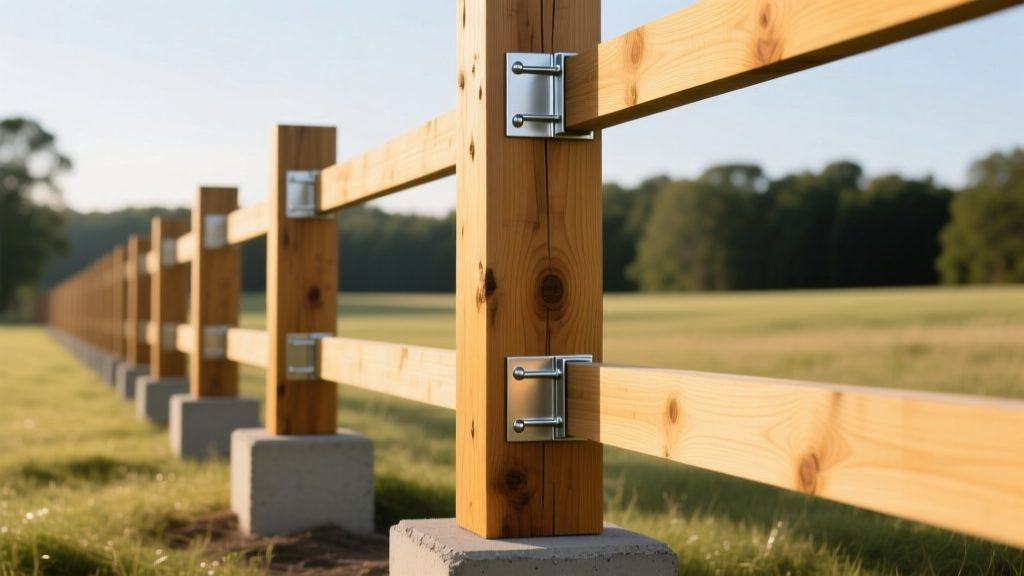
The post acts as a vertical cantilever beam. The maximum bending moment occurs precisely at the ground line. According to data from the Forest Products Laboratory Wood Handbook, the structural integrity of the post relies heavily on both the species' natural strength and its preservative treatment retention levels for ground contact.
SYP vs. Cedar for Subsurface and Ground-Contact
Western Red Cedar contains natural thujaplicins that resist fungal decay, making it a popular choice for fence pickets. However, its low Fb (1,000 psi) means a 4x4 cedar post is highly susceptible to snapping at the base during severe microbursts. For 6-foot or taller solid privacy fences, structural engineers specify Pressure-Treated Southern Yellow Pine (SYP) for the posts. SYP boasts an Fb of 1,500 psi—a 50% increase in bending strength over cedar.
When purchasing SYP posts, verify the AWPA (American Wood Preservers' Association) tag. For posts set in concrete or direct soil contact, you must use UC4B (Ground Contact, Heavy Duty) treated lumber, which has a preservative retention of 0.60 pcf (pounds per cubic foot) for MCA (Micronized Copper Azole) or ACQ (Alkaline Copper Quaternary). Standard UC4A (0.40 pcf) is insufficient for structural posts and will lead to subsurface rot within 7 to 10 years in high-moisture soils.
Span Limits and Rail Engineering
Horizontal rails transfer the wind load from the pickets to the posts. The orientation of the rail dramatically alters its structural capacity due to the moment of inertia. A 2x4 rail installed flat (wide side parallel to the ground) will deflect significantly more than a 2x4 installed on edge (narrow side parallel to the ground).
- 2x4 SYP on edge (8-foot span): Can safely support solid picket wind loads up to 25 psf with minimal deflection (L/180 limit).
- 2x4 WRC on edge (8-foot span): Exceeds safe deflection limits at 20 psf; requires reducing post spacing to 6 feet on center.
- 2x6 SYP on edge (10-foot span): Required for heavy estate fences or semi-private shadowbox designs that create turbulent wind drag.
Shadowbox (board-on-board) fences are often marketed as 'wind-resistant' because air can pass through the gaps. In reality, wind tunnel tests show that the overlapping boards create severe turbulence and vortex shedding, increasing the drag coefficient. Always calculate shadowbox fences as 80% solid surface area for wind load purposes, compared to 100% for standard privacy fences.
Fastener Shear Strength and Corrosion
The strongest wood species will fail if the fasteners shear under lateral load or corrode due to galvanic reactions with modern wood preservatives. Standard hot-dipped galvanized (HDG) nails are no longer sufficient for ACQ or MCA pressure-treated SYP posts, as the alkaline copper rapidly corrodes the zinc coating, leading to fastener snap failures.
For structural connections in treated wood, utilize stainless steel (Type 304 or 316) or specialized polymer-coated structural screws. The Simpson Strong-Tie corrosion guidelines mandate specific coatings for treated lumber. When attaching 2x6 SYP rails to 6x6 SYP posts, use 3-1/8 inch structural screws (such as the Simpson SDWS15312) which offer a shear strength of over 1,400 lbs per screw. Always use a minimum of three structural screws per rail-to-post connection to prevent rotational racking.
Post-Setting Protocols for Frost and Uplift
Wind does not only push laterally; it creates uplift forces on the leeward side of the fence and massive overturning moments on the windward side. The structural depth of the post must exceed the local frost line to prevent frost heave from pushing the post upward and breaking the concrete collar.
"A common failure mode in structural fencing is the 'concrete boat.' Contractors pour a wide bell of concrete at the base of the post in clay soils. As the clay expands during freeze-thaw cycles, it grips the sloped sides of the concrete bell and pushes the entire assembly upward. The correct structural method is a straight-walled sonotube with a 6-inch gravel drainage base, ensuring the concrete collar acts as a friction pile rather than a heave target."
— Structural Forensic Engineering Report on Residential Retaining Walls
Depth and Diameter Requirements
For a 6-foot tall fence, the rule of thumb dictates that 1/3 of the total post length must be subsurface. This means a 9-foot post is required, buried 36 inches deep. In regions with deep frost lines (e.g., USDA Plant Hardiness Zone 5 requires 36-42 inches; Zone 6 requires 48 inches), you must bore the hole below the frost line and set the post on a 6-inch compacted gravel base. The concrete collar should only surround the upper 12 inches of the subsurface post to lock it against lateral movement, while the lower portion remains in compacted soil to allow for drainage and prevent frost grip.
Summary: Decision Framework for Fence Wood
Selecting the right types of fence wood requires balancing budget, aesthetics, and structural physics. Use Pressure-Treated SYP (UC4B) for all structural posts and bottom rails where moisture and bending moments are highest. Reserve Western Red Cedar or Redwood for the pickets and top rails where natural decay resistance and visual appeal outweigh the need for extreme bending strength. By engineering the post depth, rail orientation, and fastener chemistry to match the specific wind loads of your zip code, you ensure the fence functions as a durable structural asset rather than a recurring maintenance liability.
Written by
Elena RodriguezElena Rodriguez is a civil engineer and technical writer specializing in concrete technology, masonry systems, and ASTM/ACI compliance. She earned her B.S. in Civil Engineering from Texas A&M University and spent a decade at a materials testing laboratory, performing over 2,000 concrete compressive strength tests and masonry prism evaluations. Elena is an ACI-certified Field Testing Technician (Grade I) and a member of ASTM Committee C12 on Natural Building Stone. She currently consults on forensic engineering cases involving concrete failures and moisture intrusion. Based in San Antonio, TX, Elena is a proud member of the Society of Women Engineers (SWE) and coaches her daughter's FIRST Robotics team.
More from Elena Rodriguez
View all
Walls & Panels
Cost Analysis: Light Gauge Steel Framing Advantages and Disadvantages
Evaluate light gauge steel framing advantages and disadvantages through a strict cost analysis lens, comparing material, labor, and lifecycle expenses.
Aug 4, 2026

Walls & Panels
Gypsum Board Types: Exact Specifications, Thickness & Dimensions
Compare standard, Type X, and moisture-resistant gypsum board types. Get exact specifications, thicknesses, dimensions, and ASTM standards for your project.
Aug 4, 2026

Fire Resistance
Best Fire-Resistant Outdoor Decking Materials: 2026 Buyer Guide
Discover the best fire-resistant outdoor decking materials for 2026. Compare Class A PVC, aluminum, and hardwood options for WUI compliance and safety.
Aug 4, 2026