Complete Species Guide: Types of Wooden Spoons With Names
Discover the best wood species for carving culinary tools. This complete guide covers types of wooden spoons with names, Janka ratings, and toxicity.

The Material Science of Culinary Lumber
Selecting the correct lumber blank for carving culinary tools requires a strict understanding of wood anatomy, dimensional stability, and biological safety. When evaluating the various types of wooden spoons with names like the French cuillère en bois or the Scandinavian puukko-carved eating spoon, the underlying wood species dictates the tool's lifespan, hygiene, and structural integrity. The primary anatomical requirement for any spoon wood is a diffuse-porous cellular structure. Unlike ring-porous woods (such as oak or ash), which feature large, open earlywood vessels that harbor bacteria and prone to splitting along the grain, diffuse-porous species possess uniformly sized, microscopic vessels. This tight grain structure prevents water intrusion, resists warping during repeated wet-dry cycles, and yields a smooth, splinter-free finish when carved.
According to the USDA Forest Products Laboratory Wood Handbook, moisture content and radial versus tangential shrinkage ratios are critical when milling spoon blanks. Woods with a high tangential-to-radial (T/R) shrinkage ratio are highly susceptible to checking and cupping. Therefore, premium spoon carvers exclusively select quartersawn blanks from species with a T/R ratio below 1.8, ensuring the spoon bowl remains dimensionally stable when exposed to boiling liquids.
Heavy-Duty Stirring Spoons: High-Janka Hardwoods
Stirring spoons and spatulas endure high mechanical stress, scraping against cast iron and stainless steel while resisting thermal degradation in boiling stocks. These tools require species with a Janka hardness rating exceeding 1,200 lbf (pounds-force) to prevent edge blunting and compression fractures.
| Wood Species | Janka Hardness (lbf) | Grain Characteristics | Best Culinary Application |
|---|---|---|---|
| Sugar Maple (Hard Maple) | 1,450 | Diffuse-porous, extremely fine and uniform texture. | Heavy-duty stirring, scraping fond from pans. |
| European Beech | 1,300 | Diffuse-porous, prominent ray fleck on quartersawn faces. | Commercial kitchen spatulas, long-handled mixing spoons. |
| Olive Wood | 2,710 | Interlocked grain, highly figured, dense natural oils. | Stiff risotto spoons, high-heat sautéing tools. |
| Hickory (Shagbark) | 1,820 | Semi-ring-porous (requires tight growth rings for spoon use). | BBQ basting spoons, heavy roasting forks. |
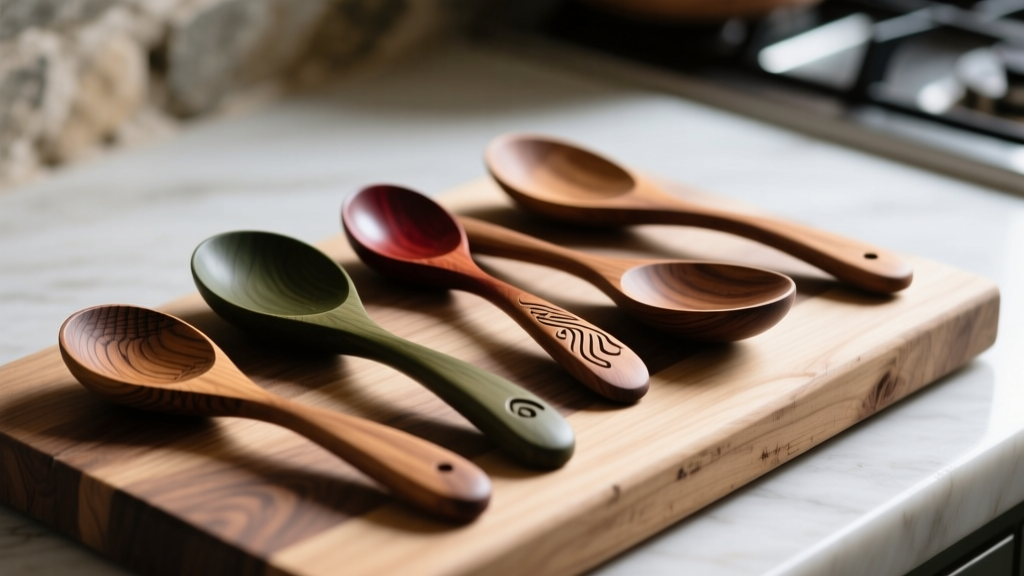
Serving and Tasting Spoons: Fine-Grain Workability
While stirring spoons prioritize brute strength, serving and tasting spoons require superior workability, allowing the carver to achieve thin, elegant walls and crisp transitions between the handle and the bowl. These species typically fall in the 800 to 1,100 lbf Janka range, offering a balance of durability and ease of carving with hook knives and gouges.
Black Cherry (Prunus serotina)
Yellow Birch (Betula alleghaniensis)
Black Walnut (Juglans nigra)
Critical Safety: Toxic Species and Open-Grain Failures
Not all hardwoods are safe for food contact. The Wood Database's comprehensive toxicity index highlights several popular exotic and domestic species that contain dangerous alkaloids, sensitizing quinones, or structural flaws that make them hazardous for culinary use.
- Pacific Yew (Taxus brevifolia): Contains taxine alkaloids, which are highly cardiotoxic. Even trace amounts of dust or leached sap can be fatal.
- African Blackwood & Rosewoods (Dalbergia spp.): Contain dalbergiones, which are severe skin and respiratory sensitizers. While the finished wood is sometimes deemed inert, the carving process poses extreme health risks, and long-term food contact is unverified.
- Red Oak (Quercus rubra): Not toxic, but structurally catastrophic for spoons. Red oak lacks tyloses (cellular plugs), meaning its large open pores act like a bundle of straws, wicking up soups, harboring bacteria, and eventually rotting from the inside out.
- Pine, Cedar, and Fir (Softwoods): High resin content imparts a bitter, turpentine-like flavor to hot foods. The low Janka hardness (often below 500 lbf) results in deep gouges that trap food particles and mold.
Blank Selection and Dimensional Stability
The transition from a raw log to a stable spoon blank requires precise milling. The ideal spoon blank measures 1.5 inches thick, 1.5 inches wide, and 10 to 12 inches long. To minimize warping, the blank must be oriented so the growth rings run perpendicular to the wide face of the handle (quartersawn).
When evaluating a stack of turning blanks or rough-sawn lumber, look for the 'cathedral' pattern on the end grain. If the end grain shows concentric circles parallel to the wide face (flatsawn), reject it for spoon carving. Flatsawn blanks will cup across the spoon bowl as the wood dries, leading to structural failure. Furthermore, ensure the blank is entirely free of pith (the center of the tree). The pith is the primary origin point for radial checking and will inevitably split the handle of the spoon as it undergoes seasonal humidity fluctuations.
Food-Safe Finishing Protocols
Raw wood, even dense diffuse-porous species, requires a hydrophobic barrier to prevent waterlogging and tannin leaching. The choice of finish dictates the spoon's maintenance cycle and food safety.
- Food-Grade Mineral Oil (USP): A non-drying, petroleum-derived oil that is biologically inert. It requires frequent reapplication (every 4-6 weeks with heavy use) but never turns rancid. It is the industry standard for commercial woodenware.
- Walnut Oil (Heat-Refined): A semi-drying plant oil that polymerizes slightly within the wood pores. It offers better water resistance than mineral oil but carries a severe allergy risk for consumers with tree-nut allergies. It must be heat-refined to remove proteins that cause allergic reactions.
- Beeswax and Mineral Oil Blends (Board Butter): A mixture of 1 part beeswax to 4 parts mineral oil, melted and applied warm. The wax fills the microscopic surface pores, providing a tactile, matte finish and superior initial water beading.
Crucial Avoidance: Never use raw linseed oil, tung oil, or commercial 'boiled' linseed oil on culinary tools. Commercial boiled linseed oil contains heavy metal driers (cobalt and manganese) that are toxic if ingested, while raw plant oils will oxidize, turn rancid, and impart a foul odor and taste to food.
Frequently Asked Questions
Can I carve a spoon from a fallen branch in my backyard?
Yes, provided the species is safe (like fruit woods from apple or cherry trees) and the wood is 'green' (unseasoned) or properly sealed. Carving green wood is significantly easier because the moisture acts as a lubricant for the blade. However, you must carve the spoon to its final dimensions immediately and apply a heavy coat of oil, as rapid moisture loss in thin sections will cause severe cracking.
Why do my maple spoons develop black spots after washing?
Black spots are typically iron-tannin reactions or mold spores trapped in micro-fissures. If your water supply has high iron content, it can react with the natural tannins in the wood. To prevent this, avoid soaking wooden spoons in the sink, wash them with mild pH-neutral soap, dry them immediately with a towel, and store them in a low-humidity, well-ventilated area.
What is the best steel for carving these specific wood species?
For high-Janka woods like Olive and Hard Maple, high-carbon steel (such as O1 or A2 tool steel) hardened to 60-62 HRC is mandatory to maintain a sharp hook knife edge. For softer fruit woods like Cherry and Birch, standard carbon steel at 58 HRC is sufficient and easier to sharpen in the field using a ceramic strop.
Written by
Sarah WhitfieldSarah Whitfield is a chartered quantity surveyor (MRICS) and construction cost analyst with 15 years of experience in material pricing, procurement strategy, and project budgeting. She earned her degree in Construction Management from the University of Reading (UK) and has worked on projects ranging from $2M custom homes to $180M mixed-use developments across North America and Europe. Sarah currently leads cost estimating for BuildMat Insight, maintaining a proprietary database of 4,000+ material price points updated quarterly. She is a frequent contributor to RSMeans cost data panels and has presented at the International Cost Engineering Council (ICEC) congress. Based in Denver, CO, Sarah is an avid trail runner and volunteer mentor for Women in Construction.
More from Sarah Whitfield
View all
Wood & Lumber
What Are the Different Types of Wood? A Builder's Guide
Compare structural softwoods, finish hardwoods, and engineered lumber. Analyze Janka ratings, MOE values, and 2026 pricing for construction.
Aug 4, 2026

Walls & Panels
Steel Framing vs Wood Framing: Corrosion and Moisture Defense
Compare steel framing vs wood framing for moisture resistance. Learn about galvanized coatings, condensation risks, and corrosion protection strategies.
Jul 21, 2026

Stone & Masonry
How to Cut Stone Veneer: Wet Saw vs Grinder Comparison
Compare the best tools for cutting stone veneer. We review wet saws, angle grinders, and chop saws to help you achieve clean, chip-free cuts.
Jul 21, 2026