Wood Panel Accent Wall Durability: Lifespan & Failure Analysis
Analyze the durability and lifespan of wood panel accent walls. Compare solid wood, MDF veneers, finishes, and moisture failure modes for lasting installs.
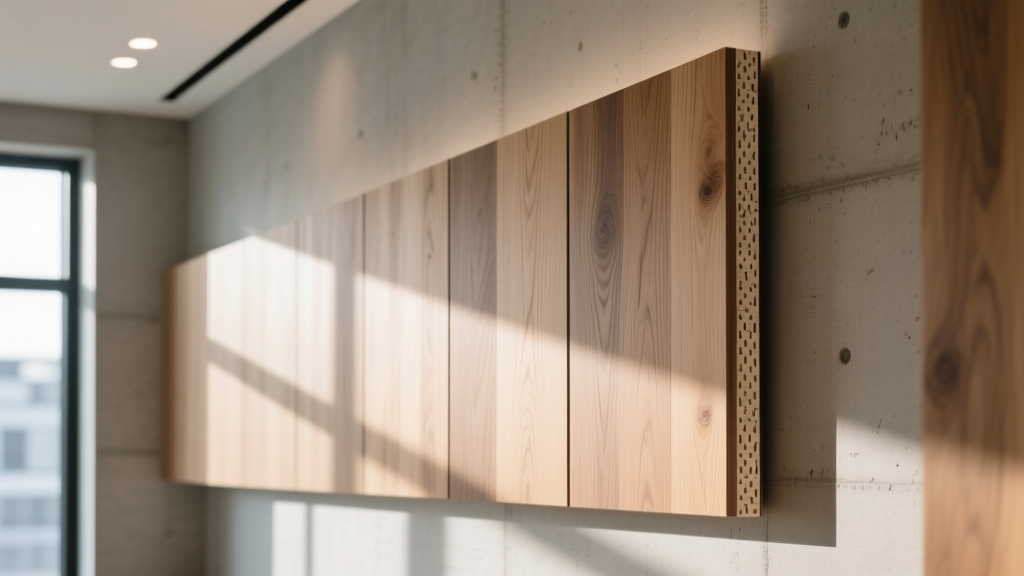
The Physics of Wood Panel Accent Wall Degradation
While often treated as purely decorative elements, wood panel accent walls are subject to the same rigorous building physics as structural timber and hardwood flooring. The lifespan of a wood wall installation—ranging from 10 to over 50 years—is rarely dictated by the physical wear of the wood itself. Instead, longevity is determined by dimensional stability, finish chemistry, and the mechanical accommodation of hygroscopic movement. When a wood panel accent wall fails, it is almost always due to moisture gradients, UV photodegradation, or rigid mounting systems that restrict natural expansion and contraction.
Wood is hygroscopic, meaning it continuously exchanges moisture with the surrounding air until it reaches Equilibrium Moisture Content (EMC). According to technical guidelines published by the American Wood Council, interior wood in climate-controlled environments typically stabilizes between 6% and 9% EMC. However, seasonal HVAC fluctuations can cause localized EMC swings of 3% to 5%. In solid hardwoods like White Oak or Walnut, this translates to tangential shrinkage and swelling that can exert hundreds of pounds of lateral force against fasteners if the panel is pinned rigidly to drywall.
Material Lifespan Matrix: Core and Veneer Configurations
The architectural market currently segments wood panel accent walls into three primary categories. Each configuration presents distinct durability profiles, maintenance cycles, and failure thresholds.
| Material Configuration | Expected Lifespan | Dimensional Stability | Primary Vulnerability | Avg. Installed Cost (per sq ft) |
|---|---|---|---|---|
| Solid Hardwood (3/4' Tongue & Groove) | 40-50+ years | Moderate (Requires expansion gaps) | Cupping, end-checking, seasonal gapping | $28 - $45 |
| Engineered Veneer (MDF/Plywood Core) | 20-30 years | High (Cross-banded core restricts movement) | Veneer delamination, edge chipping, moisture swelling at seams | $18 - $32 |
| PET Felt-Backed Wood Slats (Acoustic) | 15-25 years | Very High (Individual slats move independently) | Felt UV degradation, adhesive failure between slat and felt | $22 - $38 |
Finish Chemistry: Hardwax Oil vs. UV-Cured Polyurethane
The finish applied to a wood panel accent wall dictates its resistance to physical abrasion, staining, and UV radiation. The two dominant finish technologies in 2026 offer vastly different maintenance lifespans.
Hardwax Oils (e.g., Rubio Monocoat 2C, Osmo Polyx)
Hardwax oils penetrate the top 2 to 3 cell layers of the wood and polymerize, binding with the cellulose fibers. They leave no surface film, meaning they will never peel or flake. Lifespan: 5 to 8 years on vertical surfaces before requiring a maintenance coat. Advantage: Spot-repairability. If a section of the accent wall is dented or stained, it can be locally sanded and re-oiled without blending issues or visible lap marks. Furthermore, modern hardwax oils incorporate advanced UV-inhibitors that significantly slow the photodegradation of light-sensitive species like American Cherry.
UV-Cured Aluminum Oxide Polyurethane
Factory-finished engineered panels often utilize UV-cured polyurethane embedded with aluminum oxide particles for extreme scratch resistance. Lifespan: 15 to 25 years on vertical applications. Advantage: Near-zero maintenance. The surface film is highly resistant to household chemicals and physical impact. Drawback: If the film is deeply scratched or begins to peel after two decades, the entire panel must be replaced or professionally sanded and refinished, which is often cost-prohibitive for veneered MDF cores.
The Three Primary Failure Modes in Interior Wood Cladding
Understanding how wood panel accent walls fail allows architects and installers to engineer preventive solutions during the design phase.
1. Differential Cupping from Moisture Gradients
Cupping occurs when the face of the wood panel experiences a different humidity level than the back. If a solid wood panel is installed directly against an uninsulated exterior masonry wall, the back of the wood absorbs ambient moisture while the face remains dry from interior HVAC. The back expands, forcing the edges of the panel to curl forward. Fix: Always install a continuous vapor retarder (such as 6-mil polyethylene or a specialized dimpled drainage mat) between masonry and the wood furring strips to equalize the moisture profile.
2. Photodegradation and Color Shift
All wood species react to ultraviolet light, but the reaction is not uniform. Exotic woods like Brazilian Cherry (Jatoba) and domestic Walnut will lighten and wash out, while American Cherry and Pine will darken and amber. According to research on indoor environmental quality and material degradation cited by the EPA, managing UV exposure is critical for interior material longevity. Fix: Specify finishes with dedicated UV-blocking additives, or apply low-E window films to adjacent glazing to filter out the 315-400nm UV spectrum that triggers lignin breakdown in wood.
3. Acoustic Felt Delamination
The surge in acoustic wood slat walls has introduced a new failure point: the PET (polyethylene terephthalate) felt backing. While the wood slats themselves may last 30 years, the hot-melt adhesives binding the veneer to the felt can crystallize and fail if subjected to direct, sustained solar heat (surface temperatures exceeding 140°F). Fix: Source panels that utilize mechanical micro-stapling or high-temperature reactive polyurethane (PUR) adhesives rather than standard EVA hot-melt glues.
Long-Term Cost of Ownership and Maintenance Cycles
Evaluating a wood panel accent wall requires looking past the initial installation invoice. The following framework models the 20-year cost of ownership for a 100-square-foot feature wall in a residential living space.
| Cost Metric | Solid Walnut (Hardwax Oil) | Engineered Oak (UV Polyurethane) | PVC-Wrapped MDF (Faux Wood) |
|---|---|---|---|
| Initial Material & Install | $3,800 | $2,400 | $1,200 |
| Year 10 Maintenance (Refinishing/Repair) | $450 (Spot re-oil) | $0 | $300 (Panel replacement due to edge peel) |
| Year 20 Maintenance | $450 (Spot re-oil) | $800 (Full wall replacement due to film failure) | $1,200 (Full wall replacement) |
| 20-Year Total Cost | $4,700 | $3,200 | $2,700 |
| End-of-Life Salvage Value | High (Solid wood can be milled/reused) | Zero (Landfill) | Zero (Landfill) |
Expert Installation Framework for Maximum Longevity
To ensure a wood panel accent wall reaches its maximum engineered lifespan, installers must abandon rigid fastening methods in favor of dynamic mounting systems that accommodate hygroscopic movement. The National Wood Flooring Association emphasizes that wood movement is inevitable; the goal is to manage it, not stop it.
For large-format engineered panels or solid wood shiplap, do not use pneumatic finish nails directly into drywall. Instead, route a Z-clip (aluminum French cleat) channel into the back of the wood panels. Mount the receiving rail to the wall studs using structural screws. This allows the wood panel to hang securely while floating laterally, accommodating up to 1/4 inch of seasonal expansion and contraction without stressing the wood fibers or popping fasteners.
Acclimation Protocols
Never install wood panels directly from the delivery truck. Solid wood and thick engineered panels must be acclimated in the installation environment for a minimum of 7 to 14 days. The space must be fully enclosed, with HVAC systems operational and maintaining a temperature between 65°F and 75°F, and relative humidity between 35% and 55%. Use a pinless moisture meter to verify that the wood's EMC is within 2% of the sub-wall's moisture content before proceeding with installation.
Edge Sealing and End-Grain Protection
End-grain absorbs and releases moisture up to 15 times faster than face-grain. Whenever a wood panel accent wall is cut on-site to accommodate outlets, HVAC registers, or ceiling lines, the exposed end-grain must be sealed immediately. Apply a dedicated end-sealer or two coats of dewaxed shellac to the cut edges before installing the trim. This localized sealing prevents the ends of the panels from absorbing ambient humidity and swelling, which is the leading cause of unsightly 'picture-framing' at the perimeter of the wall.