Best Type of Wood for Raised Beds: A Lumber Grade & Quality Guide
Discover the best type of wood for raised beds. Compare lumber grades, rot resistance, and costs to build durable, safe garden boxes that last for years.
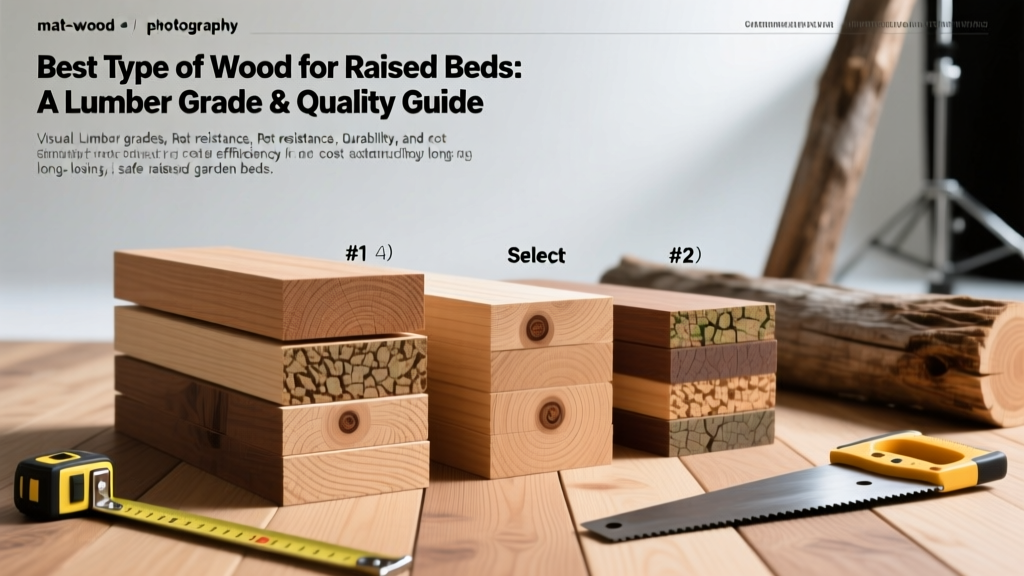
Decoding Lumber Grades for Ground Contact
When selecting the right type of wood for raised beds, most gardeners focus exclusively on species, ignoring the critical metric of lumber grading. Lumber grades dictate structural integrity, knot frequency, and dimensional stability—all of which determine whether your garden bed will hold back thousands of pounds of wet soil or bow and split after one freeze-thaw cycle.
For raised bed construction, you must balance structural load-bearing capacity with cost. According to the National Lumber Grades Authority (NLGA), boards are categorized by their strength and visual defects. For a raised bed retaining wall, No. 2 Structural is the optimal grade. It permits tight, sound knots but restricts the wane (bark edges) and slope of grain that cause warping. Avoid 'Appearance' or 'Select' grades; you are paying a premium for visual perfection that will be buried in dirt. Conversely, avoid 'No. 3' or 'Utility' grades, as the large, loose knots will inevitably fall out, creating weak points where soil pressure will fracture the board.
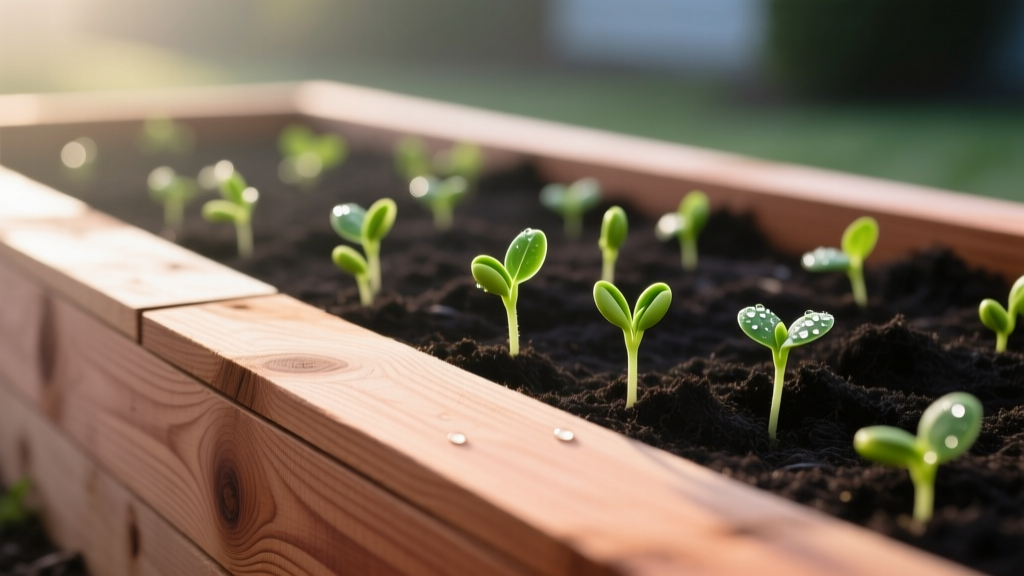
Heartwood vs. Sapwood: The Hidden Quality Metric
The single most misunderstood factor in wood durability is the heartwood-to-sapwood ratio. Even if you purchase premium Western Red Cedar, a board comprised of 60% sapwood will rot significantly faster than a lower-grade board made entirely of heartwood. According to Oregon State University Extension, heartwood contains extractives (like thujaplicins in cedar) that act as natural fungicides, while sapwood is essentially the tree's plumbing system—highly porous, moisture-retentive, and an ideal food source for decay fungi.
When inspecting lumber at the yard, look for the color contrast. In cedar and redwood, heartwood is the darker, richer reddish-brown center, while sapwood is the pale, whitish-yellow outer band. For maximum longevity, hand-select boards where the pale sapwood edge constitutes less than 10% of the board's width. If a No. 2 Cedar board is 100% heartwood, it will outperform a 'Clear Heart' graded board that has wide sapwood margins resulting from off-center milling.
Species Comparison Matrix: Grades, Lifespan, and 2026 Costs
The following matrix breaks down the most common wood species used for raised beds, evaluating their natural durability, required grade, and current market pricing.
| Wood Species | Optimal Grade | Heartwood Rot Resistance | Expected Lifespan | Approx. Cost (2026) |
|---|---|---|---|---|
| Black Locust | No. 1 or No. 2 | Exceptional (Class 1) | 25–50+ Years | $18.00 – $25.00 / LF |
| Western Red Cedar | No. 2 Structural | High (Class 2) | 10–15 Years | $12.00 – $16.00 / LF |
| Redwood (Construction Heart) | Construction Heart | High (Class 2) | 10–15 Years | $9.00 – $13.00 / LF |
| Douglas Fir | No. 2 or Better | Moderate (Class 3) | 5–8 Years | $6.00 – $9.00 / LF |
| Southern Yellow Pine (Treated) | No. 2 UC4A | N/A (Chemical Reliant) | 15–20 Years | $3.50 – $5.50 / LF |
Treated Lumber: Navigating AWPA Categories and Safety
If budget constraints make cedar or redwood prohibitive, pressure-treated Southern Yellow Pine (SYP) is the standard alternative. However, you must specify the correct American Wood Protection Association (AWPA) Use Category. Standard above-ground treated lumber (UC3B) will fail in soil contact within three years.
For raised beds, you must purchase lumber stamped UC4A (Ground Contact) or UC4B (Heavy Ground Contact). UC4A requires a minimum chemical retention of 0.31 pcf (pounds per cubic foot) for MCA-C (Micronized Copper Azole) treatments, while UC4B requires 0.40 pcf. MCA-C is widely recognized as safe for edible gardens once the wood has cured, as the copper is micronized and bound to the wood fibers, preventing significant leaching into neutral-pH soils. To ensure safety, line the interior walls of treated wood beds with heavy-duty HDPE (high-density polyethylene) plastic sheeting to create a physical barrier between the soil and the wood preservatives.
Dimensional Tolerances and Hydrostatic Load Management
Wet topsoil weighs approximately 100 pounds per cubic foot. A standard 4x8 foot raised bed filled to a depth of 18 inches holds roughly 3,600 pounds of soil, exerting immense lateral hydrostatic pressure on the retaining walls. This is where nominal vs. actual dimensions become a critical failure point.
A standard '1x' board is actually 0.75 inches thick. Under the lateral load of wet soil, a 1x board spanning 8 feet will bow outward, eventually pulling the fasteners through the wood fibers. To mitigate this without adding expensive internal cross-bracing, utilize 5/4 decking boards (actual thickness 1 inch) or standard 2x lumber (actual thickness 1.5 inches). If you must use 1x boards to save weight or cost, limit the unsupported span to 4 feet by driving 18-inch galvanized steel rebar stakes on the interior every 4 feet to act as structural stiffeners.
Fastener Compatibility and Galvanic Corrosion
The tannins and natural acids present in cedar and redwood are highly corrosive to standard electroplated zinc screws. Within a single season, these acids will eat through the zinc coating, leading to black tannin streaks down the face of your garden bed and eventual fastener failure. Furthermore, the copper in MCA-C pressure-treated lumber will rapidly corrode standard steel and aluminum.
For all cedar, redwood, and treated lumber raised beds, you must use Hot-Dipped Galvanized (HDG) fasteners meeting ASTM A153 standards, or 304/316 Stainless Steel structural screws. For corner joints, bypass standard wood screws entirely and use 1/2-inch hot-dipped galvanized carriage bolts with fender washers to clamp the corners, ensuring the bed cannot be pushed apart by frost heave or soil expansion.
Quick Decision Framework: Which Wood Fits Your Project?
Use this diagnostic framework to finalize your material selection based on your specific site conditions and budget:
- If budget is under $150 per bed and lifespan expectation is 15+ years: Select No. 2 UC4A Ground Contact Southern Yellow Pine. Line the interior with HDPE plastic and use 316 stainless steel fasteners to prevent copper-induced corrosion.
- If growing root vegetables in a premium organic setup with a $300+ budget: Source rough-sawn, 100% heartwood Western Red Cedar (2x8 or 2x12 dimensions). Avoid any chemical treatments and secure with 304 stainless steel timber screws.
- If building a permanent, multi-generational garden infrastructure: Invest in Black Locust. Despite the high initial cost and difficulty in milling due to its extreme Janka hardness (1,700 lbf), its Class 1 rot resistance requires zero chemical treatments and will easily outlast a 30-year mortgage.
- If building temporary beds for a rental property or seasonal use: Utilize No. 2 Douglas Fir. It offers decent structural stiffness at a mid-tier price point but expect to replace the boards within 5 to 7 seasons as the moderate heartwood extractives deplete.
Written by
Priya KapoorPriya Kapoor is a real estate market analyst and construction economics researcher with expertise in housing affordability, development feasibility, and infrastructure investment. She holds a Master of Regional Planning from Cornell University and previously worked as a senior analyst at CBRE's Investment Properties group, where she modeled returns for $4B in mixed-use development pipelines. Priya now runs an independent research practice advising developers, municipalities, and REITs on construction cost forecasting and market timing. She publishes the quarterly "BuildMat Market Pulse" report tracking material price indices across 12 commodity categories. Based in Austin, TX, Priya serves on the board of Habitat for Humanity Austin and is a marathon runner.
More from Priya Kapoor
View all
Construction Cost
Cost to Build a 1600 Sq Ft Home in 2026: Full Breakdown
Accurate 2026 cost to build a 1600 sq ft home—material, labor, and regional pricing breakdowns included. Plan your budget with real-time estimates.
Aug 11, 2026

Wood & Lumber
Name the Types of Wood for Pressure Treatment and Preservation
Learn how to name the types of wood best suited for pressure treatment. Compare species treatability, chemical retention levels, and 2026 preservation costs.
Aug 4, 2026

Stone & Masonry
Stone Veneer Suppliers Lindenhurst: 2026 Cost Analysis
Analyze 2026 stone veneer costs in Lindenhurst, NY. Compare local supplier pricing, delivery fees, and Suffolk County installation labor rates.
Aug 4, 2026