Wood Species Guide for Building Types of Wooden Chairs
Discover the best lumber species for crafting durable types of wooden chairs. Compare Janka hardness, grain, and costs for hardwoods and softwoods.

The Intersection of Lumber Selection and Chair Design
Selecting the correct lumber is the most critical decision when manufacturing or commissioning different types of wooden chairs. Unlike static cabinetry, seating furniture endures dynamic, multi-directional stress. A dining chair must support shifting human weight, resist lateral racking forces, and maintain joint integrity across seasonal humidity fluctuations. The wood species chosen dictates not only the aesthetic outcome but the structural lifespan of the piece. This guide breaks down the mechanical properties, milling requirements, and 2026 market costs for the primary wood species used in chair construction.
Quick Specs: Chair Lumber Requirements
- Minimum Janka Hardness: 900 lbf for structural joinery (mortise and tenon, dowels).
- Target Moisture Content (MC): 6% to 8% for indoor seating; 10% to 12% for covered outdoor.
- Ideal T/R Ratio: Below 1.8 to minimize joint failure from uneven shrinkage.
- Grain Orientation: Straight-grain, rift-sawn, or quarter-sawn lumber preferred for legs and spindles.
Hardwood vs. Softwood: Structural Demands of Chair Joinery
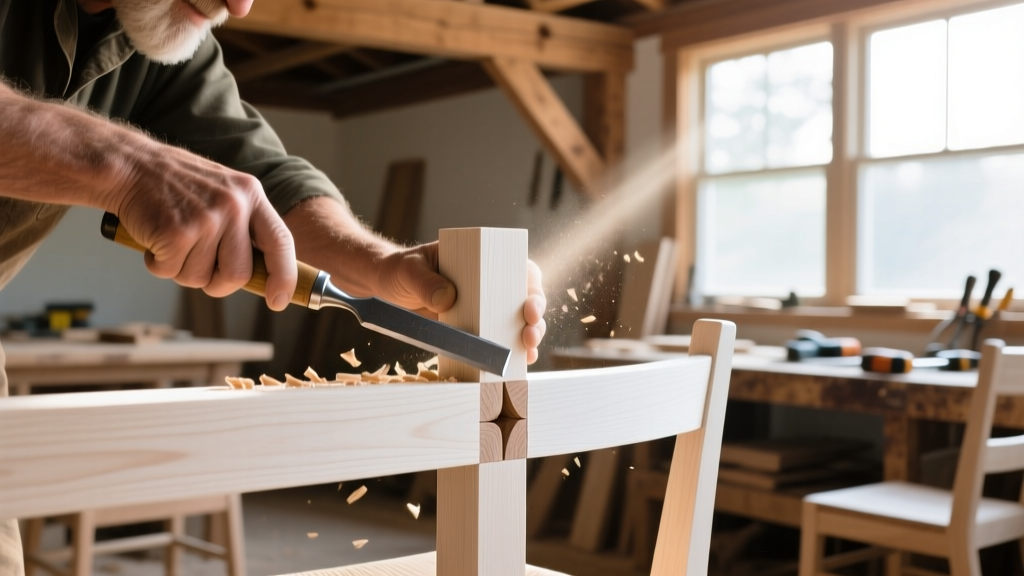
The primary structural connection in high-quality wooden chairs is the mortise and tenon joint. This joint relies on the shear strength and compressive resistance of the wood fibers. Softwoods, such as Eastern White Pine (Janka: 380 lbf), compress under the cyclical loading of human weight. Over time, this compression causes tenons to loosen within their mortises, resulting in a wobbly chair. For this reason, premium types of wooden chairs—such as Windsor, ladder-back, and modern dining chairs—rely almost exclusively on dense hardwoods.
According to the Janka hardness scale maintained by the Wood Database, woods exceeding 1,000 lbf provide the necessary edge-holding strength for complex joinery and the durability required for high-traffic seating environments.
Premium Hardwoods for Heirloom Chair Types
When building heirloom-quality seating, woodworkers prioritize species with high dimensional stability, excellent workability, and superior finishing characteristics. Here are the industry standards for premium chair manufacturing.
White Oak (Quercus alba)
White oak is the benchmark for durable, heavy-duty seating. Its closed-cell structure, created by tyloses, makes it highly resistant to moisture ingress, which is why it is frequently used for outdoor dining chairs and commercial hospitality seating.
- Janka Hardness: 1,360 lbf
- 2026 Avg. Cost: $8.50 to $12.00 per board foot (4/4, FAS grade)
- Best Applications: Mission-style chairs, commercial dining seating, steam-bent Windsor hoops.
- Milling Note: Quarter-sawn white oak is highly recommended for chair legs to expose the medullary rays and reduce tangential shrinkage, keeping the legs perfectly cylindrical over decades.
Hard Maple (Acer saccharum)
Hard maple features a diffuse-porous grain structure that is incredibly tight and uniform. This makes it the undisputed champion for turned chair parts, such as spindles, stretchers, and cabriole legs, as it holds crisp details on a lathe without tear-out.
- Janka Hardness: 1,450 lbf
- 2026 Avg. Cost: $7.00 to $10.50 per board foot
- Best Applications: Shaker chairs, turned spindle-back chairs, schoolhouse seating.
- Workability Warning: Hard maple burns easily under router bits and dulls tooling quickly. Carbide-tipped tooling is mandatory for production milling.
Black Walnut (Juglans nigra)
Prized for its rich, dark heartwood and exceptional workability, black walnut is the go-to species for high-end, bespoke lounge chairs and mid-century modern designs. While slightly softer than oak or maple, its 1,010 lbf Janka rating is more than sufficient for residential seating joinery.
- Janka Hardness: 1,010 lbf
- 2026 Avg. Cost: $14.00 to $22.00 per board foot
- Best Applications: Mid-century lounge chairs, carved dining chairs, sculptural seating.
- Finishing: Walnut requires minimal finishing. A simple application of tung oil or hardwax oil (like Rubio Monocoat) enhances the chatoyance without the need for grain fillers.
Utilitarian & Softwood Species for Rustic and Outdoor Chairs
Not all types of wooden chairs require dense hardwoods. Rustic, Adirondack, and casual outdoor seating often utilize softwoods or tropical hardwoods chosen for their decay resistance and ease of mass production.
Teak (Tectona grandis)
Teak remains the gold standard for luxury outdoor seating. Its high natural oil and silica content make it virtually impervious to rot, fungal decay, and insect damage. However, the silica content acts as an abrasive, rapidly dulling standard HSS (High-Speed Steel) tooling.
- Janka Hardness: 1,070 lbf
- 2026 Avg. Cost: $28.00 to $38.00 per board foot (Plantation-grown, FSC certified)
- Best Applications: Luxury patio dining chairs, marine seating, outdoor lounge furniture.
Western Red Cedar (Thuja plicata)
For casual, wide-slat outdoor seating like the Adirondack chair, Western Red Cedar offers an excellent strength-to-weight ratio and natural rot resistance. Because these chair types rely on mechanical fasteners (stainless steel screws) rather than complex mortise and tenon joinery, the low Janka hardness (350 lbf) is not a structural liability.
- Janka Hardness: 350 lbf
- 2026 Avg. Cost: $6.00 to $9.00 per board foot
- Best Applications: Adirondack chairs, rustic porch rockers, garden benches.
Wood Species Comparison Matrix for Chair Manufacturing
| Wood Species | Janka (lbf) | T/R Ratio | Cost/BF (2026) | Primary Chair Application |
|---|---|---|---|---|
| Hard Maple | 1,450 | 1.5 | $7 - $10 | Turned spindles, Shaker seating |
| White Oak | 1,360 | 1.8 | $8 - $12 | Mission style, steam-bent hoops |
| Black Walnut | 1,010 | 1.4 | $14 - $22 | Mid-century lounge, carved dining |
| Cherry | 950 | 1.5 | $10 - $15 | Formal dining, traditional carving |
| Teak | 1,070 | 1.6 | $28 - $38 | Luxury outdoor, marine seating |
Moisture Content and Kiln-Drying Standards for Chair Lumber
Wood movement is the primary cause of chair joint failure. As the Wood Database notes on wood movement, wood shrinks and swells primarily across the grain (tangentially and radially), with negligible movement along the longitudinal axis. If a chair is assembled with lumber that has not been properly acclimated, the tenon will shrink away from the mortise wall during the winter heating season, leading to a catastrophic joint failure.
Expert Milling Directive: For indoor residential seating, lumber must be kiln-dried to a moisture content (MC) of 6% to 8%. Before milling, allow the rough-sawn lumber to acclimate in the climate-controlled workshop for a minimum of 14 days. Use a pin-type moisture meter to verify the core MC, not just the surface.
Furthermore, understanding the Tangential-to-Radial (T/R) shrinkage ratio is vital. A species with a high T/R ratio (like Hickory, at 2.1) will tend to cup and warp significantly as it dries, making it difficult to mill into perfectly square chair legs. Species with lower T/R ratios, such as Black Walnut (1.4) and Hard Maple (1.5), remain dimensionally stable, ensuring that square mortises stay square and round tenons stay round.
Sourcing and Milling: Flat Sawn vs. Quarter Sawn
The way a log is milled drastically affects its suitability for chair parts. Flat-sawn (plain-sawn) lumber is the most common and economical, but it exhibits the highest tangential shrinkage. It is suitable for chair seats, backrests, and wide horizontal rails where width movement can be accommodated by design.
However, for chair legs, stretchers, and spindles, research from the USDA Forest Products Laboratory dictates the use of rift-sawn or quarter-sawn lumber. Quarter-sawn lumber exposes the radial plane, which shrinks at roughly half the rate of the tangential plane. This ensures that turned chair legs remain perfectly cylindrical and do not develop ovality or split along the growth rings over time.
Frequently Asked Questions
What is the best wood for steam-bending chair parts?
White Oak and Ash are the premier choices for steam-bending, a technique heavily used in Windsor and hoop-back chairs. The wood must be air-dried or very mildly kiln-dried (MC above 12%) before bending. Kiln-drying to 6% MC sets the lignin permanently, causing the wood to snap rather than bend when exposed to steam. Always source 'green' or air-dried blanks specifically for steam-bent components.
Can I use plywood or MDF for chair construction?
While engineered wood products can be used for the seats or backrest panels of modern, flat-pack chair designs, they lack the shear strength required for structural joinery. You cannot cut a reliable mortise and tenon or dowel joint into MDF or standard plywood edges. For structural frames, solid lumber remains mandatory.
How do I prevent cherry wood from burning during routing?
Cherry (Prunus serotina) is notorious for burning when machined with dull tooling or slow feed rates. To prevent burn marks on chair parts, ensure your router bits are razor-sharp, increase your feed rate, and take multiple shallow passes rather than one deep cut. If burn marks occur, they must be scraped or hand-planed away, as sanding will leave a depressed area that becomes visible under finish.
Written by
Marcus ChenMarcus Chen is a licensed structural engineer (PE) and building materials analyst with over 12 years of experience across residential, commercial, and industrial construction. He holds a Master of Science in Civil Engineering from UC Berkeley and spent six years at Thornton Tomasetti before transitioning to independent consulting and technical writing. Marcus specializes in material selection for seismic-prone regions, concrete reinforcement strategies, and lifecycle cost analysis. His work has been cited by the American Concrete Institute (ACI) and the Structural Engineers Association of California (SEAOC). When he is not on a job site or at his desk, you will find him hiking the Sierra Nevada or restoring a 1920s craftsman bungalow in Oakland, CA.
More from Marcus Chen
View all
Construction Cost
How Much Did the Eiffel Tower Cost to Build?
How much did the Eiffel Tower cost to build in 1889? We adjust for inflation and compare its budget to modern skyscraper construction.
Aug 4, 2026

Fire Resistance
What Is a Fire Resistant Material? Testing & Certification Guide
Discover what is a fire resistant material through ASTM and UL testing. Learn how fire ratings, certifications, and assemblies work in construction.
Aug 4, 2026

Construction Cost
How Much Did the Burj Khalifa Cost to Build?
How much did the Burj Khalifa cost to build? We break down the $1.5B project and extract 5 money-saving strategies for your next build.
Jul 30, 2026