Wood Veneer Cost Calculator & Sheet Estimator Guide 2026
Calculate exact wood veneer sheet quantities and 2026 project costs. Includes waste factors, species pricing matrices, and substrate estimation formulas.
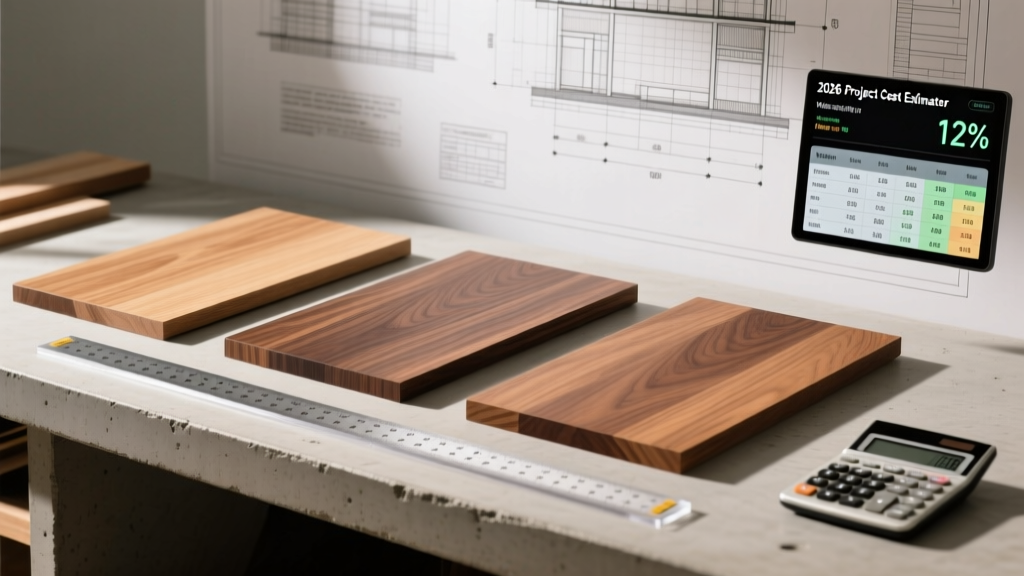
The True Cost of Wood Veneer: Beyond the Square Footage
Estimating the cost of a wood veneer project requires more than dividing your total surface area by the dimensions of a standard sheet. Unlike paint or laminate, wood veneer is a natural material subject to grain variations, clipping losses, and strict sequence-matching requirements. A miscalculation in your wood veneer estimator doesn't just result in a shortage; it forces you to introduce mismatched grain patterns from a different log flitch, ruining the architectural continuity of cabinetry or wall paneling.
This guide provides a precise framework for calculating wood veneer sheet quantities, factoring in match-type waste, substrate requirements, and 2026 market pricing for both raw and backed veneers.
Quick Yield Formula
Total Veneer Area Needed = Net Surface Area × (1 + Waste & Matching Factor) + Edge Banding Overlap
Note: Always calculate based on the specific flitch size available from your supplier, not just theoretical 4x8 sheet dimensions.
Step-by-Step Wood Veneer Quantity Calculator
To build an accurate material list, follow this three-step calculation process. This methodology aligns with the tolerances established by the Architectural Woodwork Institute (AWI) for premium and custom grade millwork.
Step 1: Calculate Net Square Footage and Linear Edging
Measure every face of your cabinetry, doors, or panels. Do not deduct for small cutouts (like hinge bores or outlet holes) as the material removed cannot be reused for other faces. Next, calculate the linear feet of all exposed edges that require edge banding.
- Face Area: Sum of all width × height dimensions for veneered surfaces.
- Edge Banding: Sum of all perimeter lengths. Add 12% to this linear total to account for trimming and snipe at the ends of rolls.
Step 2: Apply the Waste and Matching Factor
The way you arrange the veneer leaves (matching) dictates how much material is lost to clipping. If you are building a large run of cabinets, you must book-match or slip-match consecutive leaves. This requires clipping the irregular edges of the natural leaf, which generates significant waste.
| Match Type | Visual Description | Waste Factor | Best Application |
|---|---|---|---|
| Random Match | Leaves from different logs/bundles mixed together. | 5% - 10% | Commercial casework, hidden interiors. |
| Slip Match | Consecutive leaves joined side-by-side, repeating the grain. | 12% - 18% | Long wall panels, continuous horizontal runs. |
| Book Match | Consecutive leaves opened like a book, creating a mirror image. | 20% - 28% | Premium cabinet doors, conference tables. |
| Diamond / Parquet | Leaves cut at angles and spliced to form geometric patterns. | 35% - 50% | High-end feature walls, luxury yacht interiors. |
Step 3: Convert to Flitch and Sheet Quantities
Standard architectural veneer is often sold in 4'x8' (32 sq ft) or 4'x10' (40 sq ft) sheets. However, for sequence-matched projects, you must purchase entire flitches (bundles of consecutive leaves sliced from a single log). A typical flitch contains 16 to 32 leaves. If your net area plus waste equals 180 sq ft, and you are using a flitch of 24 leaves that are each 20 inches wide by 96 inches long (13.3 sq ft per leaf, 319 sq ft total per flitch), you must buy the entire flitch to maintain the sequence, even if it leaves you with surplus material.
2026 Wood Veneer Pricing Matrix by Species and Cut
Pricing fluctuates based on timber availability, slicing method, and grade. The Hardwood Plywood & Veneer Association (HPVA) defines grading standards, with 'AA' being premium (clear, consistent color) and 'A' allowing slight natural character marks. Below are the 2026 average market rates for raw, unbacked veneer.
| Wood Species | Cut Method | Grade | Price per Sq Ft (Raw) | Price per Sq Ft (Paper-Backed) |
|---|---|---|---|---|
| Red Oak | Plain Sliced | A | $2.80 - $3.90 | $4.50 - $5.80 |
| White Oak | Rift Sawn | AA | $7.50 - $10.50 | $10.00 - $13.50 |
| Black Walnut | Quarter Sawn | A | $9.00 - $14.00 | $12.50 - $18.00 |
| Hard Maple | Curly / Figured | AA | $12.00 - $17.50 | $16.00 - $22.00 |
Hidden Costs: Substrates, Adhesives, and Backing
The veneer itself is only one part of the material cost. Raw veneer is fragile (typically 1/42 to 1/28 inch thick) and requires a stable substrate and specialized adhesives. When building your estimate, include the following line items:
1. Substrate Selection and Telegraphing Prevention
Telegraphing occurs when the grain texture or imperfections of the substrate bleed through the thin veneer face, ruining the finish. According to species data from The Wood Database, open-grained woods like oak are more forgiving, but tight-grained woods like maple will telegraph every scratch.
- 3/4-inch MDF (Medium Density Fiberboard): The most stable, flat substrate. Ideal for large panels. Cost: $55 - $70 per 4x8 sheet. Warning: Heavy and prone to sagging on long horizontal shelves.
- 3/4-inch Veneer Core Plywood: Best for structural shelving and long spans. Cost: $85 - $115 per 4x8 sheet. Requires a cross-banding layer (a secondary layer of cheaper veneer applied perpendicular to the face) to prevent telegraphing of the core ply joints.
- Particleboard (Industrial Grade 45#): Budget option for commercial casework. Cost: $35 - $45 per 4x8 sheet. Holds screws poorly; requires specialized hardware.
2. Backed vs. Raw Veneer
Paper-backed or phenolic-backed veneer comes pre-mounted on a flexible roll (usually 2'x8' or 4'x8'). While backed veneer costs 30% to 50% more per square foot than raw veneer, it drastically reduces labor time, eliminates the need for veneer tape during splicing, and allows the use of contact cement for quick, cold-press applications. For high-volume commercial jobs, backed veneer often yields a lower total installed cost.
3. Adhesives and Press Time
- PVA (Polyvinyl Acetate) Cold Press Glue: e.g., Better Bond or Titebond. Requires a vacuum bag or mechanical cold press. Coverage: ~400 sq ft per gallon. Cost: $45 - $60 per gallon.
- Urea Formaldehyde (Hot Press): Used in industrial manufacturing. Requires a heated hydraulic press. Cost: $30 - $40 per gallon (two-part system).
- Contact Cement: Only for paper/phenolic backed veneers applied to MDF. No press required. Coverage: ~200 sq ft per gallon. Cost: $55 - $80 per gallon.
Estimator's Rule of Thumb: When estimating finishing costs for wood veneer, always budget for a 'wash coat' or sanding sealer prior to staining. Veneer is sliced so thin that aggressive sanding will burn right through the face layer into the substrate. You cannot sand veneer like solid lumber; chemical stripping and careful sealer application are mandatory for color correction.
Common Estimation Mistakes That Blow the Budget
Even experienced millwork estimators fall into specific traps when calculating wood veneer projects. Avoid these critical errors:
- Ignoring Grain Direction: Veneer has a strict 'long grain' direction. If you are covering a 5-foot tall cabinet door, you must buy a 5-foot long leaf (or splice them). You cannot rotate a 4-foot wide leaf sideways to cover a 5-foot height without creating a visible, structurally weak cross-grain seam. Always calculate based on the required grain orientation.
- Forgetting Edge Banding Overlap: Pre-glued iron-on edge banding shrinks slightly when heated and requires trimming on both the top and bottom edges. Always add 10-15% to your linear foot calculation for edge banding.
- Assuming Flitch Uniformity: Even within a single flitch, the first few leaves (closest to the bark) may have different coloration than the inner leaves (closer to the heartwood). Premium architectural projects require 'flitch culling'—discarding the outer 2-3 leaves of a bundle to ensure color consistency, which adds a hidden 10% waste factor.
Frequently Asked Questions
How much does it cost to veneer a standard kitchen?
A standard 10x10 kitchen with 30 linear feet of base and wall cabinets requires approximately 120 to 150 square feet of veneered surface area. Using mid-grade White Oak rift-sawn veneer (including MDF substrates, PVA glue, and pre-finished edge banding), material costs typically range from $1,800 to $2,600, excluding labor and finishing supplies.
Can I use standard construction adhesive for raw veneer?
No. Standard construction adhesives (like Liquid Nails) contain solvents and have a high viscosity that will bleed through the porous cellular structure of raw wood veneer, causing permanent dark stains and 'telegraphing' on the finished surface. You must use specialized woodworking PVA, urea formaldehyde, or hot hide glue.
What is the difference between plain sliced and quarter sawn veneer?
Plain sliced veneer is cut parallel to the log's center, producing a 'cathedral' grain pattern and maximizing yield (lower cost). Quarter sawn veneer is cut at a 90-degree angle to the growth rings, producing a tight, straight 'fleck' or 'ray' pattern. Quarter sawn is highly resistant to warping and cupping but yields less material per log, making it 40% to 60% more expensive.