Cost of Asphalt vs Concrete Driveway: 2026 Price Guide
Compare the true cost of asphalt vs concrete driveways in 2026. Explore material prices, installation, maintenance, and 30-year lifecycle expenses.
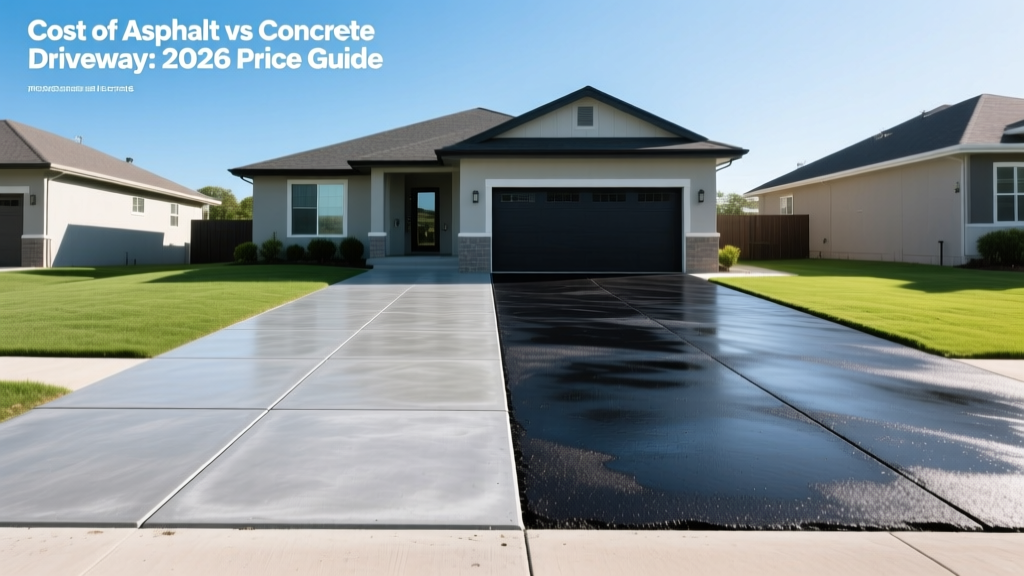
The 2026 Driveway Pricing Landscape
Choosing between asphalt and concrete for a residential driveway is fundamentally a capital expenditure (CapEx) versus operational expenditure (OpEx) decision. In 2026, material costs have shifted due to global bitumen supply chain adjustments and new carbon-capture mandates affecting Portland cement production. While asphalt remains the lower-cost option for initial installation, concrete offers a superior long-term lifecycle value in specific climates. This guide breaks down the exact costs, material specifications, and hidden expenses of both paving systems.
Quick 2026 Pricing Snapshot (Per Square Foot)
- Asphalt (Standard): $7.50 – $13.00 installed
- Concrete (Broom Finish): $11.00 – $18.00 installed
- Concrete (Stamped/Decorative): $19.00 – $32.00 installed
- Average Driveway Size: 600 sq. ft. (12' x 50')
Upfront Installation and Material Costs
The initial quote from a paving contractor only tells half the story. To understand the true cost of asphalt vs concrete driveway installations, you must examine the material composition and thickness requirements.
Asphalt Driveway Specifications
A standard residential asphalt driveway in 2026 requires a 2-inch to 3-inch surface layer of hot-mix asphalt (HMA) over a compacted aggregate base. The binder used is typically a Performance Grade (PG) 64-22, engineered to resist rutting at high temperatures and thermal cracking at low temperatures. Asphalt is a flexible pavement; it relies on the structural integrity of the base layer beneath it to distribute vehicular loads.
Concrete Driveway Specifications
Concrete is a rigid pavement. A standard residential slab requires a minimum thickness of 4 inches (5 inches for heavy trucks or RVs) poured with 4,000 PSI compressive strength concrete. According to standards referenced by the Portland Cement Association, driveways in freeze-thaw climates must include 5% to 7% air entrainment to prevent surface spalling. Reinforcement typically consists of 6x6 W1.4xW1.4 welded wire mesh or synthetic macro-fibers to control shrinkage cracking.
Hidden Costs: Site Prep and Base Layers
Both materials will fail prematurely if the subgrade is inadequate. The cost of site preparation is virtually identical for both materials, ranging from $1.50 to $3.00 per square foot for excavation and grading.
The base layer requires 4 to 8 inches of compacted, angular crushed stone (meeting ASTM D448 specifications, typically #57 or #304 stone). Round stones like pea gravel are unacceptable as they do not interlock under load. For a 600 sq. ft. driveway, expect to pay $900 to $1,800 just for base material and compaction. If your soil has high clay content, contractors may need to install a geotextile fabric separator ($0.25 – $0.45 per sq. ft.) to prevent the clay from migrating into the gravel base and compromising drainage.
Long-Term Financials: 30-Year Lifecycle Cost Matrix
The most critical flaw in the cost of asphalt vs concrete driveway debate is looking only at day-one pricing. Asphalt requires cyclical maintenance, while concrete requires minimal but highly specific interventions. Below is a 30-year lifecycle cost projection for a standard 600 sq. ft. driveway, assuming a 5% annual inflation rate on maintenance materials.
| Cost Category | Asphalt (30 Years) | Concrete (30 Years) |
|---|---|---|
| Initial Installation | $6,000 | $9,000 |
| Routine Sealing / Coating | $1,800 (Every 3-4 yrs) | $600 (Penetrating sealer) |
| Crack / Joint Maintenance | $450 | $300 |
| Major Repair / Resurfacing | $2,500 (Overlay at yr 20) | $800 (Mudjacking/Slabjacking) |
| Estimated 30-Year Total | $10,750 | $10,700 |
As noted by the American Concrete Pavement Association, rigid pavements frequently outlast flexible pavements by 15 to 20 years before requiring total reconstruction, effectively neutralizing the initial installation premium over a multi-decade horizon.
Climate and Environmental Cost Variables
Your geographic location drastically alters the cost-effectiveness of each material. Environmental stressors dictate the failure modes of both asphalt and concrete.
The Heat and UV Penalty
Asphalt is a petroleum-based binder. In regions where summer surface temperatures regularly exceed 130°F (common in the Southwest US), standard PG 64-22 binders can soften, leading to rutting and tracking into garages. Mitigating this requires polymer-modified binders, which add $1.00 to $2.00 per square foot to the installation cost. Furthermore, UV radiation oxidizes the asphalt surface, causing it to turn gray and become brittle. This necessitates strict adherence to a 3-year coal tar or asphalt emulsion sealcoating schedule.
The Freeze-Thaw and De-icing Penalty
Concrete is highly susceptible to scaling and spalling if exposed to chloride-based de-icing salts (like calcium chloride or rock salt) during its first winter. Homeowners must use calcium magnesium acetate (CMA) ice melters, which cost roughly three times more than traditional rock salt. If a concrete slab settles due to base washout, the repair requires slab jacking (pumping a polyurethane foam or cementitious slurry beneath the slab), costing $500 to $1,200 per affected section. Asphalt, being flexible, tolerates minor base settling without catastrophic cracking, though it will require localized patching.
Decision Framework: Which Should You Choose?
Use this framework to make your final material selection based on your specific property constraints and financial preferences.
- Choose Asphalt If: You have a strict upfront budget cap, your driveway features complex curves or steep gradients (asphalt provides superior skid resistance and is easier to plow), or you live in a heavily wooded area where root heave is a constant threat (asphalt is easier and cheaper to patch repeatedly).
- Choose Concrete If: You plan to stay in the home for 15+ years, you park heavy vehicles (RVs, boat trailers) that will cause asphalt to rut, you live in a high-heat climate where asphalt tracking is a nuisance, or you want to maximize property resale value in an upscale neighborhood where concrete is the baseline expectation.
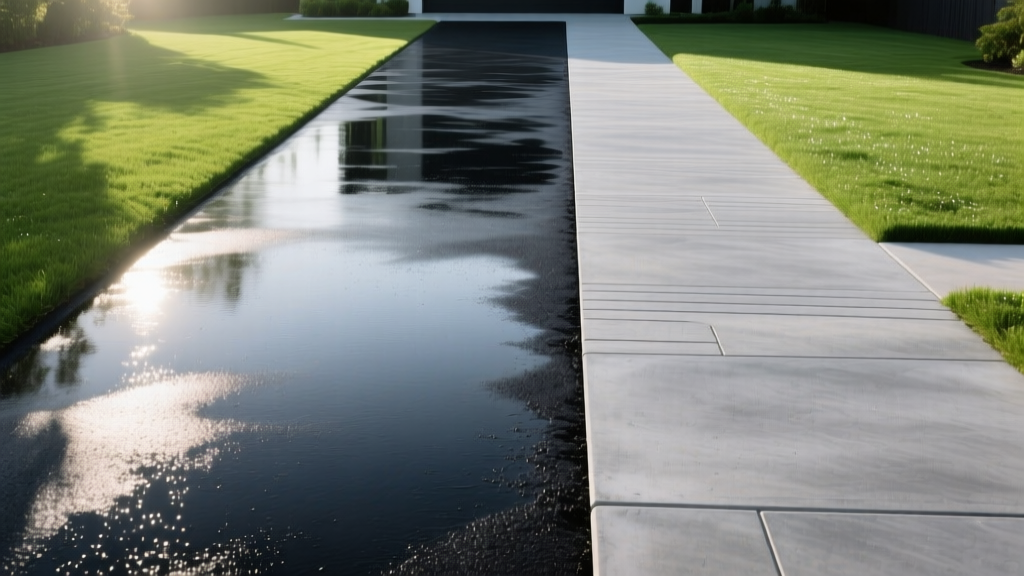
Frequently Asked Questions
Can I install a new concrete driveway over an existing asphalt driveway?
While technically possible, it is highly discouraged. Asphalt is a flexible, petroleum-based material that expands and contracts significantly with temperature changes. Pouring a rigid concrete slab over it will result in reflective cracking within the first year as the asphalt base shifts. The asphalt must be milled and removed down to the aggregate base before pouring concrete.
How long before I can drive on a newly paved driveway?
For asphalt, you must wait a minimum of 3 to 5 days for the volatile compounds to evaporate and the mat to harden, though waiting 14 days is optimal in hot weather. For concrete, the slab reaches sufficient compressive strength for passenger vehicles at 7 days, but it does not reach its full design strength until 28 days of continuous curing. Keep heavy point-loads (like trailer jacks) off new concrete for at least 30 days.
Does the color of the material affect long-term costs?
Yes. Standard black asphalt absorbs up to 90% of solar radiation, contributing to the urban heat island effect and accelerating binder oxidation. Light-colored concrete reflects sunlight, reducing local ambient temperatures. The National Asphalt Pavement Association notes that while lighter colored asphalt coatings exist, they require more frequent reapplication, adding to the long-term maintenance budget.
Written by
Priya KapoorPriya Kapoor is a real estate market analyst and construction economics researcher with expertise in housing affordability, development feasibility, and infrastructure investment. She holds a Master of Regional Planning from Cornell University and previously worked as a senior analyst at CBRE's Investment Properties group, where she modeled returns for $4B in mixed-use development pipelines. Priya now runs an independent research practice advising developers, municipalities, and REITs on construction cost forecasting and market timing. She publishes the quarterly "BuildMat Market Pulse" report tracking material price indices across 12 commodity categories. Based in Austin, TX, Priya serves on the board of Habitat for Humanity Austin and is a marathon runner.
More from Priya Kapoor
View all
Construction Cost
Cost to Build a 1600 Sq Ft Home in 2026: Full Breakdown
Accurate 2026 cost to build a 1600 sq ft home—material, labor, and regional pricing breakdowns included. Plan your budget with real-time estimates.
Aug 11, 2026

Wood & Lumber
Name the Types of Wood for Pressure Treatment and Preservation
Learn how to name the types of wood best suited for pressure treatment. Compare species treatability, chemical retention levels, and 2026 preservation costs.
Aug 4, 2026

Stone & Masonry
Stone Veneer Suppliers Lindenhurst: 2026 Cost Analysis
Analyze 2026 stone veneer costs in Lindenhurst, NY. Compare local supplier pricing, delivery fees, and Suffolk County installation labor rates.
Aug 4, 2026