Asphalt vs Concrete Road Repair: Troubleshooting Pavement Failures
Compare asphalt vs concrete road repair methods. Diagnose alligator cracking, spalling, and rutting with 2026 lifecycle cost matrices.

Diagnosing Pavement Distress: The Structural vs. Surface Divide
When evaluating the deteriorating condition of municipal, commercial, or private infrastructure, the debate of asphalt vs concrete road maintenance hinges entirely on accurate distress identification. Pavement engineers utilize the Pavement Condition Index (PCI), standardized under ASTM D6433, to quantify degradation. However, a numerical score is insufficient for prescribing repairs. Troubleshooting requires distinguishing between surface-level functional failures and deep structural yield.
Asphalt Road Failure Modes & Targeted Repair Protocols
Hot Mix Asphalt (HMA) is a viscoelastic material. Its primary advantage—flexibility—is also the source of its most common failure modes. Troubleshooting asphalt requires addressing temperature susceptibility and base layer integrity.
Alligator (Fatigue) Cracking
Characterized by interconnected, crocodile-skin-like fissures, alligator cracking is a definitive sign of subgrade or base course failure, not merely surface aging. The repeated tensile strain at the bottom of the asphalt layer exceeds the material's fatigue limit.
- Root Cause: Moisture infiltration weakening the aggregate base, or an under-designed structural thickness for current traffic loads (ESALs).
- Incorrect Fix: Routing and sealing. This traps water and accelerates base failure.
- Correct Protocol: Full-Depth Reclamation (FDR). Mill out the distressed HMA and 4 to 6 inches of the base course. Pulverize the base, stabilize it with 2% to 4% Portland cement or foamed asphalt, compact with a vibratory roller, and overlay with a minimum 3-inch polymer-modified HMA lift.
Rutting and Shoving
Rutting manifests as longitudinal depressions in the wheel paths. If the rut depth exceeds 0.5 inches, it poses a severe hydroplaning hazard.
- Root Cause: Shear failure within the HMA layer (mix instability) or consolidation of a weak subgrade.
- Correct Protocol: For mix-instability rutting, perform a mill-and-fill operation. Remove the deformed surface course and replace it with a stone matrix asphalt (SMA) or a mix utilizing a highly modified Performance Grade (PG) binder, such as PG 76-22, to resist high-temperature shear.
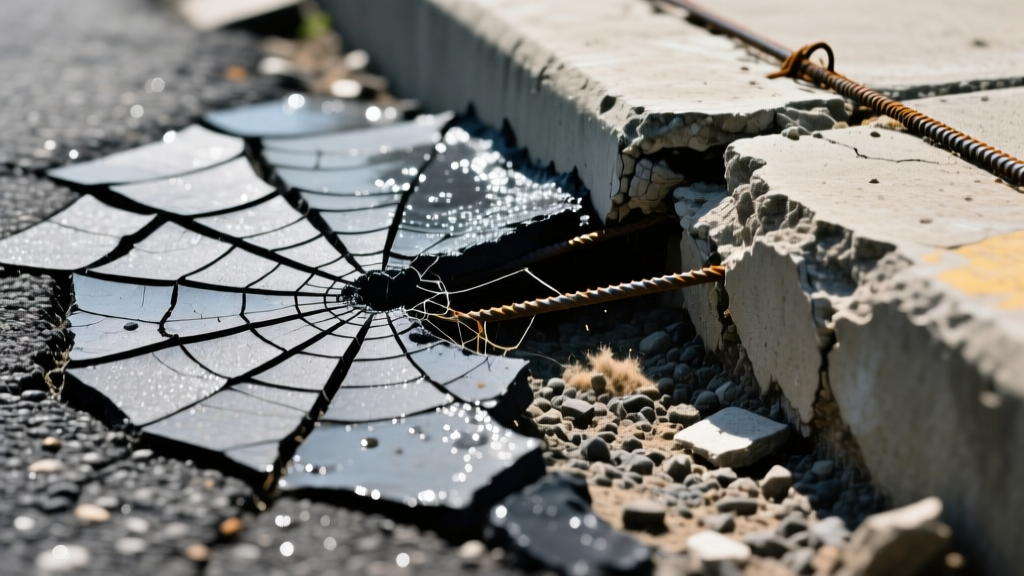
Concrete Road Failure Modes & Targeted Repair Protocols
Jointed Plain Concrete Pavement (JPCP) and Continuously Reinforced Concrete Pavement (CRCP) fail differently than flexible pavements. Concrete troubleshooting focuses on load transfer efficiency, joint integrity, and environmental degradation.
Joint Spalling and Faulting
Spalling occurs when concrete fragments break away near the joint, while faulting is the vertical displacement between adjacent slabs. Both indicate a failure in load transfer across the joint.
- Root Cause: Incompressible materials (rocks, debris) entering the joint sealant, causing compressive stresses during thermal expansion, or corroded/missing dowel bars.
- Correct Protocol (Spalling): Sawcut a clean boundary at least 2 inches beyond the spall. Chip out the damaged concrete to a minimum depth of 2 inches. Apply an epoxy bonding agent and patch with a rapid-setting, high-early-strength concrete (e.g., CTS Cement RapidSet) to achieve 3,000 psi in under two hours for fast-track reopening.
- Correct Protocol (Faulting): If faulting exceeds 0.25 inches, perform a Dowel Bar Retrofit (DBR). This involves sawing slots across the joint, inserting epoxy-coated steel dowel bars, and backfilling with a high-strength, non-shrink grout to restore load transfer.
D-Cracking and Freeze-Thaw Damage
D-cracking appears as a series of fine cracks parallel to joints and edges, caused by the freezing and thawing of water trapped in porous coarse aggregates.
- Root Cause: Use of non-durable, highly absorptive aggregates (like certain limestones or cherts) in the original mix design.
- Correct Protocol: There is no surface-level cure for D-cracking. The distress will propagate through any overlay. The only viable long-term repair is full-panel replacement using concrete mixed with durable, low-absorption aggregates and an air-void system strictly maintained between 5% and 8% per American Concrete Pavement Association (ACPA) guidelines.
The Overlay Dilemma: Rehabilitation Strategies
When routine maintenance fails, engineers face the ultimate asphalt vs concrete road decision: overlaying the existing distressed pavement with the opposite material. This requires specialized preparation to prevent reflective cracking.
Whitetopping: Concrete Over Asphalt
Thin Whitetopping (TWT) involves placing a 4- to 6-inch layer of fiber-reinforced concrete directly over an existing, structurally sound asphalt base. The asphalt acts as a stabilized subbase. This is highly effective for urban intersections suffering from severe HMA rutting due to heavy braking and acceleration forces. The key to success is ensuring the existing asphalt is at least 2 inches thick and firmly bonded to the base; otherwise, the composite action fails, leading to rapid concrete cracking.
Rubblization: Asphalt Over Concrete
Overlaying deteriorated concrete with asphalt usually results in reflective cracks mirroring the concrete joints within 12 to 18 months. To prevent this, contractors use rubblization. A multi-head breaker (MHB) or resonant pavement breaker fractures the old concrete slab into pieces no larger than 6 inches. This destroys the slab's structural continuity, eliminating the mechanism that causes reflective cracking. The rubblized layer is then compacted and overlaid with 6 to 8 inches of HMA.
2026 Lifecycle Cost & Repair Frequency Matrix
Understanding the financial implications of the asphalt vs concrete road debate requires analyzing long-term preservation costs, not just initial construction. The table below outlines 2026 industry averages for arterial road maintenance.
| Material Type | Expected Design Life | Primary Maintenance Trigger | Avg. Repair Cost (per Sq. Yd.) |
|---|---|---|---|
| HMA (Asphalt) | 15 - 20 Years | Oxidation, Rutting, Base Failure | $14 - $22 (Mill & Overlay) |
| JPCP (Concrete) | 30 - 40 Years | Joint Faulting, Spalling, ASR | $160 - $240 (Full-Depth Panel) |
| CRCP (Continuous Concrete) | 40+ Years | Punchouts, Steel Corrosion | $250 - $350 (Punchout Repair) |
While concrete repairs are significantly more expensive on a per-square-yard basis, the frequency of these interventions is drastically lower. According to Federal Highway Administration (FHWA) pavement preservation data, a well-designed concrete road may require zero structural rehabilitation for the first 25 years, whereas an asphalt road will typically require a mill-and-overlay at year 12 and year 24 to maintain an acceptable International Roughness Index (IRI).
Advanced Diagnostic Tools for Pavement Engineers
Modern troubleshooting relies on non-destructive testing (NDT) to prescribe exact repair boundaries and depths.
- Ground Penetrating Radar (GPR): Operated at 1.0 to 2.0 GHz frequencies, GPR maps the exact thickness of the asphalt lifts and identifies moisture-saturated zones in the aggregate base that are invisible to the naked eye.
- Thermal Profiling: Infrared thermal cameras mounted on survey vehicles detect temperature differentials in newly laid asphalt mats, identifying areas of segregation or poor compaction before the road even opens to traffic.
- Automated Road Condition Vehicles (ARCV): Equipped with high-definition lasers and AI-driven image recognition, these vehicles map every crack, pothole, and spall, automatically calculating the PCI and generating GIS-mapped repair work orders.
Written by
James ThorntonJames Thornton is a construction industry veteran with 25 years of hands-on experience in wood framing, lumber grading, and residential building codes. He started as a framing carpenter in rural Oregon, earned his ICC Residential Building Inspector certification, and eventually became a senior plan reviewer for the City of Portland Bureau of Development Services. James holds a B.S. in Wood Science & Technology from Oregon State University and is a certified lumber grader through the West Coast Lumber Inspection Bureau (WCLIB). He has inspected over 3,000 residential construction sites and authored the city's internal guide on advanced framing techniques (2x6 at 24" O.C.). James lives in Bend, OR, where he builds custom timber-frame cabins and competes in lumberjack sports.
More from James Thornton
View all
Insulation
Best Home Insulation Materials: Complete 2026 Guide
Compare top home insulation materials for 2026. Find R-values, installed costs per square foot, and best uses for fiberglass, spray foam, and mineral wool.
Aug 4, 2026

Sustainable Building
Certify Your Green Building Material for LEED and WELL
Step-by-step guide to certifying a green building material for LEED v5 and WELL v2. Master EPDs, HPDs, and VOC limits for 2026 project specifications.
Aug 4, 2026

Stone & Masonry
Veneer Stacked Stone Panels: Interior Design & Style Showcase
Discover how veneer stacked stone panels transform interiors. Explore modern design profiles, material pairings, and technical installation specs.
Aug 4, 2026