Clay vs Concrete Roof Tiles: Troubleshooting & Repair Guide
Expert guide to troubleshooting and repairing clay vs concrete roof tiles. Learn to identify failures, fix leaks, and compare 2026 repair costs.
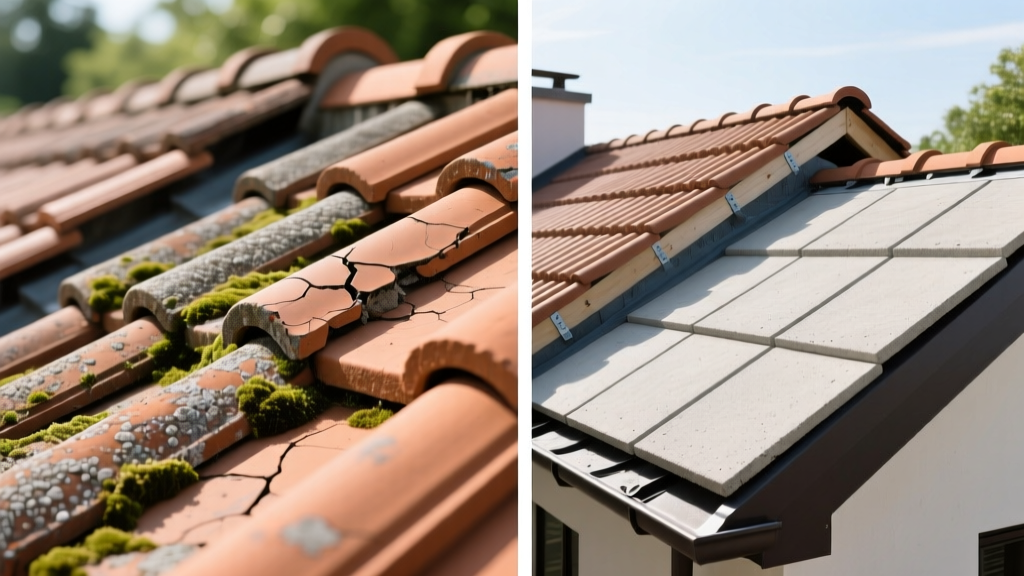
Diagnostic Matrix: Identifying Your Tile Substrate
Mistaking concrete for clay (or vice versa) is the most common cause of catastrophic repair failures in tile roofing. Concrete tiles are highly porous and rely on surface coatings, while clay tiles are kiln-fired and rely on their vitrified body for water resistance. Applying a concrete sealer to a clay roof will trap moisture and accelerate spalling. Before initiating any repairs, verify your substrate using the diagnostic matrix below.
| Diagnostic Feature | Concrete Roof Tile | Clay Roof Tile |
|---|---|---|
| Weight (per square) | 900 – 1,100 lbs | 600 – 900 lbs |
| Acoustic Test (Tap) | Dull, heavy thud | Sharp, ceramic clink |
| Cross-Section Color | Uniform gray/brown aggregate core | Solid terracotta/red hue throughout |
| Water Absorption | Higher (requires chemical sealing) | Lower (if properly vitrified) |
| Primary Failure Mode | Efflorescence, UV chalking, thermal cracking | Shaling, freeze-thaw delamination, impact fracture |
Concrete Tile Failures: Troubleshooting & Chemical Repairs
Concrete tiles are manufactured from Portland cement, sand, and water, extruded under high pressure. Their cementitious matrix makes them susceptible to alkaline reactions and UV degradation of their factory-applied acrylic slurry coats.
Efflorescence and Alkaline Burn
Efflorescence appears as a white, powdery residue on the tile surface. It occurs when water soluble calcium hydroxide migrates to the surface and reacts with atmospheric carbon dioxide. While primarily cosmetic, heavy efflorescence can degrade adjacent metal flashings through alkaline corrosion.
- The Fix: Dry-brush the surface to remove loose salts. For stubborn deposits, apply a diluted 5% muriatic acid solution (1 part 31.45% acid to 5 parts water). Agitate with a stiff nylon brush, then rinse thoroughly.
- Prevention: Once the tile is completely dry, apply a breathable, penetrating silane-siloxane sealer (such as Foundation Armor SX5000). This lines the concrete pores, preventing water ingress without creating a surface film that could trap internal moisture.
UV Chalking and Slurry Coat Degradation
Unlike clay, concrete tiles are typically coated with an acrylic slurry and pigment at the factory. After 15 to 20 years of UV exposure, this coating breaks down, resulting in a chalky residue that washes into gutters and exposes the porous concrete core.
- The Fix: Pressure wash the roof at a maximum of 1,200 PSI. Exceeding this pressure will erode the cementitious matrix and expose the sand aggregate. Allow 48 hours of drying time.
- Coating Selection: Apply a 100% acrylic elastomeric roof coating specifically rated for cementitious substrates, such as Sherwin-Williams Sher-Crylic. Never use silicone or asphalt-based coatings on concrete tile; they trap vapor drive and cause subsurface spalling.
Clay Tile Failures: Physical Damage & Moisture Intrusion
Clay tiles are kiln-fired at temperatures exceeding 2,000°F, creating a hard, vitrified surface. They do not require sealers and should never be painted. Their primary vulnerabilities are mechanical impact and freeze-thaw cycling in under-fired or low-grade profiles.
Freeze-Thaw Shaling (Delamination)
Shaling occurs when the top laminar layer of a clay tile flakes or peels away. This happens when micro-fissures in the clay body absorb moisture, which then expands upon freezing. According to the Tile Roofing Institute Alliance (TRI), shaling is a terminal failure mode for the affected tile.
- The Fix: Do not attempt to seal or patch delaminating clay. Coatings will trap moisture inside the clay body, accelerating the freeze-thaw destruction. The only viable repair is complete tile replacement.
- Replacement Protocol: Source replacement tiles from the original manufacturer to ensure the extrusion profile (e.g., Spanish S-profile, Mission barrel, or Flat interlocking) matches exactly. Mismatched profiles will break the interlocking weather seal and cause lateral water migration.
Biological Root Intrusion (Lichen & Moss)
While clay is highly water-resistant, its porous unglazed underside and the interlocking channels provide ideal environments for lichen and moss. The rhizines (root-like structures) of lichen can penetrate the clay matrix, causing micro-fractures.
- The Fix: Avoid liquid chlorine bleach, which degrades the clay body and harms surrounding landscaping. Instead, apply a dry zinc sulfate powder directly to the moss colonies during a dry spell. The next rain will activate the zinc, killing the root system without chemical erosion.
- Long-Term Prevention: Install 99.9% pure zinc strips (minimum 2.5 inches wide) directly beneath the ridge cap tiles. As rain washes over the zinc, it deposits a microscopic metallic barrier across the roof plane that inhibits biological growth.

Isolating Underlayment and Flashing Leaks
When water infiltrates a tile roof, the tiles are rarely the primary culprit. According to the National Roofing Contractors Association (NRCA), tile is considered a "water-shedding" layer, while the underlying membrane is the true "waterproofing" layer. If you have an interior leak, follow this isolation protocol:
- Water Test from the Eave: Use a garden hose to simulate rain, starting at the eave and working upward. Stop and move up every 15 minutes. This isolates the exact horizontal course where the underlayment has failed.
- Safe Tile Removal: Use a specialized tile lifter (such as the Malco T-Lifter) to gently elevate the overlapping tiles. Never use a flat pry bar, which will chip the interlocking nibs.
- Inspect the Underlayment: Older roofs may use 90-lb mineral-surfaced roll roofing, which becomes brittle and cracks after 20 years. Modern 2026 standards dictate the use of high-tensile synthetic underlayments (e.g., GAF TigerPaw or Polyglass TU Plus). If the underlayment is torn or degraded, cut out a 12x12 inch section and patch it using compatible synthetic membrane and butyl flashing tape.
- Check Headwall Flashing: Where the roof meets a vertical wall, step-flashing must be integrated. If galvanized steel flashing has rusted through, replace it with 16oz copper or 24-gauge galvanized steel, ensuring a minimum 2-inch headlap.
2026 Repair Cost & Material Data
Budgeting for tile roof repairs requires an understanding of material scarcity and specialized labor rates. Below is the current national average pricing for targeted repairs.
| Repair Service | Material / Scope | Estimated 2026 Cost |
|---|---|---|
| Single Concrete Tile Replacement | Standard profile, includes labor & matching | $45 – $75 per tile |
| Single Clay Tile Replacement | Custom kiln match / salvage sourcing | $85 – $150 per tile |
| Underlayment Spot Repair | Synthetic patch, butyl tape, 100 sq ft area | $400 – $650 per square |
| Concrete Cleaning & Sealing | Pressure wash + Silane-Siloxane application | $1.75 – $2.50 per sq ft |
| Zinc Strip Installation | 99.9% pure zinc, installed at ridge | $12 – $18 per linear foot |
Expert FAQ: Tile Roof Maintenance
Q: Can I use a standard asphalt roofing cement to patch a cracked concrete tile?
A: No. Asphalt cements contain solvents that break down the cementitious matrix of concrete tiles and will stain the surface. Furthermore, asphalt lacks the UV stability required for exposed tile repairs. Use a high-modulus, polyurethane-based tile adhesive (such as Sikaflex-1a) for minor, non-structural hairline cracks. If the crack exceeds 1/8 inch, replace the tile.
Q: My roof was built in 1995. Do I need to worry about the structural load bearing capacity if I replace broken concrete tiles with clay?
A: Switching from concrete (approx. 1,000 lbs/sq) to clay (approx. 700 lbs/sq) reduces the dead load on your roof trusses, which is structurally safe. However, switching from clay to concrete requires a structural engineering evaluation to ensure your trusses can handle the additional 300+ lbs per square, as mandated by the International Residential Code (IRC).
Written by
Priya KapoorPriya Kapoor is a real estate market analyst and construction economics researcher with expertise in housing affordability, development feasibility, and infrastructure investment. She holds a Master of Regional Planning from Cornell University and previously worked as a senior analyst at CBRE's Investment Properties group, where she modeled returns for $4B in mixed-use development pipelines. Priya now runs an independent research practice advising developers, municipalities, and REITs on construction cost forecasting and market timing. She publishes the quarterly "BuildMat Market Pulse" report tracking material price indices across 12 commodity categories. Based in Austin, TX, Priya serves on the board of Habitat for Humanity Austin and is a marathon runner.
More from Priya Kapoor
View all
Construction Cost
Cost to Build a 1600 Sq Ft Home in 2026: Full Breakdown
Accurate 2026 cost to build a 1600 sq ft home—material, labor, and regional pricing breakdowns included. Plan your budget with real-time estimates.
Aug 11, 2026

Wood & Lumber
Name the Types of Wood for Pressure Treatment and Preservation
Learn how to name the types of wood best suited for pressure treatment. Compare species treatability, chemical retention levels, and 2026 preservation costs.
Aug 4, 2026

Stone & Masonry
Stone Veneer Suppliers Lindenhurst: 2026 Cost Analysis
Analyze 2026 stone veneer costs in Lindenhurst, NY. Compare local supplier pricing, delivery fees, and Suffolk County installation labor rates.
Aug 4, 2026