Gunite Pool vs Concrete: Cost, Durability, and Build Compared
Compare gunite pool vs concrete shells. Analyze PSI strength, rebound risks, 2026 build costs, and site constraints to choose the right inground pool.

The Technical Divide: Pneumatic Dry-Mix vs. Cast-in-Place
When evaluating a gunite pool vs concrete (specifically cast-in-place poured concrete) for an inground swimming pool shell, the distinction lies entirely in the placement method and mix design. While both utilize Portland cement, sand, and aggregate, their structural behaviors, labor requirements, and long-term durability profiles diverge significantly once applied.
Head-to-Head Engineering Matrix
The following matrix breaks down the core engineering and logistical differences between dry-mix gunite and traditional poured concrete pool shells.
| Feature | Gunite (Dry-Mix Projection) | Poured Concrete (Cast-in-Place) |
|---|---|---|
| Compressive Strength | 7,500 – 9,000+ PSI | 3,000 – 4,500 PSI |
| Water-Cement Ratio | 0.35 – 0.45 (Low) | 0.45 – 0.60 (Moderate/High) |
| Max Aggregate Size | 3/8 inch | 3/4 inch to 1 inch |
| Formwork Required | No (Uses rebar cage & templates) | Yes (Extensive custom formwork) |
| Material Rebound | 5% – 15% (Must be discarded) | 0% (Contained by forms) |
| Design Flexibility | High (Freeform, custom depths) | Low (Restricted to form shapes) |
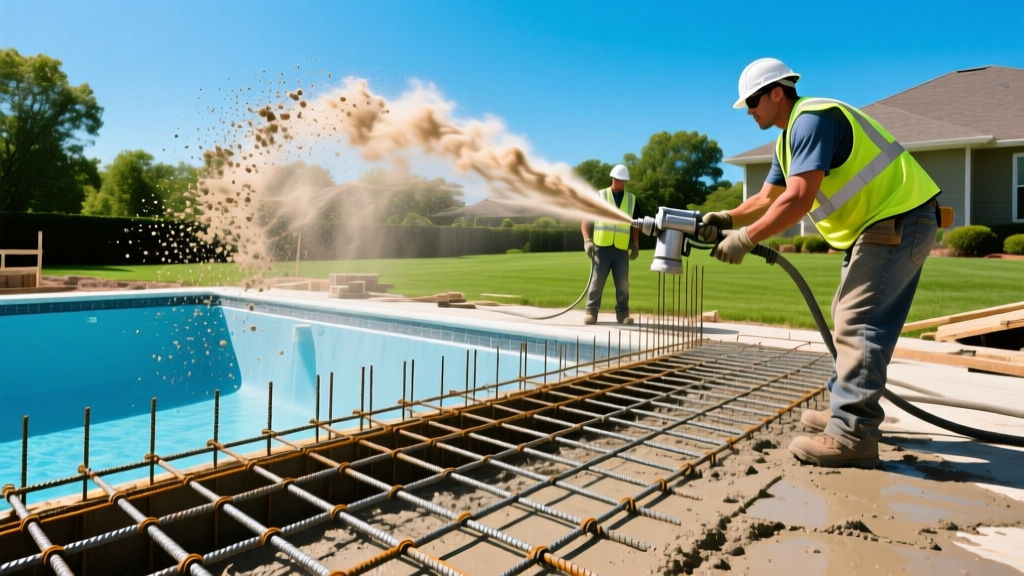
Structural Integrity: The PSI Advantage and the Rebound Trap
Compressive Strength and Water-Cement Ratios
Gunite achieves vastly superior compressive strength—routinely exceeding 8,000 PSI at 28 days—compared to the 3,500 PSI typical of poured pool concrete. This disparity is driven by the water-cement (w/c) ratio. Poured concrete requires a higher w/c ratio (often 0.50 or higher) to maintain a 4-to-6-inch slump, ensuring it flows into formwork and around rebar. Higher water content leaves microscopic capillary voids as it evaporates, weakening the final matrix.
Conversely, gunite is projected at high velocities (typically 35 to 50 PSI nozzle pressure) with a very low w/c ratio of 0.35 to 0.45. The impact force compacts the mixture densely against the earth and rebar, resulting in a highly impermeable, high-strength shell. According to guidelines from the American Shotcrete Association, properly applied dry-mix gunite yields a denser matrix that naturally resists water migration better than standard cast-in-place alternatives.
The Hidden Danger of Troweling Rebound
The most critical vulnerability in gunite construction is "rebound." When the dry mix hits the steel rebar cage and the excavated soil, 5% to 15% of the material bounces off. This rebounded material is heavily depleted of cement and enriched with coarse sand, rendering it structurally worthless.
2026 Cost Breakdown: Shell Construction vs. Total Project
When comparing a gunite pool vs concrete poured shells, the cost dynamics are heavily skewed by labor and formwork. While the raw materials for gunite are slightly more expensive per cubic yard due to the specialized mix and pumping equipment, the labor savings are massive.
- Gunite Shell Cost: $35,000 to $55,000 for the structural shell (excavation, rebar, plumbing rough-in, and gunite application). Total turnkey pool projects typically range from $85,000 to $150,000+ depending on finishes and decking.
- Poured Concrete Shell Cost: $50,000 to $80,000+ for the shell. The requirement to build, brace, and strip complex custom formwork for freeform or even standard rectangular pools adds $15,000 to $25,000 in specialized carpentry labor alone.
- Rebar and Steel: Both methods require a robust #3 or #4 rebar grid tied on 8-inch to 12-inch centers. However, gunite requires a strict minimum of 2 inches of concrete cover over the steel to prevent "rust jacking" (where corroding rebar expands and spalls the concrete). Poured concrete forms naturally enforce this spacing via chairs and ties.
Site Access, Formwork, and Topography Constraints
Topography and site access frequently dictate the choice between these two methods. Poured concrete requires heavy formwork staging. If a property has narrow side yards, steep gradients, or limited access for concrete mixer trucks and boom pumps, cast-in-place construction becomes logistically nightmarish and prohibitively expensive.
Gunite equipment, consisting of a specialized volumetric mixer truck and a pneumatic hose, can reach up to 200 feet from the street. The hose can be snaked through narrow corridors, over existing structures, and down steep embankments. Furthermore, gunite excels in expansive soil conditions or high water tables where the excavation can be slightly over-dug and the gunite applied directly against the earth (with a gravel drainage layer), eliminating the need to build back-side formwork.
Curing Protocols and Long-Term Durability
Both structures require a rigorous 28-day moist curing process to achieve their design strength, as outlined by the American Concrete Institute. However, the execution differs.
Because gunite has a low water content and a high surface-area-to-volume ratio, it is highly susceptible to plastic shrinkage cracking in the first 48 hours. Contractors must mist the shell with water 3 to 4 times daily for the first week, or apply a liquid membrane-forming curing compound. Poured concrete, retained within forms, naturally retains its moisture longer, though the exposed top bond beam still requires wet curing. Failure to properly cure a gunite shell will result in a network of micro-fractures that compromise the shell's watertight integrity before the plaster or pebble finish is even applied.
Expert Verdict: When to Choose Which
Selection Flowchart for Pool Builders and Homeowners
Choose Gunite (Dry-Mix) If:
- You require a custom freeform design, vanishing edge, or complex integrated spa.
- The site has tight access restrictions, steep slopes, or limited staging area for formwork.
- You prioritize maximum compressive strength (8,000+ PSI) and a lower water-cement ratio for superior impermeability.
- You want to minimize the overall timeline, as gunite eliminates the 3-to-5-day formwork construction and stripping phases.
Choose Poured Concrete (Cast-in-Place) If:
- You are building a highly repetitive, standardized geometric shape (e.g., a commercial hotel pool or a standardized community development) where modular steel forms can be reused dozens of times to offset initial costs.
- Local municipal codes or specific commercial engineering specs explicitly mandate cast-in-place vibration-consolidated concrete for seismic or specialized load-bearing reasons.
- You are integrating the pool shell directly into a larger poured-concrete retaining wall or basement foundation where continuous monolithic pours are structurally required.
Ultimately, for 95% of custom residential applications, the gunite pool vs concrete debate is settled in favor of gunite. Its unparalleled design flexibility, superior high-velocity compaction, and elimination of costly formwork make it the definitive standard for modern inground pool construction, provided the contractor strictly adheres to rebound removal and 28-day curing protocols.
Written by
Sarah WhitfieldSarah Whitfield is a chartered quantity surveyor (MRICS) and construction cost analyst with 15 years of experience in material pricing, procurement strategy, and project budgeting. She earned her degree in Construction Management from the University of Reading (UK) and has worked on projects ranging from $2M custom homes to $180M mixed-use developments across North America and Europe. Sarah currently leads cost estimating for BuildMat Insight, maintaining a proprietary database of 4,000+ material price points updated quarterly. She is a frequent contributor to RSMeans cost data panels and has presented at the International Cost Engineering Council (ICEC) congress. Based in Denver, CO, Sarah is an avid trail runner and volunteer mentor for Women in Construction.
More from Sarah Whitfield
View all
Wood & Lumber
What Are the Different Types of Wood? A Builder's Guide
Compare structural softwoods, finish hardwoods, and engineered lumber. Analyze Janka ratings, MOE values, and 2026 pricing for construction.
Aug 4, 2026

Walls & Panels
Steel Framing vs Wood Framing: Corrosion and Moisture Defense
Compare steel framing vs wood framing for moisture resistance. Learn about galvanized coatings, condensation risks, and corrosion protection strategies.
Jul 21, 2026

Stone & Masonry
How to Cut Stone Veneer: Wet Saw vs Grinder Comparison
Compare the best tools for cutting stone veneer. We review wet saws, angle grinders, and chop saws to help you achieve clean, chip-free cuts.
Jul 21, 2026