Concrete vs Asphalt Cost for Driveways: 2026 Breakdown
Compare the 2026 concrete vs asphalt cost for driveways. Explore upfront pricing, 30-year lifecycle expenses, base prep, and climate ROI.

The Upfront Cost Matrix: 2026 Installation Pricing
When evaluating the concrete vs asphalt cost for driveways, homeowners often fixate on the initial installation quote. However, the sticker price is heavily influenced by material science, regional labor rates, and site-specific preparation. In 2026, supply chain stabilization has normalized cement and bitumen prices, but specialized labor for finishing and grading remains a premium expense.
Below is the current national average cost breakdown for a standard 600-square-foot residential driveway (12x50 feet), excluding extreme regional variances.
| Cost Component | Asphalt (Hot Mix) | Concrete (4,000 PSI) |
|---|---|---|
| Material Cost (per sq. ft.) | $2.50 - $4.00 | $4.50 - $7.50 |
| Labor & Finishing (per sq. ft.) | $3.00 - $5.50 | $5.50 - $11.00 |
| Base Preparation (per sq. ft.) | $2.00 - $3.50 | $2.50 - $4.50 |
| Excavation & Haul-off | $800 - $1,200 (flat) | $900 - $1,500 (flat) |
| Total Installed Cost (per sq. ft.) | $8.50 - $14.00 | $13.50 - $24.50 |
| Estimated Total (600 sq. ft.) | $5,100 - $8,400 | $8,100 - $14,700 |
Contractors quoting below $8.00 per square foot for asphalt or $12.00 for concrete in 2026 are typically cutting corners on the aggregate base course (ABC) or reducing slab thickness. A 3-inch concrete slab will inevitably crack under the weight of a standard SUV, while a 1.5-inch asphalt overlay will rut within three summers.
Subgrade and Base Preparation: Where Budgets Break
The most critical divergence in the concrete vs asphalt cost for driveways lies beneath the surface. Asphalt is a flexible pavement; it bends and settles with minor subgrade shifts. Concrete is a rigid pavement; it possesses immense compressive strength but very low tensile strength. If the soil beneath a concrete slab washes out or settles unevenly, the slab will snap.
Asphalt Base Requirements
A proper asphalt driveway requires a 4 to 6-inch layer of compacted crushed stone (typically 3/4-inch minus aggregate). Because asphalt relies on the base for structural support, poor drainage under the base will lead to 'alligator cracking' as water freezes and thaws, heaving the flexible surface.
Concrete Base Requirements
Concrete requires a highly uniform, densely graded base. Contractors must use a 4 to 6-inch layer of compacted gravel, often topped with a 6-mil polyethylene vapor barrier to prevent moisture from the soil wicking up into the slab (which can cause efflorescence and freeze-thaw spalling). Furthermore, concrete requires forming (wood or metal edges) and steel rebar or wire mesh reinforcement, adding $1.50 to $2.50 per square foot to the prep cost that asphalt simply does not require.
The 30-Year Lifecycle Cost Analysis
Upfront costs only tell half the story. To understand the true financial impact, we must apply a lifecycle cost analysis (LCCA) framework. According to the Federal Highway Administration's LCCA guidelines, evaluating pavement over a 30-to-40-year horizon reveals vastly different maintenance trajectories for residential applications.
Asphalt Lifecycle Expenses (30 Years)
- Sealcoating: Required every 3 to 5 years to protect the bitumen binder from UV oxidation and petroleum spills. Cost: $0.20 - $0.35 per sq. ft. (Approx. $1,500 total over 30 years).
- Crack Filling: Annual maintenance to prevent water intrusion. Cost: $150/year.
- Mill and Overlay: At year 15-20, the top 1.5 inches will likely need milling and replacement. Cost: $4.00 - $6.00 per sq. ft. ($2,400 - $3,600).
- Total 30-Year Maintenance: $5,500 - $8,000.
- End of Life: Full removal and replacement required around year 25-30.
Concrete Lifecycle Expenses (30 Years)
- Sealing: Penetrating siloxane sealers are required every 5 to 7 years to prevent chloride and water ingress. Cost: $0.30 - $0.45 per sq. ft. (Approx. $1,200 total over 30 years).
- Joint Resealing: Control joints must be cleaned and re-caulked with polyurethane sealant every 10 years to prevent incompressible debris from causing spalling. Cost: $400 per cycle.
- Crack Repair: Unlike asphalt, concrete cracks cannot be simply filled with tar. Epoxy injection or slab stitching is required for structural cracks, costing $300 - $600 per incident.
- Total 30-Year Maintenance: $2,500 - $4,000.
- End of Life: A properly poured 4,000 PSI slab with 5-6% air-entrainment will easily last 40 to 50 years without needing a full replacement.
The Break-Even Point: While concrete costs roughly 60% to 80% more on day one, the break-even point occurs around year 18. Beyond year 20, concrete becomes the significantly cheaper option due to the elimination of asphalt overlays and the extended lifespan of the original slab.
Climate Modifiers and Material Science
Your geographic location dictates which material will suffer from premature failure modes, drastically altering your long-term costs.
Freeze-Thaw Cycles (Northern Climates)
In regions with harsh winters, concrete is highly susceptible to scaling and spalling if not mixed correctly. You must specify an air-entrained mix (5% to 7% air content). This creates microscopic bubbles that give expanding freezing water room to expand without blowing the surface off the slab. The Portland Cement Association mandates air-entrainment for any concrete exposed to deicing salts and freezing temperatures. Asphalt, being flexible and dark (which absorbs solar heat to melt snow), generally performs better in extreme freeze-thaw zones, though it is vulnerable to damage from metal snowplow blades.
High Heat and UV Exposure (Southern Climates)
Asphalt relies on a petroleum-based binder that softens in high heat. In regions where summer pavement temperatures exceed 130°F (like the US Southwest), standard asphalt will experience 'rutting' and 'bleeding' (where the binder rises to the surface). To combat this, contractors must use a stiffer Performance Grade (PG) binder, such as PG 76-22, which increases the material cost by 15-20%. Concrete is entirely immune to UV degradation and heat softening, making it the superior, lower-maintenance choice for hot climates.
Hidden Cost Traps to Anticipate
1. Tree Root Intrusion
Planting large shade trees near a driveway is a common landscaping mistake. Asphalt will buckle and form a 'tent' over growing roots, requiring a localized cut-and-patch repair ($400-$600). Concrete will either crack violently or be lifted entirely, requiring full slab demolition and root pruning ($1,200+). Maintain a 10-foot clearance from the driveway edge for species like Oak, Maple, or Sycamore.
2. Automotive Fluid Stains
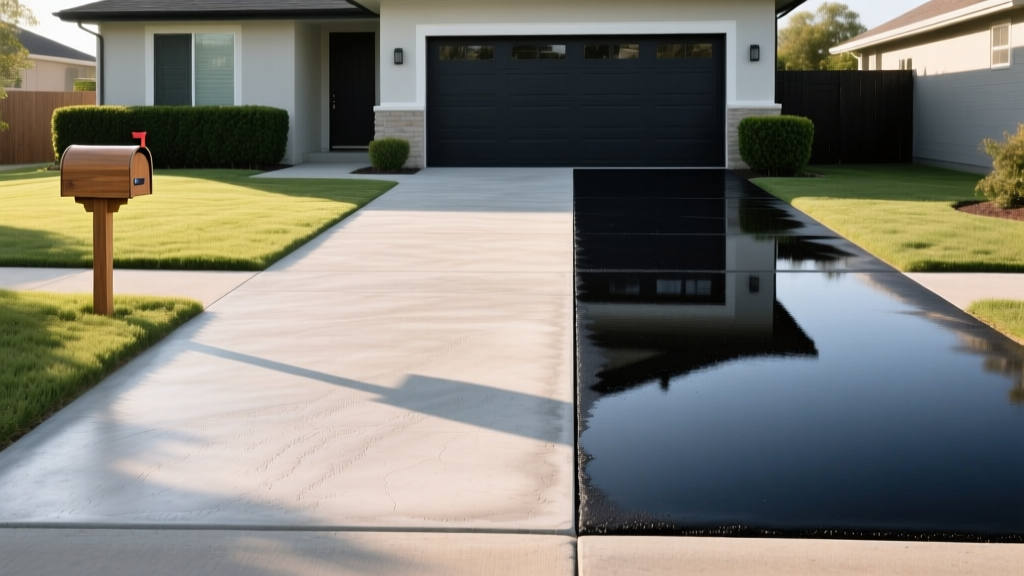
Asphalt is naturally black and petroleum-based; minor oil drips are virtually invisible. Concrete is porous and light-colored. A single transmission fluid leak on an unsealed concrete driveway will leave a permanent dark stain. If you park older vehicles or perform DIY mechanic work, the cost of frequent concrete degreasing and aesthetic degradation heavily favors asphalt.
3. Heavy Load Bearing (RVs and Boats)
Standard 4-inch concrete (3,500 PSI) will crack under the point-loads of RV leveling jacks or boat trailer tires sitting for months. If you plan to store heavy recreational vehicles, you must upgrade to a 6-inch slab with 4,500 PSI compressive strength and a thicker aggregate base, increasing your concrete budget by 25%.
Resale Value and Real Estate ROI
From a real estate perspective, the concrete vs asphalt cost for driveways debate extends to property valuation. Appraisers and real estate agents consistently note that a pristine, well-maintained concrete driveway—particularly stamped or exposed aggregate finishes—yields a higher curb appeal premium than asphalt. According to the National Asphalt Pavement Association, while asphalt provides excellent utility, it is generally viewed by buyers as a 'standard' or 'builder-grade' material. Upgrading from an aging asphalt driveway to a new concrete one prior to listing a home typically recoups 70% to 85% of the installation cost in the final sale price, whereas replacing asphalt with new asphalt simply maintains the baseline property value.
The Final Decision Framework
Use this matrix to make your final material selection based on your specific parameters:
- Choose Asphalt If: Your upfront budget is strictly capped below $10/sq. ft., you live in an extreme freeze-thaw climate where deicing salts are heavily used, you need the driveway usable within 48 hours, or you frequently park vehicles that leak oil.
- Choose Concrete If: You plan to stay in the home for 15+ years (capturing the lifecycle break-even), you live in a high-heat/southern climate, you want to maximize resale value and curb appeal, or you plan to park heavy RVs (with a 6-inch upgrade).
- Consider Permeable Pavers If: Your local municipality has strict stormwater runoff impervious surface limits, and you need to maximize your lot's allowable hardscape footprint (though expect costs to exceed $25/sq. ft.).
Ultimately, the cheapest driveway is the one that is engineered correctly for your specific soil and climate. Demand core samples or soil bearing capacity tests from your contractor before signing a contract, and ensure your bid explicitly lists the PSI (for concrete) or PG binder grade (for asphalt) to guarantee you are paying for a structural asset, not just a temporary surface covering.
Written by
David NakamuraDavid Nakamura is a licensed architect (AIA) and construction technology writer focused on sustainable building methods, mass timber engineering, and high-performance building envelopes. He holds a Master of Architecture from the University of Washington and is a certified Passive House Consultant (CPHC). David spent eight years at the Seattle firm Mithun, where he led the design of three LEED Platinum projects, before founding his own practice specializing in net-zero residential design. He serves on the editorial advisory board of GreenBuilder Magazine and has authored peer-reviewed papers on cross-laminated timber (CLT) connections for the Journal of Structural Engineering. In his spare time, David teaches woodworking at Pratt Fine Arts Center and kayaks the Puget Sound.
More from David Nakamura
View all
Construction Cost
Labor Cost to Build a Deck Per Sq Ft: 2026 Installation Guide
Discover the exact labor cost to build a deck per sq ft in 2026. This installation guide breaks down contractor rates, complexity factors, and hidden fees.
Aug 4, 2026

Construction Cost
How Much Does It Cost to Build a 3 Bedroom House? Financing Guide
Learn exactly how much it costs to build a 3 bedroom house and explore 2026 financing options, construction loan types, and budget frameworks for your build.
Aug 4, 2026

Construction Cost
Cost to Build a Tennis Court: 2026 Guide
How much does it cost to build a tennis court in 2026? Breakdowns for asphalt, concrete, and synthetic surfaces plus fencing and lighting.
Jul 30, 2026