Asphalt vs Concrete: Technical Specs, Load Limits, and Mix Designs
Compare asphalt vs concrete with deep technical specs, load-bearing capacities, mix designs, and thermal properties for paving projects.

Material Composition and Mix Design Fundamentals
Evaluating asphalt vs concrete requires moving beyond surface-level cost comparisons to analyze rheological properties, structural load distribution, and environmental degradation vectors. Both materials serve as primary paving solutions, but their engineering specifications dictate entirely different approaches to subgrade preparation, structural thickness, and long-term maintenance.
Portland Cement Concrete (PCC) Parameters
Rigid pavement systems rely on Portland cement concrete, a composite material where the cement paste binds fine and coarse aggregates. For exterior paving applications subject to freeze-thaw cycles, standard specifications dictate a compressive strength of 4,000 PSI at 28 days. The water-cement (w/c) ratio must be strictly maintained between 0.40 and 0.45 to minimize capillary porosity. Furthermore, air-entraining admixtures per ASTM C260 are mandatory in temperate climates, targeting a microscopic air void system of 5% to 7% to provide relief valves for expanding water during freezing.
Hot Mix Asphalt (HMA) Parameters
Flexible pavement systems utilize Hot Mix Asphalt, a viscoelastic composite of bitumen binder and graded aggregates. Modern HMA specifications rely on the Performance Graded (PG) binder system established by AASHTO M 320. A standard PG 64-22 binder is engineered to resist rutting at maximum pavement temperatures of 64°C while preventing thermal cracking at minimum temperatures of -22°C. During installation, HMA must be compacted to achieve a density of 92% to 94% of the theoretical maximum specific gravity (Gmm) to prevent premature oxidation and moisture infiltration.
For comprehensive mix design guidelines, civil engineers frequently reference the National Asphalt Pavement Association (NAPA) technical resources, which outline Superpave volumetric design protocols for varying traffic loads.
Structural Load-Bearing Capacity and Thickness Requirements
The fundamental difference in load distribution defines the asphalt vs concrete debate for heavy-duty applications. Concrete acts as a rigid slab that bridges over minor subgrade irregularities, distributing loads across a wider area via beam action. Asphalt is a flexible system that transfers loads directly downward through the aggregate layers to the subgrade, requiring a much stronger underlying base.
| Technical Property | Portland Cement Concrete (PCC) | Hot Mix Asphalt (HMA) |
|---|---|---|
| Compressive Strength | 4,000 - 6,000 PSI | N/A (Measured in Stability/Flow) |
| Tensile / Flexural Strength | 500 - 700 PSI (Modulus of Rupture) | 100 - 200 PSI (Indirect Tensile) |
| Modulus of Elasticity | 3,000,000 - 5,000,000 PSI | 200,000 - 500,000 PSI (Temperature Dependent) |
| Residential Driveway Thickness | 4 inches (with 4-inch gravel base) | 2.5 to 3 inches (with 6-8 inch aggregate base) |
| Heavy Commercial Thickness | 8 to 12 inches | 6 to 10 inches (over 12+ inch base) |
| Curing / Cooldown Time | 7 days for vehicular traffic (28 days full cure) | 24 to 48 hours (upon cooling to ambient temp) |
Thermal Dynamics and Expansion Joint Engineering
Thermal expansion and contraction dictate the geometric layout of rigid pavements. Concrete has a coefficient of thermal expansion (CTE) of approximately 5.5 microstrains per degree Fahrenheit. Without engineered relief mechanisms, thermal stresses will exceed the concrete's tensile capacity, resulting in uncontrolled blowups or random cracking.
Engineering Callout: Concrete Joint Spacing Formula
Transverse contraction joints must be saw-cut within 4 to 12 hours of placement. The maximum joint spacing (in feet) is calculated as 1.5 to 2.0 times the slab thickness (in inches). For a standard 5-inch thick commercial parking slab, joints must be spaced no further than 7.5 to 10 feet apart in both directions to ensure controlled cracking at the joint invert.
Asphalt, conversely, does not utilize expansion joints. Its viscoelastic nature allows it to accommodate thermal contraction through micro-yielding. However, in extreme cold, the binder stiffens, leading to low-temperature thermal cracking. This is mitigated by selecting a PG binder with a lower minimum temperature rating or by incorporating polymer-modified asphalt (PMA) like SBS (Styrene-Butadiene-Styrene) to increase elasticity.
Permeability, Drainage, and Hydrological Impact
Modern stormwater management regulations frequently mandate permeable paving systems to reduce runoff and filter pollutants. Both materials offer engineered porous variants, governed by strict ASTM testing protocols:
- Pervious Concrete (ASTM C1701): Formulated with a gap-graded aggregate structure and minimal fine sand. Yields an infiltration rate of 2 to 5 gallons per minute per square foot. Requires a minimum subgrade stone recharge bed to store water during peak storm events.
- Porous Asphalt (ASTM D7313): Utilizes an open-graded friction course (OGFC) mix design with a binder-rich drainage layer. Offers similar infiltration rates but is more susceptible to surface clogging from sediment and requires regular vacuum-sweeping maintenance to preserve hydraulic conductivity.
"Proper subgrade preparation is the single highest predictor of permeable pavement success. A California Bearing Ratio (CBR) of less than 5 requires extensive geogrid reinforcement or deep excavation, regardless of the surface material chosen." - Federal Highway Administration (FHWA) Pavement Preservation Guidelines.
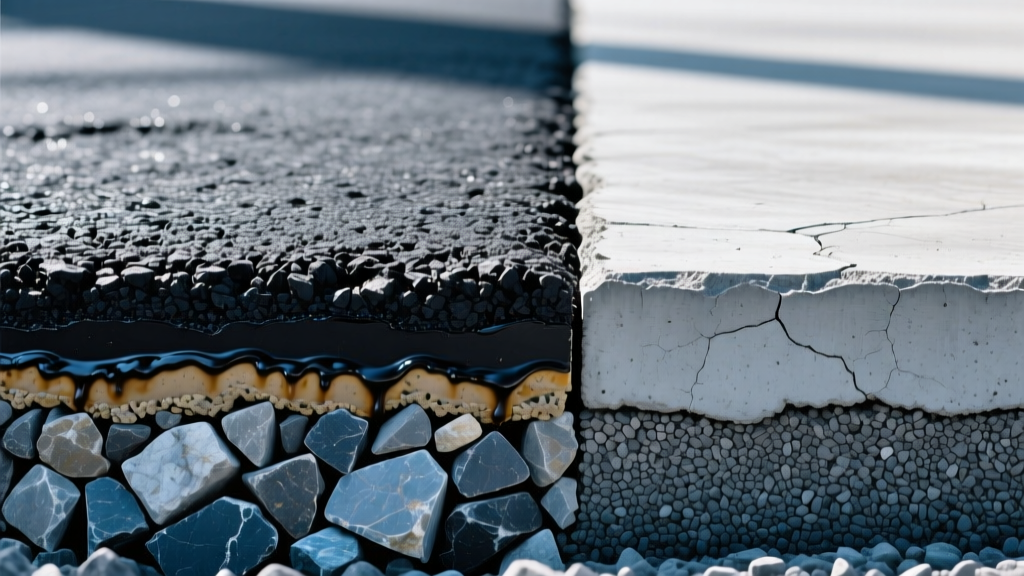
Lifecycle Degradation and Failure Mode Analysis
Understanding how each material fails is critical for lifecycle cost analysis. The degradation vectors for asphalt and concrete are fundamentally different.
Concrete Failure Modes
Rigid pavements primarily fail via chemical and mechanical fatigue. Alkali-Silica Reaction (ASR) occurs when reactive silica in the aggregates reacts with alkali hydroxides in the cement pore solution, forming an expansive gel that maps-cracks the slab. Mitigation requires using low-alkali cement (ASTM C150) or supplementary cementitious materials like fly ash or slag. Spalling at joints occurs when incompressible debris enters the joint, causing compressive stresses during thermal expansion that fracture the joint edges.
Asphalt Failure Modes
Flexible pavements fail primarily through environmental aging and structural fatigue. Oxidation and Raveling occur when UV radiation and oxygen strip the volatile oils from the bitumen binder, causing it to become brittle and lose aggregate adhesion. Alligator (Fatigue) Cracking is a bottom-up structural failure caused by repeated heavy axle loads exceeding the tensile strain capacity at the bottom of the asphalt layer, indicating a failed subgrade or insufficient structural number.
For deep-dive mitigation strategies regarding freeze-thaw scaling and chemical attacks, the Portland Cement Association (PCA) durability guidelines provide essential mix-design adjustments.
Decision Matrix: Selecting the Right Pavement System
Use this engineering decision flow to specify the correct material for your project parameters:
- Calculate Traffic ESALs (Equivalent Single Axle Loads): If the project is a residential driveway or low-volume access road (<100 ESALs), both materials are viable; select based on aesthetic preference and initial budget. If the project involves heavy truck traffic, loading docks, or industrial yards (>10,000 ESALs), specify rigid concrete to prevent deep rutting and shear deformation.
- Test Subgrade CBR (California Bearing Ratio): If soil borings reveal a weak, clay-heavy subgrade (CBR < 5), concrete's rigid slab action will bridge the soft spots better than asphalt, which will mirror subgrade deflections. If using asphalt on weak soils, you must budget for a 12-to-18-inch crushed aggregate base.
- Evaluate Climate and Chemical Exposure: If the facility involves frequent exposure to petroleum distillates, diesel fuel, or hydraulic fluid (e.g., gas stations, truck depots), you must specify concrete. Asphalt binder is petroleum-based and will rapidly dissolve and soften when exposed to fuel spills. Conversely, if the site requires heavy use of de-icing salts and the concrete mix lacks proper air-entrainment, asphalt will resist salt-induced scaling more effectively.
- Analyze Utility Access Requirements: If the paved area sits over complex, shallow utility networks requiring frequent trenching and patching, specify asphalt. Asphalt trenches can be milled, patched, and seamlessly compacted in hours. Concrete utility cuts require full-panel replacement, resulting in permanent aesthetic scarring and higher restoration costs.
Written by
James ThorntonJames Thornton is a construction industry veteran with 25 years of hands-on experience in wood framing, lumber grading, and residential building codes. He started as a framing carpenter in rural Oregon, earned his ICC Residential Building Inspector certification, and eventually became a senior plan reviewer for the City of Portland Bureau of Development Services. James holds a B.S. in Wood Science & Technology from Oregon State University and is a certified lumber grader through the West Coast Lumber Inspection Bureau (WCLIB). He has inspected over 3,000 residential construction sites and authored the city's internal guide on advanced framing techniques (2x6 at 24" O.C.). James lives in Bend, OR, where he builds custom timber-frame cabins and competes in lumberjack sports.
More from James Thornton
View all
Insulation
Best Home Insulation Materials: Complete 2026 Guide
Compare top home insulation materials for 2026. Find R-values, installed costs per square foot, and best uses for fiberglass, spray foam, and mineral wool.
Aug 4, 2026

Sustainable Building
Certify Your Green Building Material for LEED and WELL
Step-by-step guide to certifying a green building material for LEED v5 and WELL v2. Master EPDs, HPDs, and VOC limits for 2026 project specifications.
Aug 4, 2026

Stone & Masonry
Veneer Stacked Stone Panels: Interior Design & Style Showcase
Discover how veneer stacked stone panels transform interiors. Explore modern design profiles, material pairings, and technical installation specs.
Aug 4, 2026