Concrete Thinkers vs Abstract Thinkers: Specifying Concrete vs Alternatives
Explore how concrete thinkers vs abstract thinkers approach cement specification, comparing empirical mix designs with conceptual sustainable alternatives.
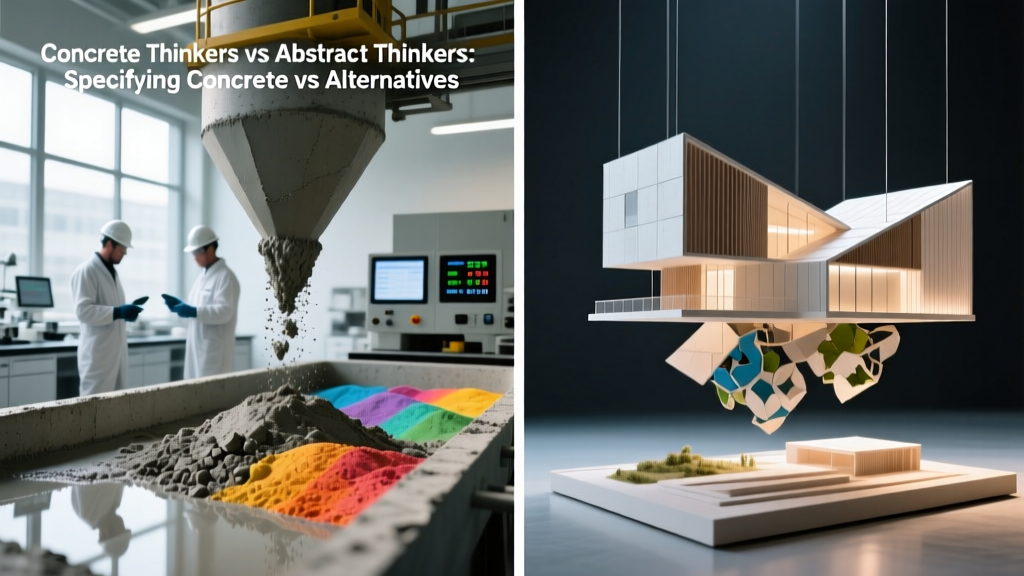
The Cognitive Divide in Material Specification
In the architecture, engineering, and construction (AEC) industry, the debate over material specification often mirrors a deeper cognitive divide: concrete thinkers vs abstract thinkers. While the word 'concrete' serves as a double entendre here, the psychological frameworks of literal, empirical processing (concrete thinking) versus conceptual, systemic processing (abstract thinking) fundamentally dictate how professionals select, design, and execute cementitious structures. Understanding this cognitive split is critical for project managers and structural engineers navigating the transition from traditional Ordinary Portland Cement (OPC) to next-generation alternative materials.
A 'concrete thinker' in material specification relies on observable, measurable, and historically proven data points: compressive strength (PSI), slump tolerances, and cost per cubic yard. Conversely, an 'abstract thinker' evaluates materials through systemic lenses: embodied carbon trajectories, parametric formwork capabilities, and lifecycle thermal dynamics. Neither approach is inherently flawed, but forcing one mindset onto the wrong application leads to structural failures, budget overruns, or missed sustainability targets.

The Concrete Thinker’s Domain: Empirical Mix Design
Concrete thinkers anchor their specifications in the physical realities of the job site and the rigid parameters of building codes. When evaluating a slab-on-grade or a high-load column, they prioritize predictability. Their material selection is heavily influenced by standards set by organizations like the American Concrete Institute (ACI).
Key Specifications for the Empirical Mindset
- Binder Selection: Type I/II Portland cement (ASTM C150). It offers a predictable hydration curve and reliable 28-day strength gain.
- Mix Ratios: A strict 0.40 to 0.45 water-to-cement (w/c) ratio to ensure durability and minimize capillary porosity.
- Aggregates: 3/4-inch crushed limestone conforming to ASTM C33, chosen for its mechanical interlock and regional availability.
- Primary Metric: 4,000 PSI compressive strength at 28 days, verified via standard cylinder break tests.
- Economic Baseline: In 2026, standard OPC mixes average $145 to $165 per cubic yard, depending on regional aggregate freight costs.
The Abstract Thinker’s Domain: Systemic and Conceptual Design
Abstract thinkers view cementitious materials not just as structural commodities, but as nodes in a larger environmental and architectural system. They are the primary drivers behind the adoption of alternative cements and advanced composites. Their focus shifts from 'Will it hold the load?' to 'How does this material interact with the building's thermal envelope and the global carbon cycle?'
Pushing the Boundaries of Cementitious Alternatives
Guided by frameworks like the Global Cement and Concrete Association's Roadmap 2050, abstract thinkers specify materials that challenge traditional formwork and curing methodologies:
- Limestone Calcined Clay Cement (LC3): By substituting up to 50% of the clinker with calcined clay and limestone, LC3 reduces embodied carbon by nearly 30% compared to OPC, while maintaining comparable late-stage strength.
- Ultra-High-Performance Concrete (UHPC): With compressive strengths exceeding 22,000 PSI and tensile ductility provided by steel micro-fibers, UHPC allows abstract thinkers to design sweeping, impossibly thin parametric facades that traditional concrete could never support.
- Geopolymer Binders: Utilizing fly ash or slag activated by alkaline solutions, geopolymers eliminate Portland clinker entirely, appealing to the abstract thinker's goal of zero-carbon structural cores.
Comparison Matrix: Mindset vs. Material Selection
The following matrix illustrates how these two cognitive approaches evaluate the same project parameters, leading to vastly different material schedules.
| Evaluation Metric | Concrete Thinker Preference | Abstract Thinker Preference |
|---|---|---|
| Primary Success Metric | 28-day PSI & Cost per CY | kgCO2e/m3 & Architectural Expression |
| Binder Selection | Type I/II OPC (ASTM C150) | LC3-50 or Alkali-Activated Geopolymers |
| Reinforcement | Grade 60 Epoxy-Coated Steel Rebar | Basalt Fiber Reinforced Polymer (BFRP) |
| Formwork Strategy | Standardized Plywood / Modular Aluminum | CNC-Milled EPS Foam for Complex Geometries |
| Risk Tolerance | Low (Relies on historical precedence) | High (Willing to pilot new admixtures) |
Bridging the Gap: When to Use Traditional Concrete vs. Alternatives
Project success in 2026 requires synthesizing both cognitive styles. Relying solely on abstract thinking can lead to unbuildable designs or catastrophic supply chain failures (e.g., specifying a geopolymer mix in a region lacking local fly ash or slag). Conversely, relying only on concrete thinking results in carbon-heavy, aesthetically rigid structures that fail to meet modern ESG (Environmental, Social, and Governance) mandates.
The Decision Framework for Project Managers
Use the following conditional logic to assign material specifications based on structural and environmental requirements:
THEN adopt the Concrete Thinker approach. Specify 4,000 to 6,000 PSI OPC with supplementary cementitious materials (SCMs) like Class C fly ash (up to 25%) to moderately offset carbon without risking supply chain disruptions.
THEN adopt the Abstract Thinker approach. Specify UHPC for facades (reducing thickness by 60% and eliminating conventional rebar) or BFRP reinforcement in marine slabs to completely eliminate corrosion-induced spalling.
Real-World Application: The 2026 Commercial Slab-on-Grade
Consider a 50,000 square-foot commercial logistics center. The abstract thinker might initially propose a post-tensioned slab using a 100% geopolymer binder to achieve net-zero embodied carbon. However, the concrete thinker will point out that geopolymer curing is highly sensitive to ambient temperature fluctuations, and the logistics center's unheated winter pour schedule guarantees inconsistent strength gain and potential surface scaling.
The Synthesized Solution: The project team specifies a traditional OPC base mix (satisfying the concrete thinker's need for reliable winter curing and local batch availability) but integrates a macro-synthetic fiber reinforcement system and a hard-dry shake metallic aggregate topping. This satisfies the abstract thinker's requirement for a highly durable, joint-less floor that reduces long-term maintenance and lifecycle material replacement, achieving systemic efficiency without risking empirical structural failure.
'The most resilient structures of the 2020s are not born from choosing between empirical strength and conceptual sustainability, but from translating abstract environmental goals into concrete, measurable mix designs.'
FAQ: Cognitive Styles in Construction Management
Q: Can a single estimator or engineer possess both cognitive styles?
A: Yes. Senior structural engineers typically develop 'cognitive flexibility,' allowing them to toggle between abstract systemic goals (like LEED v5 carbon thresholds) and concrete empirical realities (like local aggregate moisture content affecting the w/c ratio).
Q: Are alternative cements like LC3 more expensive than traditional OPC?
A: As of 2026, LC3 carries a slight premium of 5% to 12% over standard OPC due to the calcination processing of the clay. However, abstract thinkers factor in carbon tax credits and ESG financing incentives, which often make LC3 financially superior on a macro-project level.
For further reading on empirical mix design standards, consult the Portland Cement Association's technology resources to ensure your baseline specifications meet current industry tolerances.
Written by
Sarah WhitfieldSarah Whitfield is a chartered quantity surveyor (MRICS) and construction cost analyst with 15 years of experience in material pricing, procurement strategy, and project budgeting. She earned her degree in Construction Management from the University of Reading (UK) and has worked on projects ranging from $2M custom homes to $180M mixed-use developments across North America and Europe. Sarah currently leads cost estimating for BuildMat Insight, maintaining a proprietary database of 4,000+ material price points updated quarterly. She is a frequent contributor to RSMeans cost data panels and has presented at the International Cost Engineering Council (ICEC) congress. Based in Denver, CO, Sarah is an avid trail runner and volunteer mentor for Women in Construction.
More from Sarah Whitfield
View all
Wood & Lumber
What Are the Different Types of Wood? A Builder's Guide
Compare structural softwoods, finish hardwoods, and engineered lumber. Analyze Janka ratings, MOE values, and 2026 pricing for construction.
Aug 4, 2026

Walls & Panels
Steel Framing vs Wood Framing: Corrosion and Moisture Defense
Compare steel framing vs wood framing for moisture resistance. Learn about galvanized coatings, condensation risks, and corrosion protection strategies.
Jul 21, 2026

Stone & Masonry
How to Cut Stone Veneer: Wet Saw vs Grinder Comparison
Compare the best tools for cutting stone veneer. We review wet saws, angle grinders, and chop saws to help you achieve clean, chip-free cuts.
Jul 21, 2026