Mastering the Concrete Pad Calculator: Scenario-Based Sizing for Loads
Learn how to adjust your concrete pad calculator inputs for specific load scenarios, from hot tubs to RV pads, ensuring structural integrity.
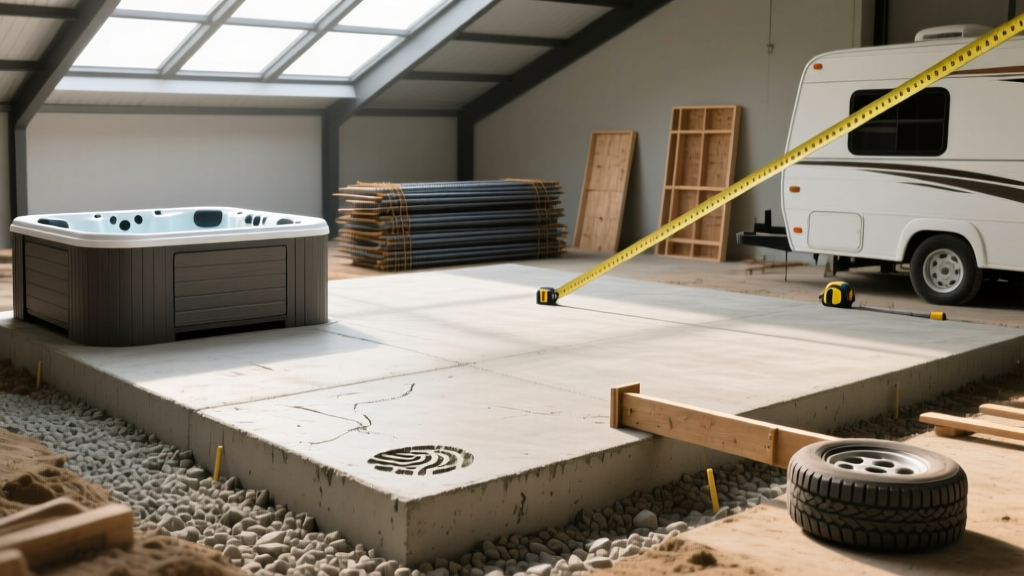
Beyond Basic Volume: Why Application Dictates Your Concrete Pad Specs
Most homeowners and contractors type length, width, and a standard 4-inch depth into a concrete pad calculator, order the exact cubic yardage it spits out, and wonder why their slab cracks under a hot tub or sinks under an RV. A standard calculator only computes geometric volume; it does not account for structural loads, subgrade compression, or material waste. To build a slab that lasts, you must use the calculator as a baseline and adjust the inputs based on your specific application scenario.
The American Concrete Institute (ACI) emphasizes that slab thickness and reinforcement must be matched to the anticipated load type and soil subgrade. Treating a heavy machinery pad the same as a garden shed walkway is a primary cause of premature concrete failure. Below, we break down how to manipulate your calculator inputs to match real-world scenarios.
The Scenario-Matching Framework for Concrete Pads
Before entering numbers into your concrete pad calculator, identify your load category. This matrix dictates the minimum thickness, compressive strength (PSI), and reinforcement required.
| Application Scenario | Load Type | Min. Thickness | Concrete PSI | Reinforcement Strategy |
|---|---|---|---|---|
| Sheds, AC Units, Trash Bins | Light / Static | 3.5 to 4 inches | 3,000 PSI | 6x6 W1.4xW1.4 Wire Mesh |
| Patios, Walkways, Hot Tubs | Medium / Concentrated | 4 to 6 inches | 4,000 PSI | #3 Rebar at 16' OC Grid |
| RV Pads, Workshop Floors | Heavy / Dynamic Point | 6 to 8 inches | 4,500+ PSI | #4 Rebar at 12' OC + Fiber |
How to Adjust Calculator Inputs by Scenario
Scenario A: Light-Duty (Sheds and Utility Pads)
For a standard 10x12 foot storage shed, the dead load is relatively low and evenly distributed. Set your concrete pad calculator to a depth of 3.5 inches. However, to account for minor subgrade settling, many professionals input 4 inches into the calculator to yield a slight overage, ensuring the final finished depth never drops below 3.5 inches. Use a standard 3,000 PSI mix. According to the Portland Cement Association (PCA), 3,000 PSI is more than adequate for residential light-duty applications and offers better workability for DIY finishing.
Scenario B: Medium-Duty (The Hot Tub Concentrated Load)
Hot tubs are the most common cause of residential slab failure. Water weighs 8.34 lbs per gallon. A standard 400-gallon hot tub holds 3,336 lbs of water alone. Add the tub's dry weight (800 lbs) and four adults (800 lbs), and you are placing nearly 5,000 lbs on a 64-square-foot footprint. This creates immense shear stress.
- Calculator Adjustment: Do not use the standard 4-inch depth. Input 5 or 6 inches into your concrete pad calculator for the area directly beneath the tub.
- Mix Adjustment: Upgrade to a 4,000 PSI mix with a low water-cement ratio (0.45 or lower) to resist cracking under concentrated point loads.
- Reinforcement: Wire mesh is insufficient here. Use a grid of #3 (3/8-inch) rebar spaced 16 inches on center, elevated on 2-inch dobies (chairs) so it sits in the upper third of the slab.
Scenario C: Heavy-Duty (RV and Motorhome Parking)
Recreational vehicles introduce heavy dynamic point loads. A 15,000 lb motorhome resting on four dual-tire axles concentrates massive weight onto small tire footprints. If the subgrade is soft clay, a standard 4-inch slab will punch through and crack.
For RV pads, the calculator must account for a thicker base. Excavate an additional 2 inches and fill with compacted 3/4-inch minus gravel. When inputting your slab depth into the concrete pad calculator, use 6 inches minimum (8 inches for Class A motorhomes). Order a 4,500 PSI mix with synthetic macro-fibers added at the batch plant to control plastic shrinkage cracking.
Hidden Variables That Break Standard Calculator Estimates
A raw geometric calculation (Length x Width x Depth) will always leave you short. Professional contractors use a modified formula to account for real-world site conditions. When using your calculator, apply these multipliers to your final cubic yardage:
| Variable | Impact on Volume | Why It Happens |
|---|---|---|
| Subgrade Unevenness | +5% to +8% | Excavated dirt is rarely perfectly level; low spots consume extra concrete. |
| Formwork Bulging | +2% to +3% | The hydrostatic pressure of wet concrete pushes wooden forms outward slightly. |
| Chute and Pump Waste | +3% to +5% | Concrete left in the truck chute, pump hopper, and hoses cannot be poured. |
| Spillage and Screed Loss | +2% | Material lost over the edges during screeding and bull-floating. |
The Professional Rule of Thumb: Always add a minimum of 10% to 15% to your concrete pad calculator's final output. If the calculator says you need exactly 3.0 cubic yards, order 3.5 yards. The cost of a short-load fee and a cold joint from ordering a second truck far exceeds the cost of half a yard of leftover concrete.
2026 Cost Implications of Scenario-Specific Adjustments
Adjusting your calculator inputs for higher PSI, thicker depths, and specific reinforcements significantly impacts the budget. Below is a breakdown of current market rates to help you forecast costs accurately.
- Base 3,000 PSI Mix: $135 to $155 per cubic yard.
- 4,000 PSI Upgrade: Adds $15 to $25 per cubic yard.
- 4,500 PSI + Fiber Mesh: Adds $30 to $45 per cubic yard.
- Short Load Fees: If you order under 3 to 4 cubic yards (depending on the local National Ready Mixed Concrete Association member plant), expect a short-load fee of $75 to $125 per missing yard.
- Concrete Pump Truck: If your pad is in a backyard inaccessible to the chute, a boom pump will add $800 to $1,200 to the total project cost, regardless of the pad size.
Expert Tips for Ordering Based on Calculator Outputs
Once your scenario-adjusted concrete pad calculator provides a final volume, follow these steps when calling the batch plant:
- Specify the Application: Tell the dispatcher exactly what the pad is for (e.g., 'This is for a 5,000 lb hot tub'). They will verify your PSI request and adjust the aggregate sizing if necessary.
- Request the Right Slump: For a standard pad, request a 4-inch to 5-inch slump. If you are pumping the concrete, request a 5-inch to 6-inch slump with a water-reducing admixture (plasticizer) rather than just adding water, which weakens the final cure.
- Schedule the Finishing Crew: A 4-yard pad pours in about 20 minutes. Ensure your screed, float, and trowel team is in position before the truck drum starts spinning. Concrete waits for no one.
By treating the concrete pad calculator as a starting point rather than a final authority, and by matching your inputs to the specific structural demands of your project, you eliminate the risk of under-engineered slabs. Proper scenario matching ensures your pad remains level, crack-free, and structurally sound for decades.