Fiber vs Wire Mesh in Concrete: Complete Cost Breakdown
Analyze the true installed cost of fiber vs wire mesh in concrete. Compare material pricing, labor savings, and hidden failure economics for 2026.

The Economics of Secondary Reinforcement
When designing slabs-on-grade, engineers and contractors must address shrinkage and temperature cracking. The two dominant solutions for this secondary reinforcement are Welded Wire Fabric (WWF) and fiber reinforcement (synthetic or steel). While material costs are often the first metric evaluated, the true financial impact of choosing fiber vs wire mesh in concrete is determined by labor efficiency, placement accuracy, and long-term durability. This analysis breaks down the direct and hidden costs of both systems to provide a definitive framework for project budgeting.
Direct Material Cost Matrix
Material pricing fluctuates based on regional supply chains, resin indices (for synthetics), and steel tariffs. The table below reflects average 2026 bulk pricing for standard residential and commercial applications. Note that fiber costs are calculated per cubic yard (CY) of concrete and converted to a per-square-foot (SQ FT) equivalent based on a standard 4-inch thick slab.
| Reinforcement Type | Specification / Grade | Cost per CY (Added to Mix) | Cost per SQ FT (Material Only) |
|---|---|---|---|
| Welded Wire Fabric (WWF) | 6x6 W1.4xW1.4 (10-Gauge) | N/A (Placed on-site) | $0.18 - $0.22 |
| Welded Wire Fabric (WWF) | 6x6 W2.9xW2.9 (6-Gauge) | N/A (Placed on-site) | $0.35 - $0.42 |
| Micro-Synthetic Fiber | Polypropylene (Fibrillated) | $10.00 - $15.00 | $0.12 - $0.18 |
| Macro-Synthetic Fiber | Polyolefin (Structural/Crimped) | $28.00 - $40.00 | $0.35 - $0.50 |
| Steel Fiber | Hooked-End (1.5 to 2.5 in.) | $45.00 - $65.00 | $0.55 - $0.80 |
Note: WWF requires an additional 5% to 8% material cost for lap splicing (typically 6 inches to 12 inches at edges) and concrete or plastic chairs to elevate the mesh.
Labor and Placement: The True Cost Differentiator
The most significant financial divergence between fibers and wire mesh occurs during the placement phase. According to the National Ready Mixed Concrete Association (NRMCA), labor rates for flatwork finishing continue to rise, making on-site assembly a major budget vulnerability.
The Wire Mesh Labor Burden
Installing WWF requires a dedicated crew to unload, position, tie, and chair the sheets before the truck arrives. For a 1,000-square-foot driveway, a two-person crew will spend approximately 2.5 to 3.5 hours prepping the mesh. At an average 2026 burdened labor rate of $65/hour per worker, this adds $325 to $455 in labor costs, effectively doubling the material cost of 10-gauge WWF.
The Fiber Placement Advantage
Fibers are dosed directly into the concrete at the batch plant or added via an automated hopper into the truck chute. On-site placement labor for the reinforcement itself is zero. The finishing crew can begin screeding immediately upon discharge, accelerating the overall construction schedule and reducing overtime risks during late-afternoon pours.
For wire mesh to effectively control shrinkage cracking, the Portland Cement Association (PCA) dictates it must be located in the upper third of the slab. In practice, workers stepping on the mesh during the pour frequently push it to the bottom of the formwork. When mesh ends up in the bottom third, it provides virtually zero resistance to surface shrinkage cracks. Correcting this requires expensive plastic chairs and strict site supervision, adding hidden quality-control costs.
Hidden Costs and Lifecycle Economics
Beyond the initial pour, the choice of reinforcement impacts long-term maintenance and aesthetic liability.
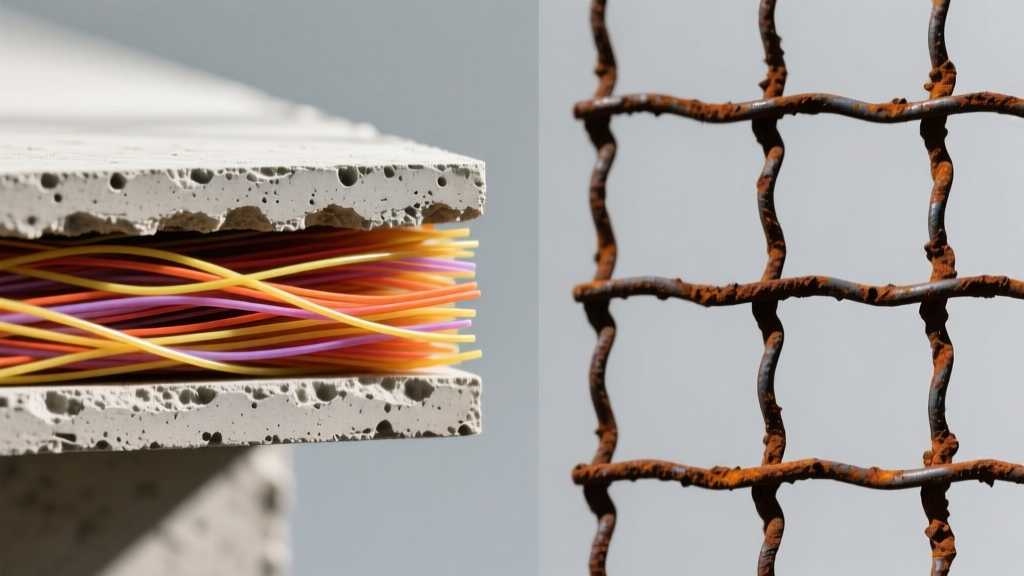
- Rust Staining: Galvanized or uncoated WWF placed too close to the surface (or exposed at saw-cut joints) will oxidize, creating unsightly rust stains. Synthetic fibers are completely immune to corrosion, eliminating this callback risk entirely.
- Cutting and Scrap Waste: WWF sheets come in standard 5x150 ft rolls or 5x10 ft panels. Irregular slab perimeters generate 10% to 15% offcut waste. Fibers are dosed to the exact cubic yard ordered, resulting in zero reinforcement waste.
- Pump Line Clogs: When pumping concrete with steel fibers or heavy macro-synthetics, contractors must use a reducer in the pump line and maintain a high slump to prevent blockages. This can add $150 to $300 in pump rental surcharges and may require a mid-range water reducer (plasticizer) in the mix design.
Project-Specific Decision Framework
Selecting between fiber and mesh should not be a blanket decision. The American Concrete Institute (ACI) Committee 544 outlines specific performance parameters for fiber-reinforced concrete. Use this framework to match the reinforcement to the application:
| Application | Recommended System | Economic Rationale |
|---|---|---|
| Residential Driveways | Macro-Synthetic or 6-Gauge WWF | Macro fibers provide equivalent post-crack ductility to 6-gauge WWF but eliminate the labor of tying heavy steel sheets in residential settings. |
| Interior Slabs-on-Grade | Micro-Synthetic Fibers | Interior slabs primarily need plastic shrinkage control during the first 24 hours. Micro-synthetic is the lowest-cost method to achieve this without adding structural steel. |
| Industrial / Warehouse Floors | Steel Fibers + Dowel Baskets | Steel fibers provide superior impact resistance and fatigue life for forklift traffic, while reducing the joint-spacing requirements compared to plain concrete. |
| Stamped / Decorative Concrete | Micro-Synthetic or Macro-Synthetic | Wire mesh near the surface will eventually rust and bleed through decorative sealers and stains. Synthetics guarantee a rust-free aesthetic lifespan. |
Total Installed Cost Scenarios
To illustrate the compounding effect of material and labor costs, consider these two real-world 2026 scenarios for a 5-inch thick slab.
Scenario A: 1,000 SQ FT Residential Driveway (5 Inches Thick)
Volume: ~15.5 Cubic Yards
- Option 1: 10-Gauge WWF (6x6 W1.4)
- Material (Mesh + Chairs + Tie Wire): $220
- Labor (2 workers x 3 hours prep): $390
- Total Reinforcement Cost: $610 ($0.61 / SQ FT)
- Option 2: Macro-Synthetic Fiber (3 lbs/CY)
- Material (Batch plant dosing @ $32/CY): $496
- Labor (On-site prep): $0
- Total Reinforcement Cost: $496 ($0.50 / SQ FT)
Result: Macro-synthetic fibers save $114 on this project while providing superior 3D crack control and eliminating the risk of mesh step-down.
Scenario B: 10,000 SQ FT Commercial Tilt-Up Pad (5 Inches Thick)
Volume: ~155 Cubic Yards
- Option 1: 6-Gauge WWF (6x6 W2.9)
- Material (Mesh + Lap Splice Overlap): $4,100
- Labor (4 workers x 12 hours prep): $3,120
- Total Reinforcement Cost: $7,220 ($0.72 / SQ FT)
- Option 2: Steel Fibers (40 lbs/CY)
- Material (Batch plant dosing @ $55/CY): $8,525
- Labor (On-site prep): $0
- Pump Surcharge (Reducer setup): $250
- Total Reinforcement Cost: $8,775 ($0.88 / SQ FT)
Result: On large-scale commercial pads where heavy structural steel is required, WWF remains more cost-effective on a pure dollar basis. However, contractors must weigh this against the schedule acceleration and reduced crew fatigue provided by steel fibers.
Expert Verdict on Secondary Reinforcement
The decision between fiber and wire mesh in concrete is fundamentally a choice between material-heavy and labor-heavy workflows. For residential, decorative, and light-commercial flatwork, synthetic fibers consistently yield a lower total installed cost while mitigating the most common placement errors associated with wire mesh. For heavy industrial applications requiring high post-crack flexural strength, steel fibers compete directly with heavy-gauge WWF, with the final choice hinging on local steel tariffs and the availability of skilled steel-tying labor. Always verify that your chosen fiber dosage meets the specific ASTM C1609 flexural toughness requirements mandated by your structural engineer.
Written by
David NakamuraDavid Nakamura is a licensed architect (AIA) and construction technology writer focused on sustainable building methods, mass timber engineering, and high-performance building envelopes. He holds a Master of Architecture from the University of Washington and is a certified Passive House Consultant (CPHC). David spent eight years at the Seattle firm Mithun, where he led the design of three LEED Platinum projects, before founding his own practice specializing in net-zero residential design. He serves on the editorial advisory board of GreenBuilder Magazine and has authored peer-reviewed papers on cross-laminated timber (CLT) connections for the Journal of Structural Engineering. In his spare time, David teaches woodworking at Pratt Fine Arts Center and kayaks the Puget Sound.
More from David Nakamura
View all
Construction Cost
Labor Cost to Build a Deck Per Sq Ft: 2026 Installation Guide
Discover the exact labor cost to build a deck per sq ft in 2026. This installation guide breaks down contractor rates, complexity factors, and hidden fees.
Aug 4, 2026

Construction Cost
How Much Does It Cost to Build a 3 Bedroom House? Financing Guide
Learn exactly how much it costs to build a 3 bedroom house and explore 2026 financing options, construction loan types, and budget frameworks for your build.
Aug 4, 2026

Construction Cost
Cost to Build a Tennis Court: 2026 Guide
How much does it cost to build a tennis court in 2026? Breakdowns for asphalt, concrete, and synthetic surfaces plus fencing and lighting.
Jul 30, 2026