Fiber Concrete vs Rebar: Mix Design and Reinforcement Guide
Compare fiber concrete vs rebar for slab reinforcement. Explore mix design adjustments, structural capacities, cost differences, and ideal applications.

The Core Engineering Difference: Active vs. Passive Reinforcement
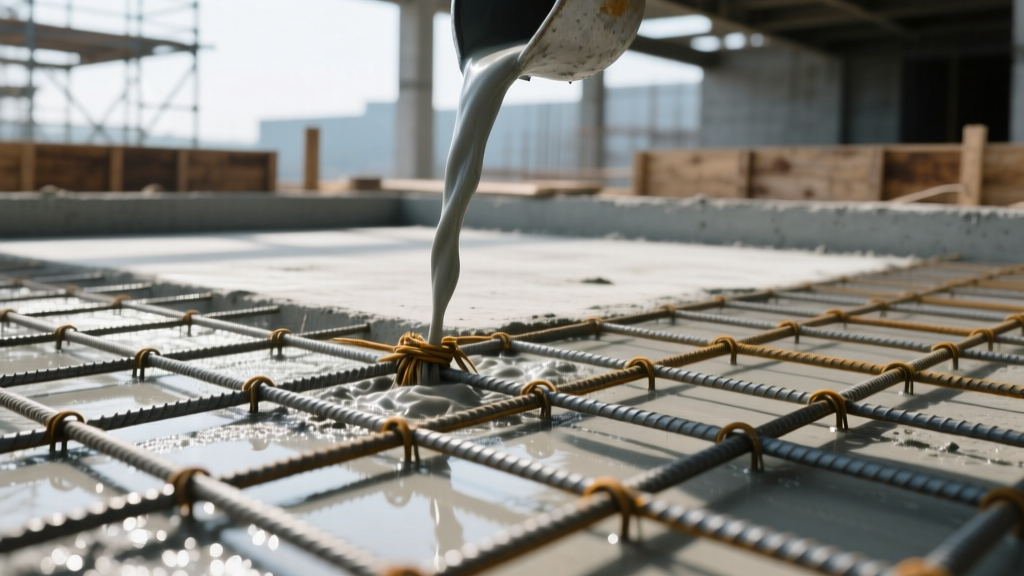
The debate between fiber concrete vs rebar fundamentally centers on how each material manages tensile stresses within a cementitious matrix. Traditional steel reinforcing bar (rebar) acts as active reinforcement. It is designed to carry significant structural loads only after the concrete has cracked, bridging macro-fractures and providing ductile failure modes. In contrast, fiber reinforcement—whether macro-synthetic, micro-synthetic, or steel—acts primarily as passive reinforcement. Fibers intersect micro-cracks as they form, arresting propagation and controlling plastic shrinkage, but they do not replace the primary structural tensile capacity of rebar in suspended or heavily loaded structural slabs.
Understanding this distinction is critical for mix design. Specifying fibers does not automatically allow you to delete rebar from structural drawings; rather, it shifts the concrete's performance profile toward enhanced durability, impact resistance, and shrinkage control.
Mix Design Adjustments for Fiber Reinforced Concrete (FRC)
Introducing fibers into a concrete mix fundamentally alters its rheology. You cannot simply dump fibers into a standard slab-on-grade mix without adjusting the proportioning. According to the Portland Cement Association (PCA), the physical presence of fibers increases the surface area within the mix, demanding more paste to maintain workability.
Slump Loss and Admixture Strategy
Macro-synthetic fibers (typically dosed at 3.0 to 7.5 lbs per cubic yard) will reduce the measured slump of a standard mix by 1 to 2.5 inches. To compensate without increasing the water-to-cement (w/c) ratio—which would destroy compressive strength—mix designers must incorporate polycarboxylate ether (PCE) based high-range water reducers (HRWR). PCE superplasticizers provide the necessary slump flow to encapsulate the fibers while maintaining a strict w/c ratio of 0.40 to 0.45.
Aggregate Graduation and Sizing
When designing a mix for steel fibers or heavy macro-synthetics, the maximum aggregate size should be reduced. While standard slab mixes use 3/4-inch coarse aggregate, stepping down to a 1/2-inch or 3/8-inch maximum size prevents the fibers from clumping around large stones. A well-graded sand with a fineness modulus between 2.60 and 2.80 ensures the mortar fraction is robust enough to suspend the fibers uniformly.
The Batching Sequence: Avoiding the 'Hedgehog' Effect
Improper batching is the leading cause of FRC failure on site. If dry fibers are added to the back of a transit mixer filled with wet concrete, they will instantly clump into unbreakable balls known in the industry as 'hedgehogs'. The correct batching sequence requires:
- At the Batch Plant: Introduce fibers onto the aggregate conveyor belt so they are mixed with the dry coarse and fine aggregates before water and cement are introduced.
- On-Site Addition (if necessary): If using a specialized fiber-dosing hopper at the job site, the concrete must be at a high slump (minimum 6 inches), and the mixer drum must be rotating at charging speed (12-15 RPM) while fibers are added slowly, followed by a minimum of 5 minutes of mixing at high speed.
Structural Capacity & Failure Modes: Comparison Matrix
When evaluating fiber concrete vs rebar, engineers must look beyond simple tensile strength and evaluate how the material behaves under specific stress conditions. The American Concrete Institute (ACI) Committee 544 provides extensive guidelines on these behavioral differences.
| Performance Parameter | #4 Rebar @ 18" O.C. (Standard) | Macro-Synthetic Fibers (5 lbs/cy) | Steel Fibers (60 lbs/cy) |
|---|---|---|---|
| Primary Function | Structural tensile load transfer | Plastic shrinkage & temperature crack control | Shear capacity, impact, & residual flexural strength |
| Crack Width Control | Excellent (holds cracks tight under load) | Good (prevents micro-cracks from widening) | Excellent (bridges macro-cracks effectively) |
| Failure Mode | Ductile (yields before breaking) | Brittle (fibers pull out of matrix) | Semi-Ductile (fibers pull out or yield) |
| Corrosion Risk | High (requires 2"-3" concrete cover) | None (chemically inert polymers) | Moderate (surface fibers rust; internal are safe) |
| Impact / Abrasion | Poor (concrete matrix still spalls) | Moderate | Excellent (highly resistant to spalling) |
Cost Analysis: Material and Labor Realities in 2026
The economic argument for fibers largely hinges on the elimination of placement labor. Below is a cost breakdown for a standard 10,000 square foot, 6-inch thick industrial slab-on-grade (approx. 185 cubic yards of concrete).
Cost Breakdown: 10,000 Sq Ft Slab
Option A: #3 Rebar at 24" O.C. Grid
- Material (Rebar, chairs, tie wire): $0.45 / sq ft
- Labor (Tying, placing, setting chairs): $0.55 / sq ft
- Total Reinforcement Cost: $1.00 / sq ft ($10,000 Total)
Option B: Macro-Synthetic Fibers (5 lbs/cy)
- Material (Fiber cost added at batch plant): $18.00 / cubic yard
- Placement Labor: $0.00 / sq ft (no tying or chairs required)
- Total Reinforcement Cost: $0.33 / sq ft ($3,330 Total)
Note: While fibers offer a 67% cost reduction in reinforcement, they cannot be substituted for rebar if the structural engineer has specified rebar for moment capacity or subgrade settlement bridging.
The Decision Framework: When to Specify Which
Selecting between fiber concrete vs rebar requires matching the reinforcement to the specific environmental and structural demands of the project.
Specify Traditional Rebar When:
- Designing Suspended Slabs: Fibers cannot provide the necessary flexural strength for elevated decks or suspended structural elements.
- Poor Subgrade Conditions: If the soil bearing capacity is low or highly variable, rebar is required to bridge differential settlement and prevent structural slab failure.
- Seismic and Lateral Load Zones: Structural continuity and ductility in moment frames or shear walls demand the yielding properties of steel rebar.
- Heavy Concentrated Point Loads: Areas supporting heavy racking systems or stationary machinery require the localized tensile strength of a rebar mat.
Specify Fiber Reinforcement When:
- Industrial and Warehouse Floors: Where forklift traffic causes high impact and abrasion, macro-synthetic or steel fibers prevent joint spalling and edge degradation far better than rebar.
- Slab-on-Grade with Stable Subgrades: For standard commercial slabs where shrinkage and temperature differentials are the primary cracking mechanisms, fibers provide 3D, omnidirectional crack control that a 2D rebar grid cannot match.
- Shotcrete and Tunnel Linings: Fibers are the industry standard for sprayed concrete applications, providing immediate ground support without the danger of working behind un-tied rebar cages.
- Corrosive Environments: In marine environments, water treatment plants, or where de-icing salts are heavily used, synthetic fibers eliminate the risk of rebar corrosion and subsequent concrete spalling.
Hybrid Designs: The Modern Standard for Heavy-Duty Slabs
In advanced mix design, the choice is rarely strictly fiber concrete vs rebar; increasingly, it is both. For heavy-duty logistics centers and manufacturing facilities, engineers are specifying a hybrid approach. A light grid of rebar (e.g., #4 bars at 48" O.C.) is placed to handle macro-level structural tensile forces and long-term settlement bridging. Simultaneously, macro-synthetic fibers are dosed into the mix at 4.5 lbs/cy to control plastic shrinkage, improve impact resistance at the joints, and eliminate surface micro-cracking.
This hybrid method leverages the National Ready Mixed Concrete Association (NRMCA) guidelines for synthetic fiber performance while satisfying structural moment requirements. The result is a slab that possesses the ductile safety net of steel rebar combined with the durability, joint integrity, and surface hardness of a fiber-modified matrix.
Final Mix Design Verification
Before finalizing any FRC specification, always require a pre-construction test batch. Have the ready-mix supplier produce a 1/4 cubic yard trial batch to verify slump retention, fiber dispersion, and finishability. Fibers can sometimes leave a 'hairy' surface finish; specifying a mid-range water reducer and ensuring proper timing for the power troweling process will burn the fibers below the surface paste, yielding a hard, dense, and visually acceptable finish.
Written by
David NakamuraDavid Nakamura is a licensed architect (AIA) and construction technology writer focused on sustainable building methods, mass timber engineering, and high-performance building envelopes. He holds a Master of Architecture from the University of Washington and is a certified Passive House Consultant (CPHC). David spent eight years at the Seattle firm Mithun, where he led the design of three LEED Platinum projects, before founding his own practice specializing in net-zero residential design. He serves on the editorial advisory board of GreenBuilder Magazine and has authored peer-reviewed papers on cross-laminated timber (CLT) connections for the Journal of Structural Engineering. In his spare time, David teaches woodworking at Pratt Fine Arts Center and kayaks the Puget Sound.
More from David Nakamura
View all
Construction Cost
Labor Cost to Build a Deck Per Sq Ft: 2026 Installation Guide
Discover the exact labor cost to build a deck per sq ft in 2026. This installation guide breaks down contractor rates, complexity factors, and hidden fees.
Aug 4, 2026

Construction Cost
How Much Does It Cost to Build a 3 Bedroom House? Financing Guide
Learn exactly how much it costs to build a 3 bedroom house and explore 2026 financing options, construction loan types, and budget frameworks for your build.
Aug 4, 2026

Construction Cost
Cost to Build a Tennis Court: 2026 Guide
How much does it cost to build a tennis court in 2026? Breakdowns for asphalt, concrete, and synthetic surfaces plus fencing and lighting.
Jul 30, 2026