Best Concrete Bags for DIY & Pro Projects: 2026 Brand Guide
Compare top concrete bags from Quikrete, Sakrete, and Rapid Set. Expert guide on PSI ratings, 2026 pricing, yield math, and specialty mix selections.
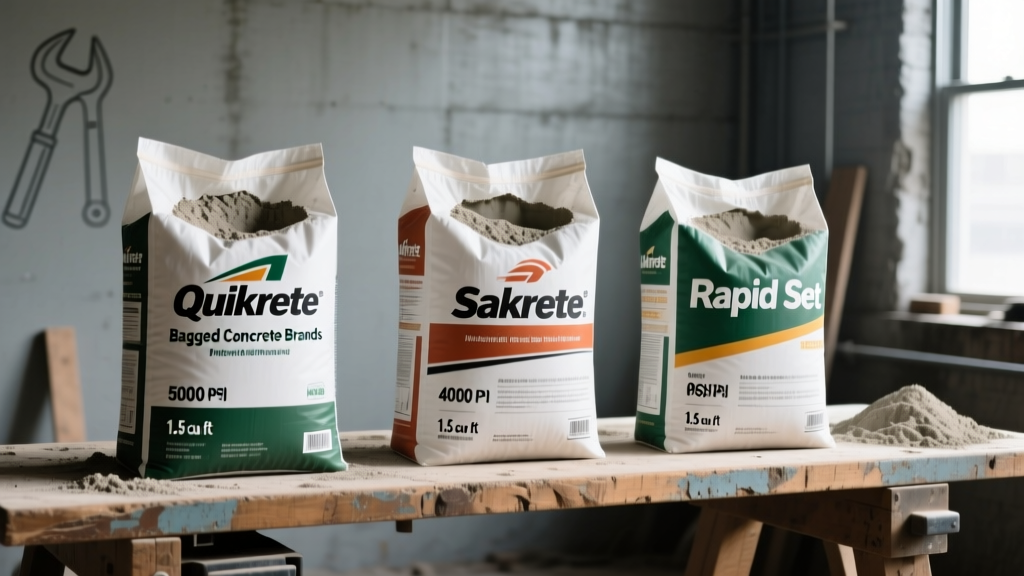
The Big Three: Quikrete vs. Sakrete vs. Rapid Set
When specifying bagged concrete for structural footings, slab patches, or architectural precast work, the market is dominated by three primary manufacturers. Understanding their distinct product philosophies is critical for avoiding catastrophic pour failures. In 2026, supply chain stabilization has normalized bag weights and regional availability, but pricing tiers remain strictly segmented by chemical admixture complexity.
- Quikrete: The undisputed market leader with the broadest SKU count. Best for general contractors needing a one-stop-shop for standard, high-strength, and specialty architectural mixes.
- Sakrete: Strong regional dominance, particularly in the Midwest and Southeast. Often priced 5-8% lower than Quikrete for standard mixes, with a superior masonry and resurfacing product line.
- Rapid Set (CTS Cement): The premium tier. Utilizes calcium sulfoaluminate (CSA) cement rather than traditional Portland cement. Engineered for ultra-high early strength, cold-weather pouring, and time-critical commercial repairs.
Product Line Deep-Dive: Matching the Mix to the Job
Selecting the correct concrete bag requires matching the mix design to the structural load and environmental conditions of the project. Here is a technical breakdown of the most critical product lines available this year.
Standard & High-Strength Mixes (4,000 - 5,000 PSI)
For structural footings, deck posts, and standard 4-inch slabs, standard mixes are sufficient. However, for driveways or shop floors subject to vehicular traffic, high-strength variants are mandatory.
- Quikrete Concrete Mix (Standard): Yields 4,000 PSI at 28 days. Ideal for footings and setting posts. 2026 average cost: $6.25 per 80lb bag.
- Quikrete 5000: A commercial-grade, high-early-strength mix. Reaches 5,000 PSI at 28 days but achieves walk-on strength in just 10-12 hours due to optimized aggregate grading and accelerating admixtures. Average cost: $7.85 per 80lb bag.
- Sakrete High Strength: Direct competitor to Quikrete 5000. Features a slightly coarser aggregate profile, making it excellent for deep structural piers where maximum density is required. Average cost: $7.45 per 80lb bag.
Fast-Setting & Repair Mixes
Time is the most expensive variable in commercial construction. Fast-setting bags utilize calcium chloride or non-chloride accelerators to drastically reduce initial set times.
- Quikrete Fast-Setting: Sets in 20 to 40 minutes. Reaches 4,000 PSI in 24 hours. Critical limitation: Not recommended for large continuous pours exceeding 2 cubic feet per batch, as the exothermic reaction can cause thermal cracking.
- CTS Rapid Set Cement All: The industry standard for DOT and commercial patching. Sets in 15 minutes and reaches an astonishing 9,000 PSI at 28 days. Because it is CSA-based, it does not shrink, making it the only acceptable choice for anchoring bolts and machinery bases. Average cost: $14.50 per 55lb bag.
Specialty & Architectural Mixes
Standard bagged concrete lacks the flowability and fine aggregate structure required for thin-profile architectural applications. Using standard mix for countertops will result in severe bug-holing and edge spalling.
- Quikrete Countertop Mix: A polymer-modified, flowable mix with a maximum aggregate size of 3/32-inch. Yields 6,000 PSI and is designed to be cast in melamine forms without requiring heavy mechanical vibration. Average cost: $19.50 per 50lb bag.
- Sakrete Top 'N Bond: A polymer-modified resurfacer designed for overlays as thin as 1/2-inch. Contains bonding agents that eliminate the need for a separate liquid bonding adhesive on the substrate.
2026 Bagged Concrete Comparison Matrix
| Brand / Product | Target PSI (28-Day) | Initial Set Time | 2026 Avg Cost | Yield (cu ft) | Ideal Application |
|---|---|---|---|---|---|
| Quikrete Standard | 4,000 | 24-48 Hours | $6.25 (80lb) | 0.60 | Footings, post setting |
| Quikrete 5000 | 5,000 | 10-12 Hours | $7.85 (80lb) | 0.60 | Driveways, shop floors |
| Quikrete Fast-Setting | 4,000 | 20-40 Mins | $8.50 (50lb) | 0.37 | Fence posts, small patches |
| CTS Rapid Set Cement All | 9,000 | 15 Mins | $14.50 (55lb) | 0.40 | Bolt anchoring, DOT repair |
| Quikrete Countertop | 6,000 | 24 Hours | $19.50 (50lb) | 0.34 | Precast countertops, sinks |
The Math: Calculating Yield and Procurement
Under-ordering bagged concrete leads to cold joints and structural weakness; over-ordering results in wasted capital and heavy disposal fees. Precision in yield calculation is non-negotiable.
An 80-pound bag of standard concrete yields exactly 0.60 cubic feet.
To calculate bags needed for a slab:
(Length x Width x Depth in feet) / 0.60 = Total Bags.Always apply a 10% waste and subgrade-variance multiplier to your final bag count.
For example, a 10x10 foot patio poured at 4 inches thick (0.33 feet) requires 33 cubic feet of volume. Divided by 0.60, that is 55 bags. Adding the 10% waste factor brings the procurement target to 61 bags. For any project requiring more than 80 bags (roughly 2 cubic yards), transition to ready-mix trucks to ensure continuous pour integrity and lower per-yard costs.
Critical Mixing & Curing Mistakes That Ruin Bagged Concrete
Bagged concrete is engineered in a controlled factory environment. The majority of compressive strength failures occur on the job site due to improper site practices.
1. The Overwatering Trap
Adding extra water to make the mix "easier to shovel" is the most destructive habit in DIY concrete work. According to the Portland Cement Association, exceeding the manufacturer's specified water volume by just 10% can reduce the ultimate compressive strength of the slab by up to 20%. If the mix is too stiff, use a plasticizing admixture, not water.
2. Re-Tempering Fast-Setting Mixes
Never add water to a fast-setting or CSA-based mix once it begins to stiffen (the initial set). Re-tempering breaks the crystalline matrix forming within the paste, resulting in a chalky, structurally useless material that will eventually spall under load.
3. Ignoring the Curing Window
Concrete does not "dry"; it cures via a chemical hydration reaction. If the surface loses moisture to wind or heat before the 28-day cure is complete, plastic shrinkage cracking will occur. The American Concrete Institute (ACI) mandates continuous moisture retention for a minimum of 7 days for standard mixes. Apply a liquid membrane curing compound or wet burlap immediately after the final trowel finish.
4. Silica Dust Exposure During Dry Dumping
When emptying dry concrete bags into a mechanical mixer, massive amounts of respirable crystalline silica are released. Under OSHA's silica standards, dry dumping requires strict Table 1 compliance. Always wear a NIOSH-approved N95 or P100 respirator, and consider using a mixer with an integrated water-mist dust suppression system or pre-wetting the drum before dumping the bags.
Sourcing and Storage: Keeping Your Bags Viable
Portland cement is highly hygroscopic. If a bag of concrete absorbs ambient moisture, the cement particles will begin to hydrate inside the paper packaging, creating "warehouse set" or hard lumps.
- Shelf Life: Standard bagged concrete has a maximum viable shelf life of 6 months in standard warehouse conditions, or up to 12 months if stored in a climate-controlled, dehumidified environment.
- Palletizing: Never store bags directly on a concrete floor or dirt. Always elevate pallets by at least 4 inches using dunnage to prevent ground-moisture wicking.
- The Squeeze Test: Before mixing, squeeze the corners of the bag. If the material feels hard or yields distinct, unbreakable lumps, the cement has pre-hydrated. Discard the bag; it will not achieve its rated PSI.
By matching the exact chemical profile of the bagged mix to your structural requirements, calculating yields with a strict waste factor, and adhering to rigid water-to-cement ratios, you can achieve commercial-grade results using retail bagged concrete.