Paver Driveway Cost vs Concrete: 2026 Technical Specs
Analyze paver driveway cost vs concrete through technical specs. Compare PSI ratings, base prep, ASTM standards, and 2026 pricing per square foot.

The Core Engineering Divergence: Monolithic Slab vs. Flexible Matrix
The cost differential between interlocking concrete pavers and poured concrete driveways is rarely just a premium for aesthetics. When analyzing paver driveway cost vs concrete from a technical specifications perspective, the price gap is driven by material manufacturing tolerances, compressive strength requirements, and subgrade preparation protocols. In 2026, understanding these structural variables is essential for contractors and homeowners evaluating lifecycle value against initial capital expenditure. Poured concrete operates as a rigid, monolithic slab relying on tensile reinforcement and uniform subgrade support. Concrete pavers function as a flexible, segmented matrix that distributes loads through interlock and friction, requiring entirely different base engineering.
Material Specifications and Compressive Strength
Standard residential poured concrete driveways typically specify a 4,000 PSI mix design with a maximum water-cement ratio of 0.45 to ensure freeze-thaw durability. According to guidelines from the National Ready Mixed Concrete Association (NRMCA), this mix is usually placed at a 4-inch slump with 5% to 7% air entrainment. The material itself is relatively inexpensive, but it requires strict curing protocols to prevent plastic shrinkage cracking.
Conversely, concrete pavers are manufactured to ASTM C936 standards. This specification mandates a minimum compressive strength of 8,000 PSI and water absorption of less than 5%. To achieve this, pavers are produced using a zero-slump, high-density concrete mix that is vibrated and hydraulically pressed in steel molds. This intensive manufacturing process makes the unit material cost of pavers inherently higher than ready-mix concrete delivered to the site.
Subgrade and Base Preparation: Where the Budget Shifts
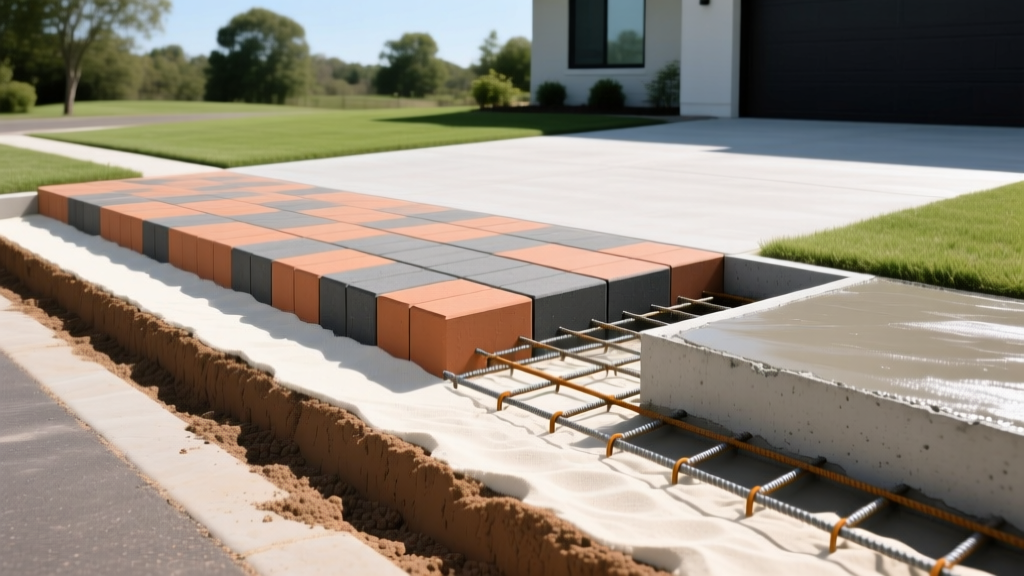
The most significant technical driver of the paver driveway cost vs concrete debate occurs below the surface. A monolithic concrete slab can often be poured directly over a well-compacted native subgrade or a minimal 4-inch gravel base, provided the soil bearing capacity is adequate. Pavers, however, require a highly engineered aggregate base to prevent differential settlement and maintain surface interlock.
| Base Component | Poured Concrete Specification | Concrete Paver Specification |
|---|---|---|
| Excavation Depth | 8 to 10 inches | 11 to 14 inches |
| Base Aggregate | 4 inches compacted gravel (optional) | 6 to 8 inches Class II road base (ASTM D2940) |
| Compaction Requirement | 95% Standard Proctor | 98% Standard Proctor (vibratory roller) |
| Bedding Layer | None (poured directly on base/subgrade) | 1 inch coarse concrete sand (ASTM C33) |
| Estimated Base Cost | $1.00 - $2.00 per sq. ft. | $3.50 - $5.50 per sq. ft. |
The Interlocking Concrete Pavement Institute (ICPI) strictly mandates the use of open-graded or well-graded aggregates compacted in 2-inch lifts. This extra aggregate volume, combined with the labor and heavy equipment required for 98% Proctor density compaction, adds substantial upfront cost before a single paver is laid.
2026 Cost Breakdown by Technical Component
When breaking down the total installed cost per square foot, the technical requirements dictate the labor and material distribution. The following ranges reflect 2026 national averages for standard residential driveways (400-600 sq. ft.) with standard access.
- Poured Concrete ($9.00 - $15.50 per sq. ft.): The majority of this cost is tied to forming, finishing labor (screeding, floating, troweling), and joint cutting. The ready-mix concrete itself accounts for only 25% to 30% of the total project cost.
- Concrete Pavers ($18.00 - $31.50 per sq. ft.): The cost is heavily weighted toward base preparation (30%) and meticulous laying/screeding labor (35%). The paver units account for roughly 25% of the cost, with edge restraints and polymeric sand making up the remainder.
Edge Restraints and Jointing: The Hidden Engineering Costs
A critical structural difference lies in how each system manages lateral forces and thermal expansion. Poured concrete relies on internal friction and mass, but it requires control joints to manage tensile stresses from shrinkage. Standard practice dictates saw-cutting control joints every 10 feet (or 2.5 times the slab thickness in feet) to a depth of one-quarter the slab thickness. This is a low-cost, high-speed operation.
Pavers, however, require rigid perimeter confinement. Without edge restraints, the lateral forces from vehicular turning and braking will cause the paver matrix to spread, leading to joint widening and structural unraveling. Technical specifications require rigid PVC or composite edge restraints (such as SnapEdge or Perma-Edge) secured with 10-inch galvanized steel spikes driven every 12 inches into the base aggregate. Furthermore, the joints between pavers must be filled with polymeric sand (e.g., Techniseal Next Generation or Gator Dust), which is swept in, compacted, and activated with water to create a flexible, water-resistant bond that prevents washout and weed growth. This edge and jointing system adds $1.50 to $2.50 per square foot to the paver installation cost.
Permeable Systems: A Technical Cost Sub-Category
When municipal stormwater regulations mandate on-site infiltration, the cost dynamics shift. Permeable Interlocking Concrete Pavement (PICP) utilizes open-graded aggregates (ASTM No. 57 and No. 8) in the base and bedding layers to detain and infiltrate runoff. PICP installations typically range from $25.00 to $40.00 per square foot due to the premium cost of washed, single-size aggregates and specialized vacuum-sweeping installation techniques.
Pervious concrete (ASTM C1701) is an alternative that generally costs less to install ($15.00 to $25.00 per square foot) but presents severe technical challenges. Pervious concrete has a narrow placement window, requires strict moisture control during curing to prevent raveling, and is highly susceptible to surface degradation in freeze-thaw climates if improperly maintained. According to the American Concrete Institute (ACI), the lifecycle maintenance of pervious concrete often exceeds that of PICP, negating the initial installation savings in many northern climates.
Structural Failure Modes and Lifecycle Economics
Evaluating cost requires analyzing how each material fails and the expense of remediation.
Concrete Failure Modes
The primary failure mode for poured concrete is cracking due to differential subgrade settlement, tree root intrusion, or overloading. Because the slab is monolithic, a localized subgrade failure translates into a structural crack across the surface. Repairing a settled concrete driveway requires full-depth sawing, removal of the affected panel, subgrade re-compaction, and pouring a new patch that will never perfectly match the faded original slab. Complete slab replacement costs $8.00 to $14.00 per square foot, plus heavy demolition and haul-away fees.
Paver Failure Modes
Pavers typically fail due to edge restraint blowout, base washout from improper drainage, or settling from inadequate initial compaction. The resulting symptoms are spreading joints, localized depressions, or a wavy surface profile. However, because the system is modular, repairs are highly localized and cost-effective. The contractor simply 'unzips' the affected area by removing the pavers, re-compacts the ASTM D2940 base, re-screeds the bedding sand, and relays the original pavers. The repair cost is generally confined to hourly labor, with zero material replacement costs unless the original pavers were damaged during extraction.
'The true cost of a driveway is not just the initial capital outlay, but the net present value of its lifecycle maintenance. A modular paver system offers a distinct economic advantage in environments where subgrade stability cannot be guaranteed over a 30-year horizon.' — Structural Pavement Engineering Principles
Technical Decision Matrix: When to Specify Which
Use the following engineering parameters to determine the most cost-effective specification for your specific site conditions:
- Specify Poured Concrete When: The native subgrade has a high California Bearing Ratio (CBR > 10), the budget is strictly constrained to under $12 per square foot, the design calls for large, unbroken planar surfaces, and heavy point-loads (like RV jack stands) are anticipated without specialized paver base reinforcement.
- Specify Concrete Pavers When: The site features expansive clays or poor drainage, utility access is required beneath the driveway (pavers can be removed and replaced without cutting concrete), the design requires complex curves or integrated permeable stormwater management, and the owner prioritizes a 50-year lifecycle with modular repairability over initial cost savings.
Written by
Marcus ChenMarcus Chen is a licensed structural engineer (PE) and building materials analyst with over 12 years of experience across residential, commercial, and industrial construction. He holds a Master of Science in Civil Engineering from UC Berkeley and spent six years at Thornton Tomasetti before transitioning to independent consulting and technical writing. Marcus specializes in material selection for seismic-prone regions, concrete reinforcement strategies, and lifecycle cost analysis. His work has been cited by the American Concrete Institute (ACI) and the Structural Engineers Association of California (SEAOC). When he is not on a job site or at his desk, you will find him hiking the Sierra Nevada or restoring a 1920s craftsman bungalow in Oakland, CA.
More from Marcus Chen
View all
Construction Cost
How Much Did the Eiffel Tower Cost to Build?
How much did the Eiffel Tower cost to build in 1889? We adjust for inflation and compare its budget to modern skyscraper construction.
Aug 4, 2026

Fire Resistance
What Is a Fire Resistant Material? Testing & Certification Guide
Discover what is a fire resistant material through ASTM and UL testing. Learn how fire ratings, certifications, and assemblies work in construction.
Aug 4, 2026

Construction Cost
How Much Did the Burj Khalifa Cost to Build?
How much did the Burj Khalifa cost to build? We break down the $1.5B project and extract 5 money-saving strategies for your next build.
Jul 30, 2026