What Is the Best Base Material for Concrete Slab Construction?
Discover the best base material for concrete slab projects. Compare gravel, RCA, and sand, and learn how subbase choices impact your mix design.

The Anatomy of a Slab: Subgrade vs. Subbase
When evaluating the best base material for concrete slab applications, contractors and engineers must first distinguish between the subgrade and the subbase. The subgrade is the native, undisturbed soil (or engineered fill) that forms the foundational earth layer. The subbase is the engineered granular layer placed directly on top of the subgrade to provide a stable, well-draining working platform for the concrete pour.
According to guidelines published by the Portland Cement Association (PCA), a properly designed subbase prevents moisture accumulation, mitigates frost heave, and distributes structural loads evenly. Skipping the subbase and pouring directly on a clay-heavy subgrade is a primary cause of differential settlement and catastrophic slab cracking.
Fine-grained soils like silt and clay act as a wick, drawing groundwater upward via capillary action. If your concrete mix is placed directly on these soils, hydrostatic pressure will force moisture vapor through the slab's capillary network, ruining epoxy coatings, hardwood floors, and moisture-sensitive adhesives. A coarse, granular subbase acts as a capillary break, severing this moisture pathway.
Evaluating the Best Base Material for Concrete Slab Applications
Not all aggregates are created equal. The ideal subbase material must possess high shear strength, excellent drainage characteristics, and the ability to achieve high compaction density. Here is how the top contenders compare.
1. Crushed Stone (Gravel) - The Gold Standard
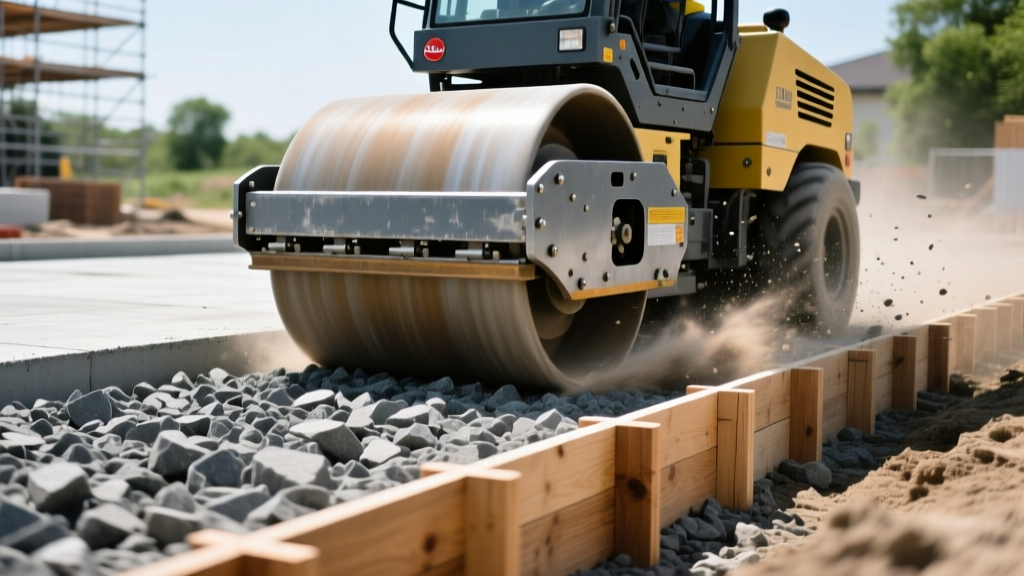
Specifically, 3/4-inch minus crushed stone (often referred to as crusher run or dense-graded aggregate conforming to ASTM D2940) is universally recognized as the best base material for concrete slab foundations. The 'minus' designation means it includes stone dust and smaller particles that fill the voids between the larger 3/4-inch angular rocks. When compacted, these angular edges mechanically interlock, creating a rigid, almost concrete-like platform that resists lateral shifting.
2. Recycled Concrete Aggregate (RCA) - The Sustainable Alternative
RCA is produced by crushing demolished concrete structures. It is highly sustainable and generally 15% to 20% cheaper than virgin gravel. However, RCA retains residual cement paste, making it highly absorptive. If used as a subbase, it can rapidly steal moisture from your fresh concrete mix, leading to plastic shrinkage cracking if not pre-wetted before the pour.
3. Washed Concrete Sand - The Problematic Option
While sand is easy to grade and provides a smooth finishing surface, it is a poor choice for a structural subbase. Sand lacks mechanical interlock, meaning it shifts under heavy point loads (like forklift wheels or structural columns). Furthermore, fine sand retains water and is highly susceptible to 'pumping'—a phenomenon where repeated traffic loads force the saturated sand up through the concrete's control joints.
Base Material Comparison Matrix
| Material Type | Drainage Rating | Compaction Target | Est. Cost (2026) | Best Application |
|---|---|---|---|---|
| 3/4" Minus Crushed Stone | Excellent | 95% Modified Proctor | $18 - $32 / ton | Heavy-duty industrial, driveways, structural slabs |
| Recycled Concrete (RCA) | Good | 95% Modified Proctor | $12 - $24 / ton | Residential patios, sidewalks, budget-conscious projects |
| Washed Concrete Sand | Poor | 90% Standard Proctor | $15 - $28 / ton | Thin leveling beds over gravel (not as primary base) |
| Rounded River Gravel | Excellent | N/A (Cannot interlock) | $20 - $35 / ton | French drains (Avoid as a slab subbase) |
How Base Material Dictates Concrete Mix Design
The choice of subbase directly influences the concrete mix design. Ignoring this relationship is a frequent cause of slab failure. The Federal Highway Administration (FHWA) and various pavement engineering bodies emphasize that the moisture state of the base material must be accounted for during batch plant calibration.
The Moisture Theft Phenomenon
If you select a highly absorptive base like dry Recycled Concrete Aggregate (RCA) or bone-dry crushed stone, the subbase will aggressively wick water out of the fresh concrete mix. This localized reduction in the water-cement (w/c) ratio at the bottom of the slab causes severe plastic shrinkage, resulting in map cracking or curling at the edges. Solution: Pre-wet the subbase 12 to 24 hours before the pour until it is in a saturated surface-dry (SSD) condition, or instruct the batch plant to increase the initial slump by 1 to 2 inches using a mid-range water reducer (HRWR) to maintain the structural w/c ratio.
Vapor Transmission and Admixtures
If site constraints force the use of a poorly draining base, or if the native subgrade is heavy clay, vapor transmission becomes a critical threat. In these scenarios, the mix design must be fortified. You must specify a low-permeability concrete mix with a maximum w/c ratio of 0.42. Additionally, incorporating a crystalline waterproofing admixture (such as Xypex Admix C-1000 NF) at a dosage of 1.5% by weight of cement will react with the moisture wicking up from the base, forming insoluble needle-like crystals that block the concrete's capillary tracts.
Placing a 15-mil polyethylene vapor retarder (ASTM E1745) directly over a wet, fine-grained subbase traps hydrostatic pressure. When the sun heats the slab, the trapped water expands and vaporizes, causing blistering in floor coatings and spalling of the concrete surface. Always place a 2-inch layer of clean, dry sand or a geocomposite drainage mat over the vapor barrier to provide a pressure-relief plane.
Step-by-Step Subbase Preparation Framework
Achieving the full structural benefit of 3/4-inch minus crushed stone requires rigorous execution. Follow this framework to ensure optimal load transfer.
- Subgrade Excavation and Proof-Rolling: Excavate to the required depth. Proof-roll the native subgrade with a fully loaded dump truck or heavy pneumatic roller. Any areas that deflect more than 1/2 inch or exhibit 'pumping' (water squelching to the surface) must be excavated and replaced with engineered fill.
- Geotextile Separation (If Required): If the subgrade is soft clay or silt, lay a non-woven geotextile fabric (e.g., Mirafi 140N). This prevents the subgrade from migrating up into the subbase voids under dynamic loading, a failure mode known as 'subgrade intrusion'.
- Layered Placement and Compaction: Do not dump and spread 6 inches of gravel at once. Place the crushed stone in maximum 3-inch lifts (layers). Compact each lift using a vibratory plate compactor or a smooth-drum roller until you achieve 95% Modified Proctor density (verified via nuclear density gauge testing).
- Fine Grading: Use a laser-guided screed or a motor grader to achieve the final subbase elevation. The tolerance should be +/- 1/4 inch over a 10-foot straightedge. This ensures uniform slab thickness, preventing weak points where the concrete is too thin.
2026 Cost Breakdown: Base Materials and Preparation
Budgeting accurately for subbase preparation prevents margin erosion on fixed-bid contracts. Below are the average regional costs for materials and labor in 2026.
- 3/4" Minus Crushed Stone (Delivered): $18 to $32 per ton (varies by local quarry proximity).
- Geotextile Fabric (Non-woven, 12ft rolls): $0.45 to $0.80 per square foot.
- Compaction Labor & Equipment: $1.25 to $2.50 per square foot, depending on site access and lift thickness.
- Nuclear Density Testing (Third-Party): $350 to $600 per day for technician and equipment mobilization.
Pro Tip: For a standard 4-inch thick, 1,000 sq. ft. residential slab requiring a 4-inch compacted gravel base, you will need approximately 22 tons of crushed stone (accounting for compaction yield and 5% waste), bringing the material cost to roughly $550 to $700.
Expert FAQ: Base Material Edge Cases
Can I use crushed asphalt as a base for a concrete slab?
Crushed asphalt (RAP - Reclaimed Asphalt Pavement) is generally not recommended as a subbase for new concrete slabs. The bitumen binder in the asphalt can soften under the heat of hydration generated by curing concrete, leading to localized settlement. Furthermore, petroleum distillates can migrate into the concrete matrix, severely compromising the adhesion of future floor coatings and sealers.
How thick should the gravel base be for a driveway vs. a garage slab?
For a standard passenger vehicle driveway, a 4-inch compacted crushed stone base over a stable subgrade is sufficient. For a garage slab that will support heavy pickup trucks, RVs, or automotive lifts, increase the subbase thickness to 6 to 8 inches, compacted in 3-inch lifts, and upgrade the concrete mix to a minimum of 4,000 PSI with fiber reinforcement.
What is the best base material for concrete slab projects in freeze-thaw climates?
In regions with severe freeze-thaw cycles, the subbase must be completely free-draining to prevent water from accumulating and freezing beneath the slab (which causes frost heave). Use a clean, washed 3/4-inch crushed stone with no fines (often called clear stone or drainage stone) for the bottom 4 inches, topped with a 2-inch layer of 3/4-inch minus to provide a smooth grading surface. Ensure perimeter French drains are installed to daylight the water away from the subbase.
Written by
James ThorntonJames Thornton is a construction industry veteran with 25 years of hands-on experience in wood framing, lumber grading, and residential building codes. He started as a framing carpenter in rural Oregon, earned his ICC Residential Building Inspector certification, and eventually became a senior plan reviewer for the City of Portland Bureau of Development Services. James holds a B.S. in Wood Science & Technology from Oregon State University and is a certified lumber grader through the West Coast Lumber Inspection Bureau (WCLIB). He has inspected over 3,000 residential construction sites and authored the city's internal guide on advanced framing techniques (2x6 at 24" O.C.). James lives in Bend, OR, where he builds custom timber-frame cabins and competes in lumberjack sports.
More from James Thornton
View all
Insulation
Best Home Insulation Materials: Complete 2026 Guide
Compare top home insulation materials for 2026. Find R-values, installed costs per square foot, and best uses for fiberglass, spray foam, and mineral wool.
Aug 4, 2026

Sustainable Building
Certify Your Green Building Material for LEED and WELL
Step-by-step guide to certifying a green building material for LEED v5 and WELL v2. Master EPDs, HPDs, and VOC limits for 2026 project specifications.
Aug 4, 2026

Stone & Masonry
Veneer Stacked Stone Panels: Interior Design & Style Showcase
Discover how veneer stacked stone panels transform interiors. Explore modern design profiles, material pairings, and technical installation specs.
Aug 4, 2026