Portland Cement Concrete Taxonomy: Selecting Type I to V
Master portland cement concrete taxonomy. Compare Type I through V and blended cements to select the exact mix for your structural or slab project.
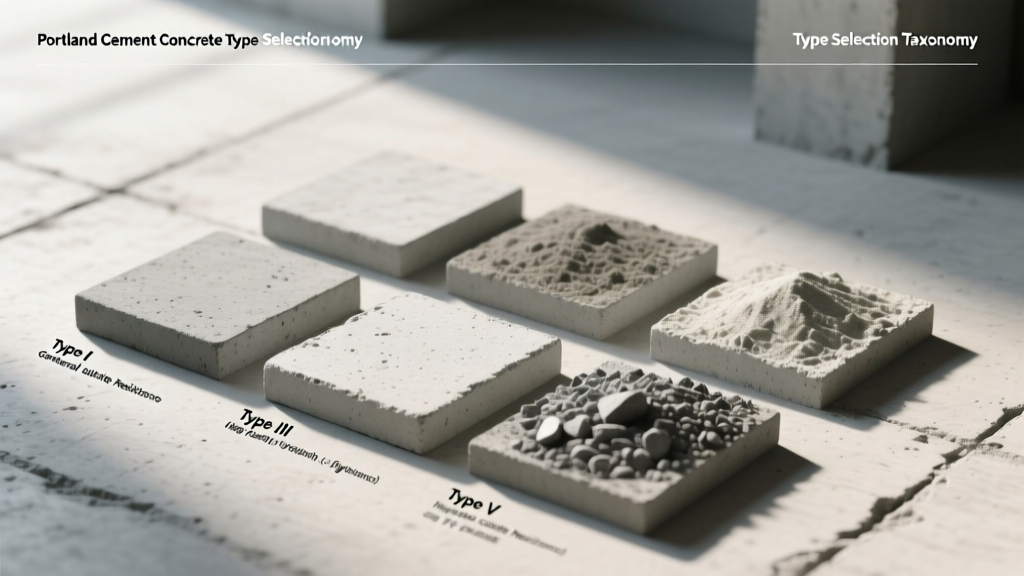
The Core Taxonomy: Decoding ASTM C150 Cement Types
Portland cement concrete (PCC) is not a monolithic material. The binder itself—Portland cement—is chemically tuned during the clinkerization process to yield distinct performance profiles. The ASTM C150 standard classifies Portland cement into five primary types based on the proportions of four main Bogue compounds: tricalcium silicate (C3S), dicalcium silicate (C2S), tricalcium aluminate (C3A), and tetracalcium aluminoferrite (C4AF). Understanding these compounds is the first step in precise material selection.
- C3S (Alite): Drives early strength (1-28 days) and initial heat of hydration.
- C2S (Belite): Contributes to long-term strength (beyond 28 days) with low heat generation.
- C3A (Aluminate): Controls flash setting and is highly vulnerable to sulfate attack. Lower C3A equals higher sulfate resistance.
- C4AF (Ferrite): Lowers the kiln temperature required for clinkerization; contributes to the gray color but adds minimal strength.
Type I: General Purpose
The baseline for most residential and commercial flatwork. Type I has no special chemical restrictions, typically containing up to 12% C3A. It is suitable for environments where the concrete will not be exposed to severe sulfate attack or excessive heat generation. Use this for standard interior slabs, sidewalks, and non-structural architectural elements.
Type II: Moderate Sulfate Resistance and Heat
Type II restricts C3A to a maximum of 8% and limits the sum of C3S and C3A to control heat. This is the default choice for foundations, retaining walls, and bridge piers in soils with moderate sulfate concentrations. In many North American markets, Type I and Type II are co-produced and sold as a dual-certified "Type I/II" to streamline supply chains.
Type III: High Early Strength
Chemically similar to Type I, but ground to a much finer Blaine fineness (often exceeding 4,000 cm²/g compared to the standard 3,200 cm²/g) and featuring higher C3S content. Type III accelerates the hydration process, allowing for early form removal and faster construction schedules. It is critical for precast plants, emergency road repairs, and cold-weather pours where rapid strength gain prevents freeze-thaw damage.
Type IV: Low Heat of Hydration
Engineered for massive structural elements like gravity dams, Type IV minimizes C3S and C3A while maximizing C2S to drastically reduce thermal cracking risks. Procurement Note: Type IV is largely obsolete in modern commercial construction. Engineers now achieve low-heat profiles more economically by specifying Type II cement blended with high volumes of fly ash or slag.
Type V: High Sulfate Resistance
Strictly limited to a maximum of 5% C3A. Type V is mandatory for marine environments, agricultural facilities, and foundations built in alkali-rich desert soils. Because producing low-C3A clinker requires specialized kiln runs and raw material sourcing, Type V carries a premium price and longer lead times.
The Sulfate Exposure Matrix: ACI 318 Selection Framework
Specifying the correct cement type requires geotechnical data. According to ACI 318 building code requirements, sulfate exposure is classified by testing soil and groundwater samples. Use the following matrix to dictate your mix design parameters:
| Exposure Class | Soil Sulfate (SO4) | Water Sulfate (ppm) | Required Cement Type | Max w/c Ratio |
|---|---|---|---|---|
| S0 (Negligible) | < 0.10% | < 150 | Type I or II | 0.50 |
| S1 (Moderate) | 0.10% - 0.20% | 150 - 1,000 | Type II (or IP/IS) | 0.50 |
| S2 (Severe) | 0.20% - 2.00% | 1,000 - 10,000 | Type V | 0.45 |
| S3 (Very Severe) | > 2.00% | > 10,000 | Type V + Pozzolan/Slag | 0.45 |
Beyond Traditional: Blended and Low-Carbon Alternatives
The taxonomy of Portland cement concrete has expanded significantly under ASTM C595 to address embodied carbon. If your project targets LEED certification or mandates Environmental Product Declarations (EPDs), traditional Type I-V cements must be evaluated against blended alternatives.
Portland-Limestone Cement (PLC / Type IL)
PLC replaces 5% to 15% of the energy-intensive clinker with finely ground limestone. According to research by the National Institute of Standards and Technology (NIST), the limestone particles act as nucleation sites that accelerate C3S hydration, effectively offsetting the strength loss usually associated with clinker dilution. Type IL performs identically to Type I/II in standard applications but reduces the mix's carbon footprint by approximately 10%. As of 2026, PLC has achieved near-total market penetration in North America, often replacing Type I at price parity.
LC3 (Limestone Calcined Clay Cement)
An emerging ternary blend combining clinker, calcined clay, and limestone. LC3 can reduce CO2 emissions by up to 40% compared to ordinary Portland cement. While not yet universally codified in all regional building codes, it is increasingly specified in large-scale commercial infrastructure projects where low-carbon procurement mandates are enforced.
Critical Admixture Interactions and Edge Cases
Selecting the cement type is only half the battle; chemical admixtures must be matched to the cement's specific compound profile to avoid catastrophic failure modes.
- Type III + Calcium Chloride Accelerators: While calcium chloride rapidly boosts early strength, combining it with the already high-heat profile of Type III in thick sections (>18 inches) virtually guarantees thermal cracking. Use non-chloride accelerators (like calcium nitrate) instead.
- Type V + Polycarboxylate Ether (PCE) Superplasticizers: Type V's low C3A content can cause severe slump-loss issues when paired with certain PCE high-range water reducers. Always conduct a mock-up batch test to verify slump retention over 90 minutes before full-scale placement.
- Type II + Air-Entraining Agents (AEA): Fly ash blended with Type II cement often contains unburned carbon, which absorbs AEA surfactants. If using Type IP (fly ash blend), increase the AEA dosage or specify a low-carbon fly ash (LOI < 2%) to maintain the required 4-7% air void system for freeze-thaw resistance.
Procurement Realities and 2026 Pricing Benchmarks
Material selection directly impacts project budgets and timelines. Bulk pricing for Portland cement fluctuates based on regional kiln capacity, energy costs, and carbon taxation. Below are the baseline bulk procurement ranges (per metric ton) for North American markets:
Type I/II & Type IL (PLC)
$135 - $155 / ton
High availability. Standard lead times (24-48 hours).
Type III (High Early)
$155 - $180 / ton
Moderate availability. Requires specific grinding runs.
Type V (High Sulfate)
$175 - $210 / ton
Low availability. Often requires 2-3 week lead times and minimum order quantities (e.g., 100+ tons).
Pro-Tip for Mill Test Reports (MTRs): Never accept a bulk delivery without reviewing the MTR. Verify that the reported C3A percentage aligns with your exposure class requirements, and check the Blaine fineness. A variance of more than 5% in fineness between batches will drastically alter your water demand and setting times, leading to finishing defects on the slab surface.
Summary: The Selection Decision Tree
To finalize your Portland cement concrete specification, run your project parameters through this sequence:
- Check Geotechnical Report: If soil sulfates exceed 0.10%, immediately pivot to Type II or Type V based on the ACI 318 matrix.
- Assess Element Mass: If the pour exceeds 3 feet in thickness, reject Type III and standard Type I. Mandate Type II with a 30% fly ash or slag substitution to cap peak hydration temperatures below 158°F (70°C).
- Evaluate Schedule Constraints: If formwork must be stripped in under 12 hours, specify Type III, but enforce strict thermal monitoring.
- Optimize for Carbon: Default to Type IL (PLC) for all general-purpose applications unless structural engineers specifically restrict limestone content due to specialized surface hardening requirements.
By aligning the chemical taxonomy of the cement with the specific environmental and structural demands of the project, you eliminate premature degradation, optimize procurement costs, and ensure long-term structural integrity.