Polished Concrete Floors vs Tiles: Mix Design & Types
Compare polished concrete floors vs tiles via mix design. Discover optimal PSI, aggregate types, and admixtures that outperform ceramic and porcelain tile.

The Structural Divergence: Monolithic Slabs vs. Layered Assemblies
Most architectural debates surrounding polished concrete floors vs tiles focus superficially on surface aesthetics or maintenance routines. However, the true performance, longevity, and cost divergence lies beneath the finish line in the mix design. Polished concrete is a monolithic, structural wearing surface where the concrete matrix itself acts as the final floor. Tile, conversely, is a layered assembly relying on a substrate, a bonding agent (mortar or adhesive), and a manufactured ceramic or porcelain wear layer.
Understanding this fundamental difference dictates how we approach concrete mix proportioning. A slab intended to receive porcelain tile merely needs to provide a stable, flat, and structurally sound base. A slab intended to be ground and polished must be engineered from the batch plant to withstand aggressive mechanical abrasion while revealing a dense, visually consistent aggregate matrix.
Engineering the Polishable Concrete Mix
To achieve a high-gloss, durable finish that rivals or exceeds the compressive strength of commercial porcelain tile, the concrete mix must be specifically proportioned. Standard ready-mix designs used for residential foundations or tile underlayments will fail under the planetary grinders used in polishing, resulting in aggregate pop-outs and a mottled, inconsistent sheen.
Compressive Strength and Water-Cement Ratios
According to guidelines published by the American Society of Concrete Contractors (ASCC), a polishable slab requires a minimum compressive strength of 4,000 PSI, with 5,000 to 6,000 PSI being the optimal target. This high strength is achieved not by simply adding more cement, but by strictly controlling the water-cement (w/c) ratio. An optimized polishable mix maintains a w/c ratio between 0.40 and 0.45. Higher water content increases capillary porosity, which prevents chemical densifiers from properly penetrating and reacting with the free lime during the polishing process.
Aggregate Selection: The Hidden Wear Layer
When comparing polished concrete floors vs tiles, the aggregate acts as the concrete's equivalent to the tile's glazed surface. For exposed aggregate polishes, the coarse aggregate must possess a Mohs hardness of 7 or higher. Quartz, granite, and trap rock are ideal. Soft aggregates like limestone or sandstone will grind away faster than the surrounding cement paste, creating a deeply pitted surface that cannot hold a high-grit resin polish.
While supplementary cementitious materials (SCMs) like fly ash improve workability, high volumes of Class F fly ash (above 15% replacement) severely hinder the polishing process. High fly ash mixes burnish prematurely under the grinder's friction, creating a false gloss that prevents chemical densifiers from penetrating the slab. Limit fly ash to 10-15% and avoid slag cement entirely if a vibrant, dye-integrated polish is specified.
Optimized 5,000 PSI Polishable Mix Proportions
The following batch proportions represent an idealized mix design for a 4-inch thick interior slab intended for a heavy exposed-aggregate polish. Data adapted from Portland Cement Association proportioning standards.
| Material | Weight per Cubic Yard | Function in Polish Matrix |
|---|---|---|
| Type I/II Portland Cement | 500 lbs | Primary binder; provides calcium hydroxide for densifier reaction. |
| Class F Fly Ash | 50 lbs (Max 10%) | Mild workability aid without compromising densifier penetration. |
| Fine Aggregate (Concrete Sand) | 1,100 lbs | Fills voids between coarse aggregate to ensure a dense paste. |
| Coarse Aggregate (3/8" Granite) | 1,800 lbs | Primary wear surface; Mohs 7 hardness resists micro-scratching. |
| Water | 225 lbs (27 gal) | Hydration; kept strictly to 0.41 w/cm ratio for low porosity. |
| Polycarboxylate Superplasticizer | 15 - 20 oz | High-range water reducer; maintains slump without adding water. |
The Tile Substrate: Why Standard Concrete Fails the Polish Test
If a builder attempts to polish a standard slab designed for tile installation, the results are often disastrous. Standard tile underlayment mixes typically target 2,500 to 3,000 PSI and utilize locally sourced, inexpensive aggregates (often soft river gravel or crushed limestone) to keep batch costs down. The Tile Council of North America (TCNA) requires substrates to be structurally sound and meet specific deflection criteria (L/360), but they do not mandate high surface hardness or specific aggregate mineralogy.
When a planetary grinder equipped with 30-grit metal bonds hits a standard 3,000 PSI limestone-aggregate slab, the soft aggregate tears out entirely. The resulting floor requires extensive patching with cementitious micro-toppings, effectively converting the monolithic slab into a layered system—negating the primary cost and structural benefits of choosing polished concrete over tile in the first place.
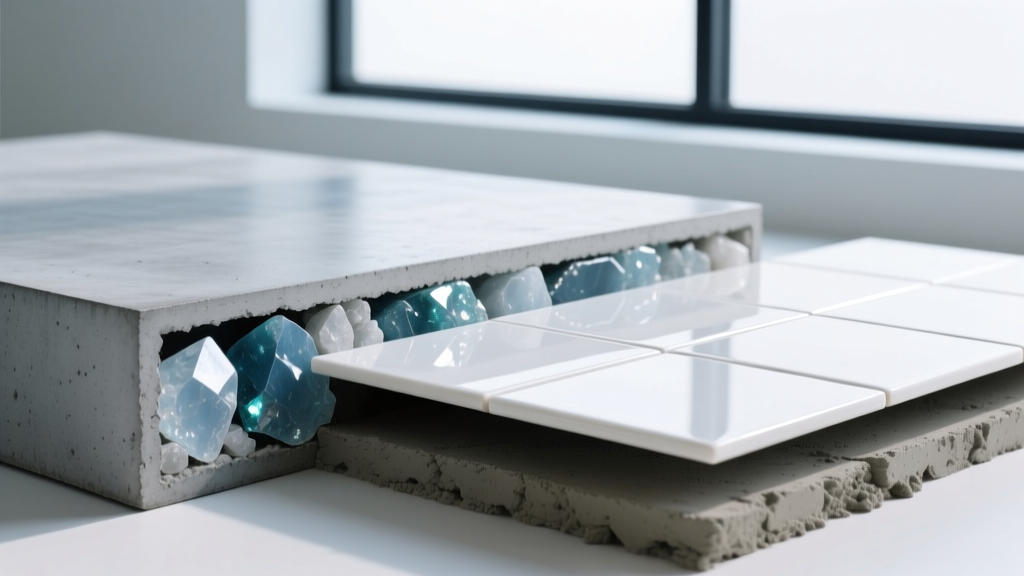
Material Comparison Matrix: Optimized Concrete vs. Porcelain Tile
Beyond the mix design, evaluating polished concrete floors vs tiles requires looking at how the finished materials perform under environmental and mechanical stress.
| Performance Metric | Polished Concrete (5,000 PSI Mix) | Large-Format Porcelain Tile |
|---|---|---|
| Surface Compressive Strength | 5,000 - 6,000 PSI (Monolithic) | 18,000 - 22,000 PSI (Manufactured Wear Layer) |
| Impact Resistance | High; absorbs shock through slab mass. | Low to Moderate; prone to shattering under point-impact. |
| Thermal Mass & Conductivity | Excellent; continuous mass for radiant heating. | Good, but interrupted by mortar bed and uncoupling membranes. |
| Moisture Vapor Transmission (MVT) | Requires penetrating densifiers; breathable. | Impervious surface; traps MVT below, risking mortar degradation. |
| Joint Requirements | Saw-cut control joints remain visible. | Grout lines and expansion joints required every 20-25 feet. |
Failure Modes Driven by Poor Mix Design
When specifying polished concrete instead of tile, contractors must actively mitigate mix-related failure modes that do not affect tiled floors:
- Aggregate Pop-outs: Caused by porous or soft coarse aggregate absorbing water during the batching process, freezing, and expanding, or simply tearing out under the grinder. Fix: Mandate hard-rock aggregate and strict ASTM C33 compliance.
- Micro-Cracking (Craze Cracking): Occurs when the w/c ratio is too high, or when finishing crews over-trowel the surface, trapping bleed water and creating a weak, high-shrinkage layer of pure cement paste (laitance). Fix: Limit slump to 4-5 inches and ban the addition of water on-site.
- Efflorescence: White, powdery salt deposits that ruin the clarity of a polish. This is exacerbated by high water content and excessive calcium hydroxide in the mix. Fix: Utilize a low w/c ratio and apply a high-quality lithium silicate densifier immediately after the initial grinding steps to lock up free lime.
2026 Cost Economics: Mix Batching vs. Tile Procurement
The financial decision between polished concrete floors vs tiles hinges on where the money is spent. Polished concrete shifts the budget toward the initial batch plant and specialized labor, while tile shifts the budget toward manufactured materials and setting labor.
Polished Concrete: A 5,000 PSI optimized ready-mix batch costs approximately $165 to $195 per cubic yard. Factoring in placement, finishing, and a 5-step mechanical polish with lithium densifier, the total installed cost ranges from $7.50 to $12.00 per square foot.
Porcelain Tile: Commercial-grade 24x24 porcelain tile costs $4.00 to $8.00 per square foot. Adding polymer-modified thinset, uncoupling membranes, and specialized large-format installation labor pushes the total installed cost to $11.00 to $18.00 per square foot.
While the raw concrete material is significantly cheaper than manufactured tile, the mechanical grinding process requires highly skilled labor. However, over a 30-year lifecycle, polished concrete eliminates the need for grout cleaning, tile replacement due to cracking, and periodic resealing, yielding a lower total cost of ownership.
Expert Decision Framework: Choosing Your Floor System
Selecting between these two systems requires matching the project's structural and environmental realities to the material's inherent properties.
Specify Polished Concrete When:
- New Construction or Deep Retrofits: You are pouring a new slab-on-grade or removing an existing floor down to the structural slab, allowing for a monolithic pour with a custom 5,000 PSI mix design.
- Radiant Heating is Planned: The continuous thermal mass of a solid concrete slab transfers heat from hydronic tubing far more efficiently than a tile assembly separated by mortar and membranes.
- Heavy Rolling Loads are Expected: Warehouses, retail spaces with heavy pallet jacks, and industrial showrooms benefit from the monolithic impact resistance of concrete, which prevents the point-load shattering common in porcelain.
Specify Porcelain Tile When:
- Existing Slab is Unmodifiable: The existing concrete substrate is of unknown origin, exhibits high Moisture Vapor Transmission (MVT), or contains soft, unpolishable aggregates. Tile assemblies can incorporate epoxy moisture barriers and uncoupling membranes to isolate the finish from the flawed substrate.
- High Chemical Spill Risk: Laboratories, commercial kitchens, or battery manufacturing facilities require the near-zero porosity and high chemical resistance of glazed porcelain, which can withstand harsh acids that would etch a concrete surface, even when densified.
- Complex Drainage Slopes are Required: Shower pans, commercial pool decks, and food processing floors require intricate multi-directional slopes. Modifying the pitch of a structural concrete slab is often cost-prohibitive compared to building up a sloped mortar bed for tile.
Written by
Elena RodriguezElena Rodriguez is a civil engineer and technical writer specializing in concrete technology, masonry systems, and ASTM/ACI compliance. She earned her B.S. in Civil Engineering from Texas A&M University and spent a decade at a materials testing laboratory, performing over 2,000 concrete compressive strength tests and masonry prism evaluations. Elena is an ACI-certified Field Testing Technician (Grade I) and a member of ASTM Committee C12 on Natural Building Stone. She currently consults on forensic engineering cases involving concrete failures and moisture intrusion. Based in San Antonio, TX, Elena is a proud member of the Society of Women Engineers (SWE) and coaches her daughter's FIRST Robotics team.
More from Elena Rodriguez
View all
Walls & Panels
Cost Analysis: Light Gauge Steel Framing Advantages and Disadvantages
Evaluate light gauge steel framing advantages and disadvantages through a strict cost analysis lens, comparing material, labor, and lifecycle expenses.
Aug 4, 2026

Walls & Panels
Gypsum Board Types: Exact Specifications, Thickness & Dimensions
Compare standard, Type X, and moisture-resistant gypsum board types. Get exact specifications, thicknesses, dimensions, and ASTM standards for your project.
Aug 4, 2026

Fire Resistance
Best Fire-Resistant Outdoor Decking Materials: 2026 Buyer Guide
Discover the best fire-resistant outdoor decking materials for 2026. Compare Class A PVC, aluminum, and hardwood options for WUI compliance and safety.
Aug 4, 2026