Blacktop vs Concrete Driveway: Cost, Lifespan, and Climate Guide
Compare blacktop vs concrete driveway costs, lifespans, and climate performance. Expert guide to material specs, base prep, and 2026 pricing.

Material Composition and Structural Mechanics
The debate between blacktop (asphalt) and concrete for driveway construction ultimately comes down to how each material handles compressive loads, thermal expansion, and moisture intrusion over decades of use. While both require a meticulously prepared sub-base, their surface mechanics differ fundamentally.
Concrete: Rigid Pavement Engineering
Concrete functions as a rigid pavement. A standard residential driveway requires a 4,000 PSI (pounds per square inch) compressive strength mix design. According to guidelines from The Concrete Network, the mix should utilize a 3/4-inch maximum aggregate size and a low water-to-cement ratio (typically 0.45 to 0.50) to minimize shrinkage cracking. In climates with freezing winters, the mix must be air-entrained, incorporating 5% to 8% microscopic air bubbles that give expanding ice room to form without spalling the surface.
Structural reinforcement is non-negotiable for concrete. A 4-inch to 5-inch slab thickness is standard, reinforced with either 6x6 W1.4xW1.4 welded wire mesh (WWM) positioned in the upper third of the slab, or #4 (1/2-inch) steel rebar tied on 2-foot centers. Control joints must be saw-cut or tooled every 10 feet to dictate where inevitable shrinkage cracks will occur.
Blacktop: Flexible Pavement Dynamics
Blacktop, technically known as Hot Mix Asphalt (HMA), operates as a flexible pavement. It relies on a bitumen binder to hold crushed stone and sand aggregates together. The flexibility allows it to distribute vehicle loads over a wider area of the sub-base, but it also means the surface will deflect slightly under heavy point loads (like RV jack stands or motorcycle kickstands).
A proper residential blacktop driveway consists of two layers: a 2-inch binder course (using larger aggregate for structural strength) topped by a 1.5-inch surface course (using finer aggregate for a smooth finish). The National Asphalt Pavement Association (NAPA) emphasizes that HMA must be compacted to at least 95% density while the mat temperature is above 175°F to prevent premature raveling and water infiltration.
Quick Decision Matrix
- Choose Blacktop If: Your budget is strictly capped below $10 per square foot, you need the driveway usable within 72 hours, or you live in a region with extreme, prolonged sub-zero winters where concrete heaving is a major risk.
- Choose Concrete If: You want a 40+ year lifespan, prefer lower lifetime maintenance costs, live in a hot climate where asphalt softens, or want decorative finishing options (stamping, staining, exposed aggregate).
2026 Cost Breakdown and Long-Term ROI
Upfront pricing for both materials has shifted due to recent fluctuations in bitumen and Portland cement markets. The table below outlines the realistic installed costs per square foot for a standard 600-square-foot driveway in 2026, assuming moderate site grading and standard base preparation.
| Cost Factor | Blacktop (Asphalt) | Concrete |
|---|---|---|
| Base Preparation (Excavation & Aggregate) | $2.50 - $4.00 / sq ft | $2.50 - $4.50 / sq ft |
| Material & Installation | $4.50 - $8.00 / sq ft | $8.50 - $16.00 / sq ft |
| Decorative Finishing (Optional) | N/A (Color coatings only) | $3.00 - $10.00 / sq ft |
| Total Upfront Cost (Standard) | $7.00 - $12.00 / sq ft | $11.00 - $20.50 / sq ft |
| Expected Lifespan | 15 - 25 Years | 30 - 50+ Years |
The Hidden Maintenance Costs
While blacktop wins on initial investment, concrete dominates the 30-year lifecycle cost analysis. Blacktop requires sealcoating every 3 to 5 years (costing $0.25 to $0.50 per square foot per application) to protect the bitumen binder from UV oxidation and petroleum drips. Over 30 years, a blacktop driveway will likely require at least one major mill-and-overlay resurfacing. Concrete, conversely, requires only occasional power washing and a penetrating silane/siloxane sealer every 5 to 10 years to prevent chloride and water ingress.
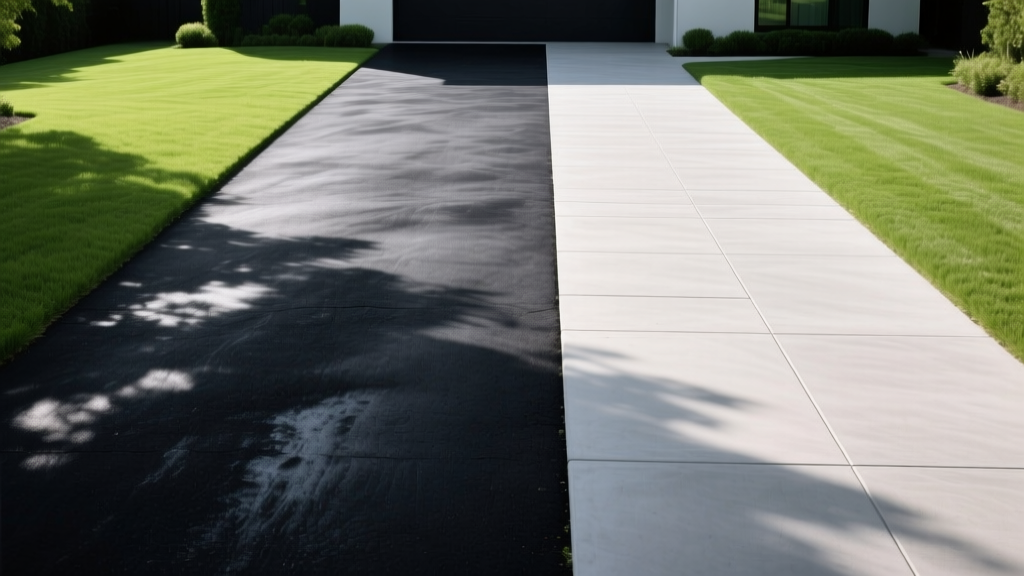
Climate Performance: Heat Islands and Freeze-Thaw Cycles
Your regional climate should heavily dictate your material choice. Blacktop and concrete react inversely to temperature extremes.
Thermal Mass and the Heat Island Effect
Concrete has a high solar reflectance (albedo), meaning it reflects sunlight and stays relatively cool. Blacktop, with its dark color, absorbs up to 90% of solar radiation. According to the EPA's Heat Island Effect data, unshaded asphalt surfaces can reach temperatures 50°F to 90°F hotter than the ambient air on a summer afternoon. In southern climates (e.g., Texas, Arizona, Florida), blacktop can become soft and rut under the weight of parked vehicles during peak summer heat. Concrete remains structurally rigid regardless of ambient heat.
Freeze-Thaw Resilience
In northern climates, the freeze-thaw cycle is the primary destroyer of driveways. Water penetrates micro-cracks, freezes, expands by 9%, and spalls the surface. Properly air-entrained concrete handles this well, but if the contractor skips the air-entrainment admixture to save money, the slab will scale and flake within three winters. Blacktop's flexibility allows it to absorb minor ground heaving without cracking, but extreme cold makes the bitumen brittle, leading to deep thermal cracking that requires expensive crack-sealing maintenance.
Expert Warning: Never use de-icing salts containing ammonium nitrate or ammonium sulfate on concrete driveways. These chemicals cause a catastrophic chemical reaction that destroys the cement paste. Use calcium chloride or magnesium chloride instead, and only after the concrete has fully cured for at least one year.
Base Preparation: The True Foundation
The most common cause of premature failure in both blacktop and concrete driveways is inadequate sub-base preparation. The surface material is only as strong as the dirt beneath it.
- Excavation: Remove 8 to 12 inches of topsoil and organic material until you reach undisturbed, load-bearing subgrade.
- Geotextile Fabric: In areas with expansive clay soils, lay a non-woven geotextile fabric over the subgrade to prevent the clay from migrating up into the aggregate base during wet seasons.
- Aggregate Base Course (ABC): Install 4 to 6 inches of crushed, angular aggregate (typically 3/4-inch minus crushed limestone or granite). Round river gravel is unacceptable as it rolls under pressure rather than locking together.
- Compaction: Use a vibratory plate compactor or smooth-drum roller to achieve 95% Standard Proctor density. The base must be sloped at a minimum of 1/8 inch per foot (2% grade) to ensure positive water runoff.
Curing Timelines and Project Scheduling
Time-to-use is a major logistical factor. A newly paved blacktop driveway can typically handle foot traffic in 24 hours and passenger vehicles in 48 to 72 hours, depending on ambient temperatures. Concrete requires a strict curing period. While it can bear foot traffic after 48 hours, you must wait a minimum of 7 days before driving a standard passenger car on it, and a full 28 days before allowing heavy trucks, RVs, or dumpsters on the slab to prevent micro-fracturing during the hydration process.
Frequently Asked Questions
Can I pave blacktop directly over an existing concrete driveway?
Yes, this is known as an asphalt overlay. However, it is generally not recommended. Concrete slabs have expansion joints that will inevitably reflect through the flexible asphalt layer within 12 to 18 months, a phenomenon known as 'reflective cracking.' If you must overlay, a paving fabric interlayer must be installed between the concrete and the asphalt to delay the cracking.
Which material handles oil and gas spills better?
Concrete is highly vulnerable to petroleum spills. Gasoline and motor oil act as solvents that break down the surface paste of concrete, leaving permanent, deeply stained pockmarks. Blacktop is also damaged by petroleum (since it is petroleum-based), but because the entire driveway is black, oil stains are virtually invisible, making it the superior choice for households with older, leak-prone vehicles or frequent DIY mechanic work.
Does concrete increase property value more than blacktop?
Appraisers and real estate professionals generally recognize a higher ROI for concrete driveways, particularly if they feature decorative finishes like stamped patterns or exposed aggregate. A well-maintained concrete driveway signals long-term property stewardship to buyers, whereas a 15-year-old blacktop driveway nearing the end of its lifespan is often factored in as a deferred maintenance liability during home inspections.
Written by
Priya KapoorPriya Kapoor is a real estate market analyst and construction economics researcher with expertise in housing affordability, development feasibility, and infrastructure investment. She holds a Master of Regional Planning from Cornell University and previously worked as a senior analyst at CBRE's Investment Properties group, where she modeled returns for $4B in mixed-use development pipelines. Priya now runs an independent research practice advising developers, municipalities, and REITs on construction cost forecasting and market timing. She publishes the quarterly "BuildMat Market Pulse" report tracking material price indices across 12 commodity categories. Based in Austin, TX, Priya serves on the board of Habitat for Humanity Austin and is a marathon runner.
More from Priya Kapoor
View all
Construction Cost
Cost to Build a 1600 Sq Ft Home in 2026: Full Breakdown
Accurate 2026 cost to build a 1600 sq ft home—material, labor, and regional pricing breakdowns included. Plan your budget with real-time estimates.
Aug 11, 2026

Wood & Lumber
Name the Types of Wood for Pressure Treatment and Preservation
Learn how to name the types of wood best suited for pressure treatment. Compare species treatability, chemical retention levels, and 2026 preservation costs.
Aug 4, 2026

Stone & Masonry
Stone Veneer Suppliers Lindenhurst: 2026 Cost Analysis
Analyze 2026 stone veneer costs in Lindenhurst, NY. Compare local supplier pricing, delivery fees, and Suffolk County installation labor rates.
Aug 4, 2026