Brick and Mortar ASTM Specifications and PSI Ratings
Analyze brick and mortar ASTM performance specifications. Compare Type M, S, N, and O mortar compressive strength, PSI ratings, and structural applications.
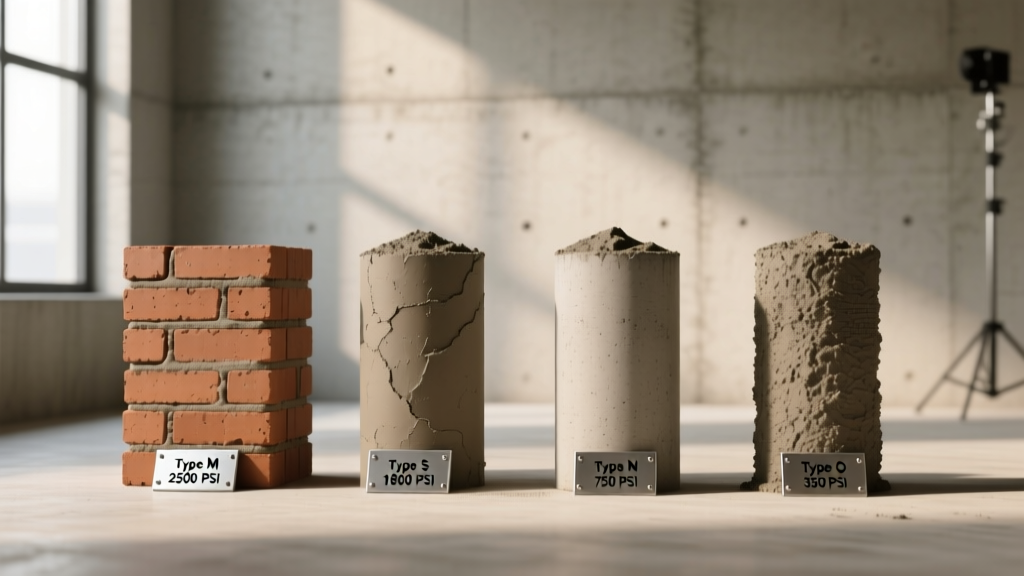
The Engineering Reality of Brick and Mortar Systems
In structural masonry, the phrase "brick and mortar" describes a composite system, not just two adjacent materials. The performance of a masonry wall relies entirely on the interaction between the clay or concrete masonry unit (CMU) and the binding matrix. Under current TMS 402/602-22 building code requirements, specifying the correct mortar is a matter of structural survival, particularly regarding compressive strength (PSI), flexural bond capacity, and water retention metrics.
A fundamental rule of masonry engineering is that the mortar must be weaker in compressive strength than the brick unit it binds. If a high-strength Type M mortar (2,500 PSI) is used with a standard low-compressive clay brick, thermal expansion, wind loads, and seismic shifts will cause the brick itself to crack rather than the mortar joint. Repairing a cracked mortar joint requires simple repointing; replacing a fractured structural brick requires demolition and reconstruction. Understanding ASTM performance ratings prevents these catastrophic specification mismatches.
Core Standard: ASTM C270
All modern brick and mortar specifications in North America are governed by ASTM C270 (Standard Specification for Mortar for Unit Masonry). This standard dictates the exact volumetric proportions and laboratory-tested property requirements for the five recognized mortar types: M, S, N, O, and K.
Decoding the Five Mortar Types: PSI and Proportions
Mortar types are categorized by their minimum compressive strength at 28 days of curing. The selection of a specific type dictates the wall's load-bearing capacity, lateral load resistance, and weathering durability.
| Mortar Type | Min. PSI (28-Day) | Volume Ratio (Cement : Lime : Sand) | Primary Structural Application |
|---|---|---|---|
| Type M | 2,500 | 1 : 1/4 : 3-3/4 | Below-grade foundations, retaining walls, high lateral loads. |
| Type S | 1,800 | 1 : 1/2 : 4-1/2 | At/below grade, exterior veneers, seismic shear walls, paving. |
| Type N | 750 | 1 : 1 : 6 | General above-grade exterior/interior load-bearing walls. |
| Type O | 350 | 1 : 2 : 9 | Interior non-load-bearing partitions, historic repointing. |
| Type K | 75 | 1 : 3 : 12 | Historic preservation (soft lime-rich antique bricks). |
Proportion Specifications vs. Property Specifications
When drafting masonry plans in 2026, architects must specify whether the brick and mortar system will follow the Proportion Specification or the Property Specification under ASTM C270. Mixing these up leads to failed lab tests and rejected site inspections.
- Proportion Specification: The mortar is mixed on-site using exact volumetric ratios (as shown in the table above). No laboratory testing of the wet mortar is required, provided the raw materials (ASTM C150 cement, ASTM C207 lime, ASTM C144 sand) meet baseline standards.
- Property Specification: The mortar is formulated by the supplier to achieve specific physical properties (minimum PSI, maximum air content, water retention). This requires laboratory testing per ASTM C780 prior to construction. This is the mandatory route for all pre-blended, bagged mortars used in commercial construction.
The Critical Metric: Flexural Bond Strength
While compressive strength (PSI) gets the most attention, flexural bond strength is the true indicator of a masonry wall's resistance to wind loads and moisture penetration. Tested under ASTM C1357, flexural bond measures the tensile capacity of the brick-to-mortar interface.
High-cement mortars (Type M) actually exhibit lower flexural bond strength than high-lime mortars (Type N or S). Lime provides superior workability, water retention, and autogenous healing (the ability of micro-cracks to self-seal when exposed to moisture). For exterior cavity walls exposed to driving rain, specifying Type S or Type N yields a significantly tighter, more water-resistant envelope than Type M, despite the lower compressive PSI.
⚠️ Warning: Water Retention Failures
ASTM C1506 requires mortar to retain at least 75% of its original water content after being subjected to a vacuum. Clay bricks are highly absorptive. If a mortar lacks adequate lime or water-retaining admixtures, the brick will instantly suck the moisture out of the joint. This halts the hydration process of the Portland cement, resulting in a powdery, weak joint with near-zero flexural bond strength. Always verify water retention data sheets when using pre-blended mortars in hot, dry climates.
ASTM C91 (Masonry Cement) vs. ASTM C270 (Portland-Lime)
A frequent specification error in commercial brick and mortar projects is confusing Masonry Cement with Portland Cement-Lime mortar. They are fundamentally different chemical systems.
Masonry Cement (ASTM C91) is a pre-blended powder containing Portland cement, ground limestone, and proprietary air-entraining/plasticizing agents. It requires only the addition of sand and water on-site. While highly workable, ASTM C91 mortars generally exhibit lower flexural bond strength and higher air content (often 10-14%) compared to traditional Portland-lime mixes. They are not recommended for reinforced masonry or high-seismic shear walls where maximum bond strength is critical.
Portland-Lime Mortar (ASTM C270) uses pure hydrated lime (Type S) and Portland cement. It yields a denser, stronger bond with lower air content (typically 4-8%), making it the required choice for structural, load-bearing, and reinforced brick masonry.
Modern Pre-Blended Mortar Specifications in 2026
The era of masons shoveling raw sand and cement into a mixer on large commercial sites is largely over. To guarantee exact PSI ratings and eliminate proportion errors, the industry has shifted to factory-batched pre-blended mortars (such as SPEC MIX or Quikrete Pro Commercial lines).
When specifying pre-blended brick and mortar systems, ensure the submittals include:
- ASTM C780 Lab Reports: Verifying compressive strength, air content, and water retention of the specific batch.
- Aggregate Grading: Confirming the sand profile matches ASTM C144 to prevent shrinkage cracking.
- Color Consistency Data: For architectural veneers, requiring the supplier to lock the pigment batch number for the entire project elevation to prevent visual banding.
Seismic and High-Wind Zone Requirements
In regions governed by strict seismic codes or high-velocity hurricane zones (HVHZ), the TMS 402 building code mandates specific brick and mortar performance thresholds. For reinforced masonry shear walls, Type S or Type M mortar is strictly required. Furthermore, the mortar must achieve a minimum flexural bond strength of 150 psi (fully grouted) or 100 psi (partially grouted) when tested per ASTM C1357. Using Type N in these structural elements will result in an automatic code violation and structural failure during lateral load events.
For comprehensive guidance on matching mortar types to specific clay brick units and environmental exposures, consult the Brick Industry Association Technical Note 9, which remains the definitive field guide for masonry specification engineers. Additionally, structural engineers should reference the latest Masonry Society (TMS) code updates for regional load-factor adjustments.