Concrete vs Asphalt Parking Lot: Lifecycle Costs and Application Guide
Compare concrete vs asphalt parking lot materials. Analyze 40-year lifecycle costs, structural specs, and ideal commercial applications.

The Paving Dilemma: Initial Cost vs. Long-Term Value
When developing a commercial, retail, or multi-family residential property, the parking surface represents a massive capital expenditure that dictates curb appeal, maintenance overhead, and structural longevity for decades. The debate over a concrete vs asphalt parking lot rarely has a universal answer; instead, the optimal choice depends entirely on traffic load, climate, budget horizon, and specific application requirements.
While asphalt typically offers a lower initial installation cost, concrete provides a significantly longer lifespan with minimal intermediate maintenance. Property owners and developers must look beyond the day-one bid sheet and evaluate the 40-year Net Present Value (NPV) of the pavement. According to the Federal Highway Administration's pavement design guidelines, selecting the right flexible (asphalt) or rigid (concrete) pavement structure requires a rigorous analysis of subgrade strength, expected Equivalent Single Axle Loads (ESALs), and environmental factors.
Quick Decision Matrix
- Choose Asphalt If: Initial capital is strictly limited, the project requires immediate heavy-load access within 48 hours, or the lot is in a region with extreme freeze-thaw cycles where flexible pavement handles ground heave better.
- Choose Concrete If: The project lifecycle exceeds 25 years, the lot will host heavy static loads (dumpsters, loading docks), nighttime visibility is a safety priority, or minimizing long-term maintenance disruptions is critical for retail tenants.
Material Specifications and Structural Requirements
A parking lot is only as strong as its aggregate base and subgrade. Both materials require meticulous earthwork, but their structural profiles differ fundamentally. Concrete acts as a rigid slab that bridges minor subgrade imperfections, while asphalt is a flexible mat that conforms to the base beneath it, making base preparation absolutely critical for asphalt longevity.
| Specification | Concrete (Rigid Pavement) | Asphalt (Flexible Pavement) |
|---|---|---|
| Surface Thickness | 6 to 8 inches (standard commercial) | 3 to 4 inches (2" surface + 1.5" binder) |
| Base Material | 4 to 6 inches compacted Aggregate Base Course (ABC) | 6 to 8 inches compacted ABC or crushed stone |
| Material Strength | Minimum 4,000 PSI compressive strength | Performance Graded (PG) binder (e.g., PG 64-22) |
| Reinforcement | Welded wire mesh or fiber mesh; dowel bars at joints | Geogrid (optional for weak subgrades) |
| Jointing | Saw-cut control joints every 12 to 15 feet | None (continuous flexible mat) |
For concrete applications in northern climates, the mix design must include 5% to 7% air entrainment. This microscopic bubble structure allows water within the concrete to expand during freezing temperatures without spalling the surface. Conversely, asphalt mixes rely on the correct binder grade; using a binder that is too stiff for the local winter climate will result in severe thermal cracking.
Installation Timelines and Curing Realities
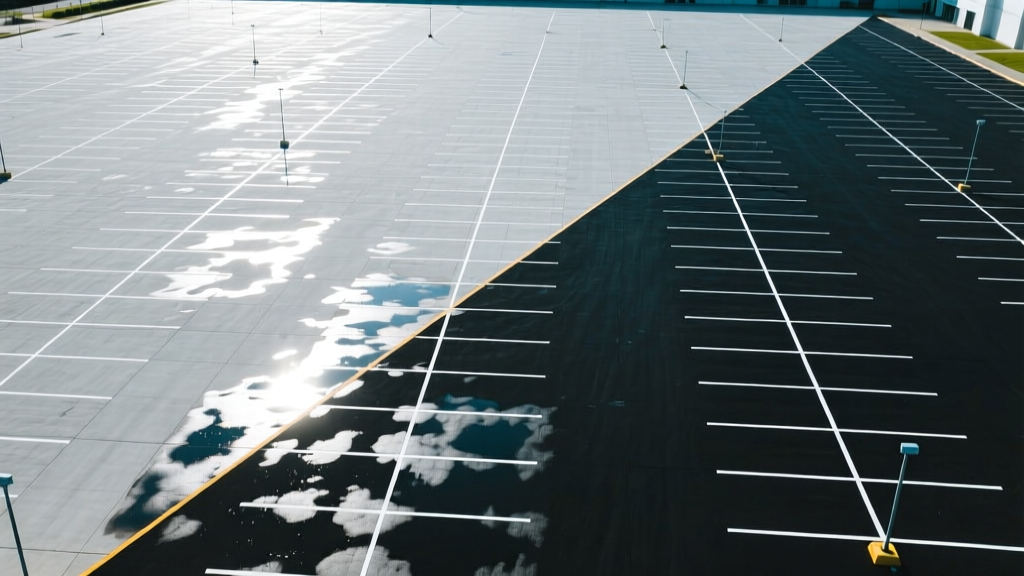
Project schedules often dictate material selection. Asphalt is the undisputed winner for rapid deployment. A freshly paved asphalt parking lot can typically handle passenger vehicle traffic within 24 to 48 hours, and heavy trucks within a week, depending on ambient temperatures. The mat cools and hardens quickly, allowing striping and opening to occur almost immediately.
Concrete requires a strict curing regimen. While initial set occurs within hours, a standard 4,000 PSI concrete mix requires a minimum of 7 days of curing before it can safely support passenger vehicles, and up to 14 to 28 days to reach the full design strength required for heavy delivery trucks or garbage collection vehicles. During this curing window, the surface must be kept moist using curing blankets or liquid membrane-forming compounds to prevent plastic shrinkage cracking. For retail developments with aggressive grand-opening deadlines, this timeline can be a dealbreaker unless accelerators (like calcium chloride, though risky for rebar corrosion) or Type III high-early-strength cement are specified.
Lifecycle Cost Analysis: The 40-Year Horizon
Evaluating a concrete vs asphalt parking lot strictly on initial installation cost heavily skews the data toward asphalt. In 2026, asphalt installation averages $4.50 to $8.00 per square foot, while concrete ranges from $8.50 to $14.00 per square foot. However, asphalt's lower upfront cost is offset by mandatory, recurring maintenance.
Many property underwriters fail to account for the recurring operational expense of asphalt sealcoating. To prevent oxidation, UV degradation, and water infiltration, asphalt must be sealcoated every 3 to 5 years at a cost of $0.15 to $0.25 per square foot. Over a 40-year lifecycle, this maintenance alone can equal 30% of the original installation cost, not including the revenue lost from closing the lot during application.
Concrete, by contrast, requires virtually no surface treatments. Maintenance is generally limited to cleaning and re-caulking the expansion and control joints every 10 to 15 years to prevent water from eroding the subgrade beneath the slab. When evaluating a 40-year lifecycle, the National Ready Mixed Concrete Association (NRMCA) frequently demonstrates that concrete parking lots achieve a lower total cost of ownership, primarily because asphalt will require at least one, if not two, mill-and-overlay rehabilitations during that same period.
Environmental and Heat Island Impacts
The albedo effect—the measure of how much light a surface reflects—plays a massive role in commercial site design. Fresh asphalt has an albedo of roughly 0.05, meaning it absorbs 95% of solar radiation. This contributes heavily to the Urban Heat Island effect, raising ambient temperatures around the building, increasing HVAC cooling loads, and accelerating the degradation of the asphalt binder itself.
Concrete has an albedo of 0.30 to 0.40, reflecting significantly more sunlight. According to the Environmental Protection Agency's Heat Island guidelines, utilizing high-albedo paving materials can reduce localized air temperatures by up to 2°F to 5°F. Furthermore, concrete is inherently more compatible with permeable paving systems. Permeable concrete parking lots allow stormwater to pass directly through the surface into the subgrade, drastically reducing the need for expensive retention ponds and helping developers meet stringent municipal impervious surface limits.
Application Showcase: Matching Material to Project Type
Different commercial applications subject parking lots to unique stress profiles. Matching the material to the specific use case ensures optimal performance.
Big-Box Retail and Grocery Centers
Recommendation: Concrete in high-stress zones, Asphalt in general parking.
Grocery centers experience severe static loading from heavy delivery trucks at the loading docks and constant turning movements from shopping cart corrals. Asphalt will rut and deform under the static weight of loaded semi-trailers, especially in high summer heat. A hybrid approach—using 8-inch reinforced concrete for the loading aprons and drive aisles, and asphalt for standard parking stalls—optimizes both budget and structural integrity.
Multi-Family Residential and HOA Lots
Recommendation: Asphalt.
For apartment complexes and condominiums, initial capital preservation is often the priority for developers. Traffic loads are relatively light (passenger vehicles), and the aesthetic requirement is lower. Asphalt provides a smooth, quiet surface that is highly cost-effective for large-scale residential footprints.
Industrial and Logistics Hubs
Recommendation: Heavy-Duty Concrete.
Facilities handling forklifts, heavy machinery, and continuous 18-wheeler traffic require rigid pavement. The point-loads from forklift wheels carrying 10,000-pound pallets will punch through standard asphalt over time. A 9-inch to 10-inch concrete slab with thickened edge beams and heavy dowel bar assemblies is the only viable solution for these extreme applications.
Common Failure Modes and Edge Cases
Understanding how each material fails is critical for proactive site design and quality assurance during construction.
- Asphalt Rutting and Depressions: Caused by heavy static loads or inadequate base compaction. Often seen near dumpsters where garbage trucks park weekly. Fix: Install concrete pads specifically under dumpster enclosures.
- Concrete Freeze-Thaw Spalling: Occurs when the finisher adds water to the surface to smooth the trowel finish, diluting the air-entrainment at the surface. Fix: Strictly prohibit water addition during finishing; use evaporation retarders instead.
- Asphalt Petroleum Degradation: Gasoline, oil, and transmission fluid leaks act as solvents, dissolving the asphalt binder and causing the surface to ravel and pit. Fix: Prompt cleanup of spills and regular sealcoating in high-leak areas.
- Concrete Joint Faulting: Happens when water infiltrates unsealed joints, eroding the base material. When a heavy truck crosses the joint, the unsupported edge snaps or drops. Fix: Implement a strict joint-routing and hot-pour sealant maintenance schedule every decade.
Ultimately, the choice between concrete and asphalt is an exercise in financial forecasting and site-specific engineering. By aligning the pavement design with the actual operational realities of the property, developers can avoid catastrophic maintenance liabilities and deliver a durable, high-performing asset.
Written by
Priya KapoorPriya Kapoor is a real estate market analyst and construction economics researcher with expertise in housing affordability, development feasibility, and infrastructure investment. She holds a Master of Regional Planning from Cornell University and previously worked as a senior analyst at CBRE's Investment Properties group, where she modeled returns for $4B in mixed-use development pipelines. Priya now runs an independent research practice advising developers, municipalities, and REITs on construction cost forecasting and market timing. She publishes the quarterly "BuildMat Market Pulse" report tracking material price indices across 12 commodity categories. Based in Austin, TX, Priya serves on the board of Habitat for Humanity Austin and is a marathon runner.
More from Priya Kapoor
View all
Construction Cost
Cost to Build a 1600 Sq Ft Home in 2026: Full Breakdown
Accurate 2026 cost to build a 1600 sq ft home—material, labor, and regional pricing breakdowns included. Plan your budget with real-time estimates.
Aug 11, 2026

Wood & Lumber
Name the Types of Wood for Pressure Treatment and Preservation
Learn how to name the types of wood best suited for pressure treatment. Compare species treatability, chemical retention levels, and 2026 preservation costs.
Aug 4, 2026

Stone & Masonry
Stone Veneer Suppliers Lindenhurst: 2026 Cost Analysis
Analyze 2026 stone veneer costs in Lindenhurst, NY. Compare local supplier pricing, delivery fees, and Suffolk County installation labor rates.
Aug 4, 2026