Brick Mortar Selection Guide: Types N, S, M, and O Explained
Discover how to select the right brick mortar for your project. Compare Types N, S, M, and O mixes, ASTM C270 standards, and structural requirements.
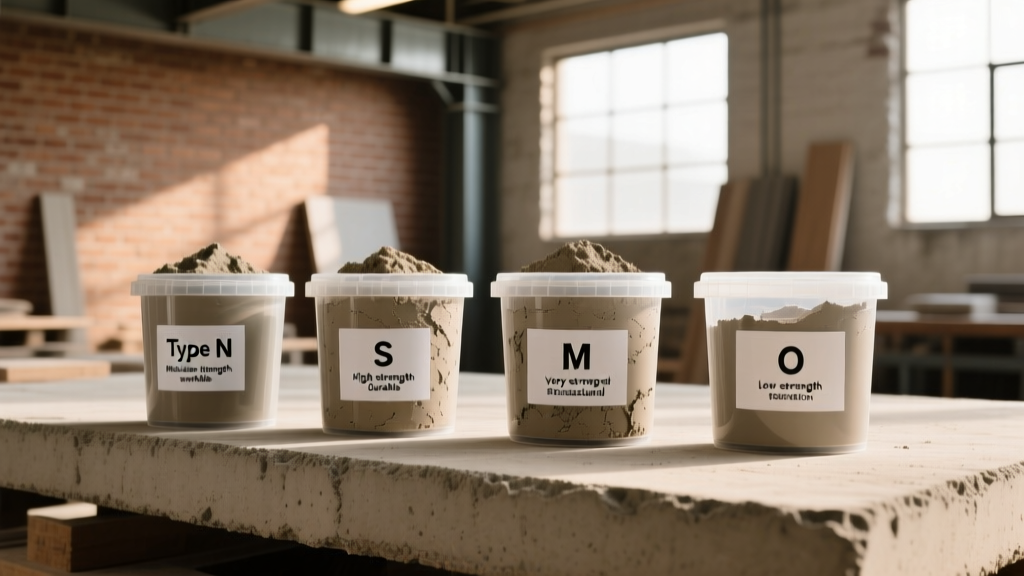
The Core Taxonomy: ASTM C270 Mortar Types
Selecting the correct brick mortar is not merely about adhesion; it is about engineering a sacrificial joint that accommodates structural movement, manages moisture, and prevents masonry unit failure. In North America, mortar taxonomy is governed by ASTM C270, which classifies mortar into five primary types based on compressive strength, bond strength, and flexibility. The mnemonic "MaSoN wOrK" (M, S, N, O, K) helps professionals remember the hierarchy from strongest to weakest.
The fundamental rule of mortar selection is that the mortar must always be softer and more permeable than the masonry unit it binds. If the mortar is too hard, thermal expansion and moisture freeze-thaw cycles will force the brick to spall rather than allowing the joint to absorb the stress.
| Mortar Type | Min. Compressive Strength (28 Days) | Proportion Specification (Cement : Lime : Sand) | Primary Application |
|---|---|---|---|
| Type M | 2,500 psi | 1 : 1/4 : 3 | Below-grade foundations, retaining walls, heavy lateral loads. |
| Type S | 1,800 psi | 1 : 1/2 : 4.5 | At-grade exterior walls, parapets, chimneys, structural masonry. |
| Type N | 750 psi | 1 : 1 : 6 | Above-grade non-load-bearing veneers, interior walls, soft brick. |
| Type O | 350 psi | 1 : 2 : 9 | Historic restoration, interior non-load-bearing, extremely soft brick. |
| Type K | 75 psi | 1 : 3 : 12 | Rare; specialized historic preservation of pre-1900 lime-washed brick. |
Binder Chemistry: Portland vs. Masonry vs. Mortar Cement
The taxonomy of brick mortar extends beyond the final letter designation into the specific binders used to achieve those properties. Specifiers must choose between three distinct cementitious products:
- Portland Cement (ASTM C150): The baseline hydraulic cement. When used for mortar, it must be manually blended with hydrated lime (ASTM C207) and sand. This offers the highest degree of customization for field engineers but introduces a higher margin for batching errors on the job site.
- Masonry Cement (ASTM C91): A pre-blended mixture of Portland cement and plasticizing materials (like limestone or lime). It requires only the addition of sand and water. While highly workable and water-retentive, it generally produces lower bond strength than Portland-lime mixes, making it less ideal for high-seismic or high-tensile structural applications.
- Mortar Cement (ASTM C1329): Designed to bridge the gap between masonry cement and Portland-lime mixes. It contains Portland cement and plasticizers but is engineered to meet the strict flexural bond strength requirements of structural masonry codes. It is the preferred pre-blended choice for load-bearing brick walls.
The Selection Framework: Matching Mortar to Masonry
To systematically select the correct brick mortar, evaluate the project against three structural and environmental vectors. Use the following decision matrix to narrow your specification:
1. Load and Structural Role
Is the brick structural (reinforced masonry carrying gravity and lateral loads) or veneer (anchored to a backup wall carrying only its own weight)? Structural brickwork demands high flexural bond strength, pointing toward Type S or Type M using Mortar Cement or Portland-Lime blends. Veneer applications only require Type N.
2. Environmental Exposure
Masonry exposed to severe weathering, driving rain, or freeze-thaw cycles requires a mortar with low water permeability and high durability. Parapets, retaining walls, and below-grade foundations must utilize Type S or Type M. Protected interior walls or exterior walls under deep overhangs can safely utilize Type N.
3. Masonry Unit Hardness
Test the brick. Modern extruded face brick is extremely hard and dense, easily accommodating Type N or S. However, if you are working with salvaged brick, handmade brick, or low-fire clay, you must drop down to Type N or Type O to ensure the joint remains the sacrificial element.
Proportion Specifications vs. Property Specifications
When writing architectural specifications or ordering materials, ASTM C270 allows for two distinct compliance paths. Understanding the difference prevents costly job-site rejections.
Proportion Specification: This method relies on the volumetric ratios of the ingredients (e.g., 1 part cement, 1 part lime, 6 parts sand). If the mason mixes the mortar to these exact ratios using approved ASTM materials, the mortar is deemed compliant without further testing. This is the most common route for residential and light commercial projects.
Property Specification: This method requires the mortar to be physically tested in a laboratory to prove it meets specific compressive strength, water retention, and air content thresholds. This is mandatory for high-rise structural masonry, critical infrastructure, and projects where proprietary pre-blended mortars are used. According to the Brick Industry Association Technical Notes, property specifications are essential when utilizing blended cements or non-standard supplementary cementitious materials (SCMs) like fly ash or slag.
Sand Grading: The Hidden Variable in Mortar Performance
A common failure point in brick mortar selection is ignoring the aggregate. Mortar sand must comply with ASTM C144. Unlike concrete aggregate, mortar sand is much finer, but the exact gradation dictates the workability and shrinkage of the joint.
- Overly fine sand: Requires excessive water to achieve workability, leading to high drying shrinkage, step-cracking, and joint erosion.
- Overly coarse sand: Creates a harsh, unworkable mix that fails to bond properly to the brick bed, reducing flexural bond strength and allowing water infiltration.
For optimal performance, specify washed masonry sand with a well-graded particle distribution. If the local sand supply is too uniform, blending two different sand sources or adding a small percentage of fine mason's sand can optimize the gradation curve.
Failure Modes: The Cost of the Wrong Mix
Selecting the incorrect brick mortar taxonomy for a specific application manifests in distinct, diagnosable failure modes:
- Brick Spalling: Caused by using mortar that is stronger and less permeable than the brick (e.g., Type M on soft clay brick). Moisture enters the brick, freezes, and expands. Because the mortar joint will not yield, the face of the brick pops off.
- Efflorescence and Leaching: Often caused by using masonry cements with high air-entrainment or improper lime content, combined with poor tooling of the joint. Water pools in the micro-voids of the joint, dissolving soluble salts and depositing them on the wall face.
- Step Cracking: A mix with too much water or overly fine sand shrinks excessively as it cures. The mortar pulls away from the brick unit, creating hairline bond-line cracks that allow bulk water ingress.
Ultimately, successful brick mortar selection requires viewing the wall as a unified, breathable system. By strictly adhering to ASTM C270 classifications, matching the binder chemistry to the structural demands, and respecting the physical properties of the masonry unit, you ensure a facade that performs structurally and aesthetically for decades.