Polished Concrete Floors vs Epoxy: The Ultimate Durability & Cost Guide
Compare polished concrete floors vs epoxy for your next project. Explore installed costs, chemical resistance, installation times, and lifespan data.
The Core Difference: Substrate Modification vs. Surface Overlay
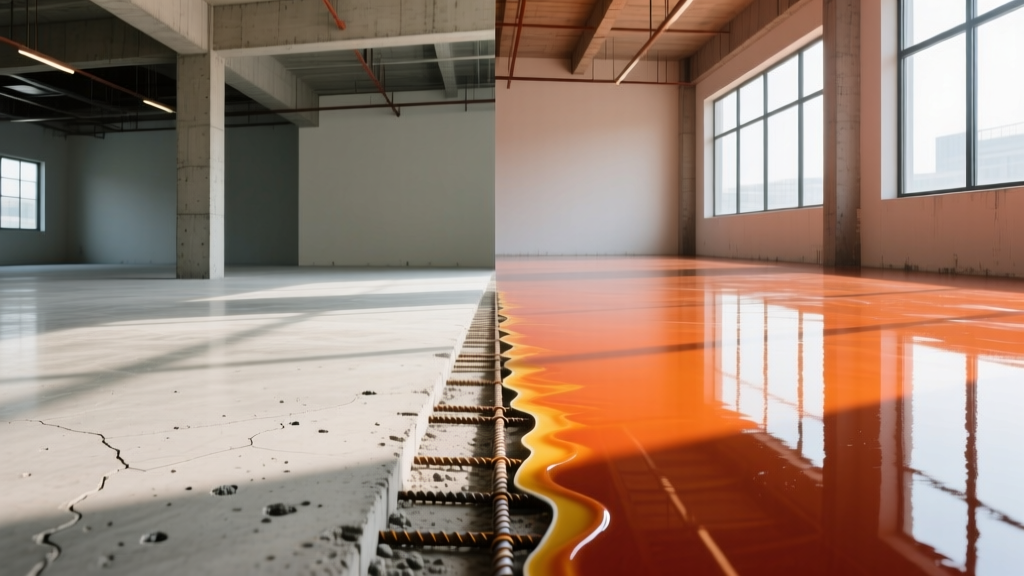
When evaluating polished concrete floors vs epoxy, facility managers and architects must first understand the fundamental mechanical difference between the two systems. Polished concrete is a subtractive and chemical process. It involves mechanically grinding the existing concrete slab with progressively finer diamond abrasives, then applying a chemical densifier that reacts with the concrete's free lime to harden the surface. The slab itself becomes the wearing course.
Epoxy, conversely, is an additive polymer overlay. It relies on applying a multi-layer resin system (typically a primer, a 100% solids epoxy body coat, and a polyurethane topcoat) over the prepared concrete. The performance of an epoxy floor is dictated by the tensile strength, chemical formulation, and mil thickness of the applied polymers, not the underlying slab.
Head-to-Head Performance Matrix
| Performance Metric | Mechanically Polished Concrete | 100% Solids Epoxy System |
|---|---|---|
| System Thickness | Subtractive (removes 1/16" to 1/8") | Additive (10 to 40 mils, up to 1/4" with mortar) |
| Surface Hardness | Mohs 6-8 (post-densification) | Mohs 3-5 (softer, relies on flexibility) |
| Chemical Resistance | Moderate (vulnerable to strong acids) | Exceptional (withstands harsh solvents/acids) |
| UV Stability | 100% UV stable (will never yellow) | Poor (requires aliphatic urethane topcoat) |
| Moisture Vapor Tolerance | High (breathable, allows vapor transmission) | Low (hydrostatic pressure causes delamination) |
| Expected Lifespan | 20+ years (with periodic burnishing) | 10-15 years (heavy traffic environments) |
Deep Dive: Polished Concrete Performance & Failure Modes
Achieving a high-gloss, durable polished concrete floor requires a strict adherence to diamond grit progression. The process begins with coarse metal-bond diamonds (30 to 40 grit) to cut the surface and expose the desired aggregate profile. It progresses through transitional hybrid bonds and finishes with resin-bond diamonds up to 3000 grit.
The Chemistry of Densification
The critical step that separates polished concrete from mere ground concrete is the application of a chemical densifier. Modern specifications mandate the use of lithium silicate densifiers (such as PROSOCO Consolideck LS) over older sodium or potassium silicates. Lithium molecules are smaller, allowing them to penetrate 1 to 3 millimeters into the capillary network. They react with calcium hydroxide to form calcium silicate hydrate (CSH), permanently filling the pores and increasing surface abrasion resistance by up to 40%. According to industry guidelines published by The Concrete Network, skipping or under-applying the densifier will result in a floor that quickly loses its sheen and dusts under foot traffic.
Polished concrete requires a minimum compressive strength of 3,500 PSI. If the existing slab is under-strength, highly porous, or heavily cracked, the mechanical grinding will tear the aggregate out rather than polish it, resulting in a pitted, uneven finish. In these scenarios, an epoxy mortar overlay is the only viable corrective measure.
Deep Dive: Epoxy Coating Systems & Edge Cases
Not all epoxies are created equal. Big-box store epoxies are typically water-based or solvent-based, containing only 30% to 50% solids. For commercial, industrial, or high-end residential applications, specifications must call for 100% solids epoxy (often formulated with bisphenol-A or bisphenol-F resins). These systems contain no volatile organic compounds (VOCs) that evaporate during curing, meaning the wet mil thickness equals the dry mil thickness.
Addressing UV Degradation and Slip Resistance
Standard aromatic epoxies will rapidly chalk and yellow when exposed to ultraviolet light. If the space has large storefront windows or skylights, the epoxy system must be sealed with an aliphatic polyurethane topcoat. This topcoat provides UV stability and allows for the addition of anti-slip aggregates. For food processing or wet environments, broadcasting aluminum oxide or graded quartz sand into the epoxy body coat at a rate of 1.5 lbs per 100 square feet is mandatory to achieve an acceptable Dynamic Coefficient of Friction (DCOF) above 0.42.
Epoxy acts as a vapor barrier. If your slab-on-grade lacks a proper polyethylene vapor barrier beneath it, moisture vapor transmission (MVT) will build hydrostatic pressure under the epoxy, causing catastrophic blistering and delamination. Always perform a calcium chloride test (ASTM F1869) or an in-situ relative humidity probe test (ASTM F2170) before specifying epoxy. If MVT exceeds 3 lbs/1000 sq ft/24 hours, you must use a moisture-mitigating epoxy primer or pivot to polished concrete, which remains breathable.
Financial Breakdown: Installed Costs & Lifecycle ROI
Comparing polished concrete floors vs epoxy requires looking beyond the initial bid. The following data reflects 2026 average commercial installed costs for a 10,000 sq ft facility, assuming standard slab conditions.
| Cost Component | Polished Concrete (Cream/Aggregate) | 100% Solids Epoxy (Quartz Broadcast) |
|---|---|---|
| Surface Preparation | $0.75 - $1.50 / sq ft (Grinding) | $0.50 - $1.00 / sq ft (Shot Blasting) |
| Material Costs | $0.80 - $1.20 / sq ft (Densifier/Guard) | $2.50 - $4.00 / sq ft (Resins/Aggregates) |
| Labor & Equipment | $3.00 - $6.00 / sq ft (Multi-day passes) | $2.50 - $5.00 / sq ft (Rolling/Troweling) |
| Total Installed Cost | $4.55 - $8.70 / sq ft | $5.50 - $10.00 / sq ft |
| 10-Year Maintenance | $0.15 / sq ft (Annual burnishing/pads) | $1.50 / sq ft (Scuff coats/re-topcoating) |
While polished concrete often carries a slightly higher upfront labor cost due to the multi-day grinding sequence, its 10-year maintenance cost is a fraction of epoxy's. Epoxy floors in high-traffic forklift aisles require scuff-sanding and re-topcoating every 3 to 5 years to maintain chemical resistance and gloss, drastically altering the lifecycle ROI.
Decision Framework: Which System Fits Your Facility?
Use this specification guide to match the flooring system to your exact operational environment:
- Retail Showrooms & Office Lobbies: Specify Polished Concrete. It offers superior light reflectivity (reducing lighting loads), limitless decorative aggregate options, and zero VOC emissions during installation, allowing adjacent areas to remain open.
- Food & Beverage Processing: Specify Epoxy with Urethane Topcoat. Polished concrete is porous at a microscopic level and will harbor bacteria or etch heavily from lactic and citric acids. A seamless, cove-based epoxy system withstands high-pressure hot water washdowns and harsh sanitizing chemicals.
- Automotive Garages & Mechanic Bays: Specify Epoxy with Aluminum Oxide Broadcast. While polished concrete handles rolling loads well, it is highly susceptible to staining from motor oil, transmission fluid, and brake fluid unless a high-quality penetrating stain guard is applied and rigorously maintained.
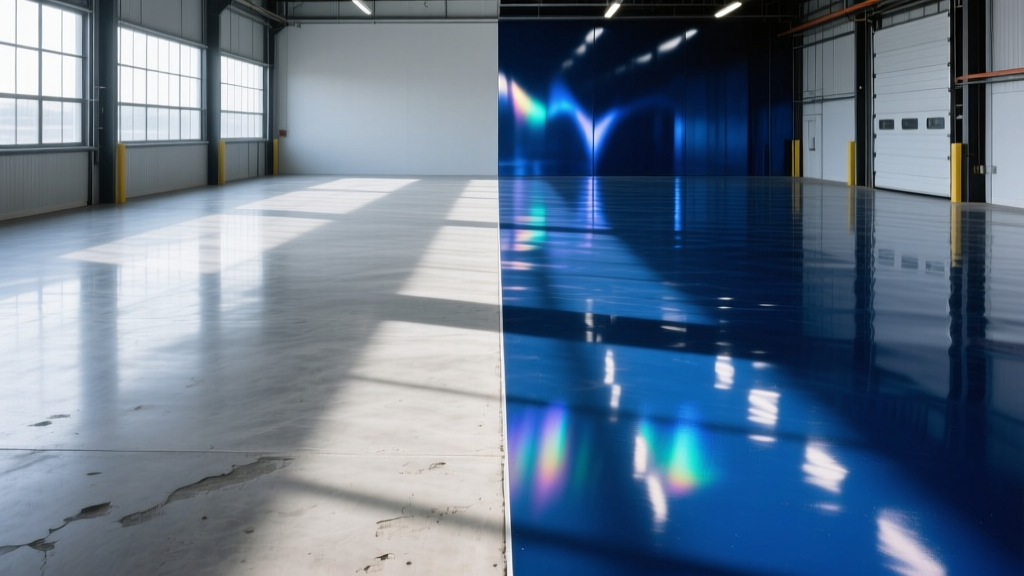
- Warehouses & Distribution Centers: Specify Polished Concrete. The hard-tire traffic from heavy forklifts will quickly grind down the top layers of an epoxy coating, leading to delamination in the main aisles. Polished concrete actually becomes smoother and more burnished under heavy rubber tire traffic.
Expert Installation Specifications
Regardless of the system chosen, the success of the floor relies entirely on substrate preparation. For polished concrete, ensure the contractor uses heavy-duty planetary grinders (minimum 600 lbs of head weight) to prevent uneven wave patterns in the slab. For epoxy, mandate diamond grinding or shot blasting to achieve a Concrete Surface Profile (CSP) of 2 to 3, as defined by the International Concrete Repair Institute (ICRI). Never allow a contractor to rely on acid etching for commercial epoxy applications; it fails to consistently open the pores and leaves residual salts that compromise the polymer bond. For comprehensive guidelines on indoor air quality and VOC management during resin installations, always consult the Environmental Protection Agency's VOC guidelines to ensure compliance with local environmental regulations.
Written by
Elena RodriguezElena Rodriguez is a civil engineer and technical writer specializing in concrete technology, masonry systems, and ASTM/ACI compliance. She earned her B.S. in Civil Engineering from Texas A&M University and spent a decade at a materials testing laboratory, performing over 2,000 concrete compressive strength tests and masonry prism evaluations. Elena is an ACI-certified Field Testing Technician (Grade I) and a member of ASTM Committee C12 on Natural Building Stone. She currently consults on forensic engineering cases involving concrete failures and moisture intrusion. Based in San Antonio, TX, Elena is a proud member of the Society of Women Engineers (SWE) and coaches her daughter's FIRST Robotics team.
More from Elena Rodriguez
View all
Walls & Panels
Cost Analysis: Light Gauge Steel Framing Advantages and Disadvantages
Evaluate light gauge steel framing advantages and disadvantages through a strict cost analysis lens, comparing material, labor, and lifecycle expenses.
Aug 4, 2026

Walls & Panels
Gypsum Board Types: Exact Specifications, Thickness & Dimensions
Compare standard, Type X, and moisture-resistant gypsum board types. Get exact specifications, thicknesses, dimensions, and ASTM standards for your project.
Aug 4, 2026

Fire Resistance
Best Fire-Resistant Outdoor Decking Materials: 2026 Buyer Guide
Discover the best fire-resistant outdoor decking materials for 2026. Compare Class A PVC, aluminum, and hardwood options for WUI compliance and safety.
Aug 4, 2026