Cobblestone Driveway vs Concrete: Ultimate Material Guide
Compare cobblestone driveway vs concrete for your home. We break down exact costs, installation specs, durability, and maintenance to help you choose.

The Core Dilemma: Aesthetics vs. Practicality
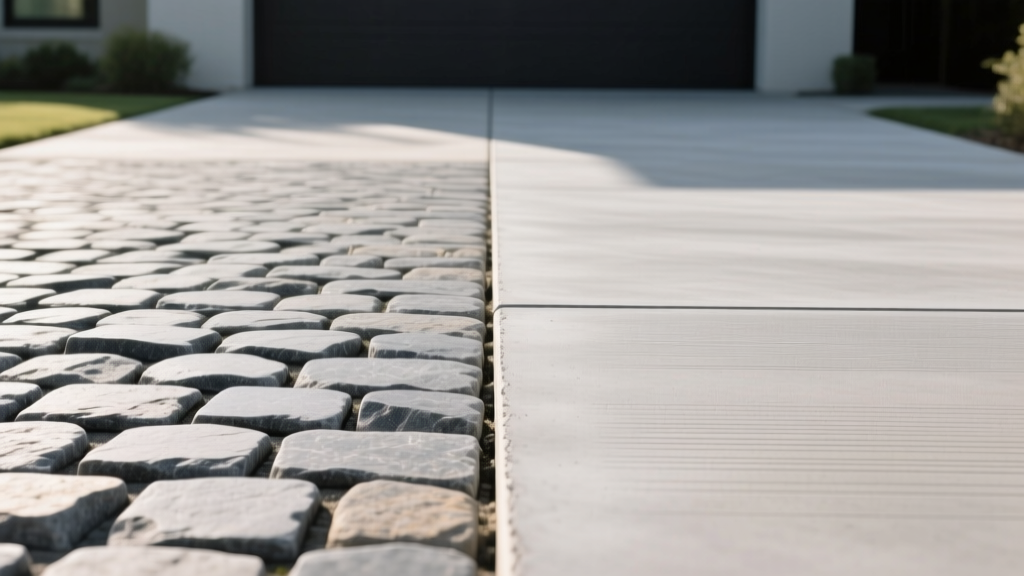
Choosing between a cobblestone driveway and poured concrete is rarely a simple aesthetic decision; it is a fundamental choice between structural monoliths and flexible, modular paving systems. While stamped concrete attempts to mimic the look of stone, this guide focuses strictly on true, natural granite cobblestone versus standard poured concrete slabs. Both materials offer distinct advantages regarding load distribution, frost heave resistance, and lifecycle maintenance, but their installation methodologies and long-term cost profiles diverge drastically.
Material Specifications: What Goes Under the Surface
The longevity of any driveway is dictated by its subgrade preparation and material specifications. A surface is only as stable as the base beneath it.
Poured Concrete Driveway Specs
A standard residential concrete driveway requires a minimum thickness of 4 inches, though 6 inches is the industry standard for accommodating occasional heavy loads like delivery trucks or RVs. The mix design should be a minimum of 4,000 PSI (pounds per square inch) compressive strength. In climates with freezing winters, the National Ready Mixed Concrete Association mandates an air-entrainment level of 5% to 7% to create microscopic voids that allow expanding ice to dissipate without spalling the surface. The slab must be poured over a 4-to-6-inch compacted base of Dense Graded Aggregate (DGA) and reinforced with 6x6 W1.4xW1.4 welded wire mesh or #4 rebar spaced at 24-inch centers.
True Cobblestone Driveway Specs
Genuine cobblestone consists of naturally rounded or hand-quarried granite blocks, typically measuring 4x4x3 inches or 6x6x4 inches. Unlike interlocking concrete pavers, true stone does not degrade from UV exposure or deicing salts. Installation requires a 6-inch compacted crushed stone base (ASTM D2940), followed by a 1-to-2-inch bedding layer of coarse sand or a mortar bed for rigid installations. According to guidelines referenced by the Natural Stone Institute, mortar-set cobblestones provide superior resistance to shifting under vehicular braking forces, while sand-set installations offer better permeability.
Head-to-Head Cost Analysis (Per Square Foot)
Pricing fluctuates based on regional labor rates and site accessibility, but the material and labor gap between these two options remains substantial. The following table outlines estimated 2026 costs for a standard 600-square-foot residential driveway.
| Cost Component | Poured Concrete (Broom Finish) | True Granite Cobblestone (Mortar Set) |
|---|---|---|
| Excavation & Base Prep | $2.50 - $4.00 | $4.00 - $6.50 |
| Material Cost | $3.00 - $5.00 | $12.00 - $22.00 |
| Labor & Installation | $3.50 - $6.00 | $14.00 - $25.00 |
| Sealing & Jointing | $0.50 - $1.50 | $2.00 - $4.00 |
| Total Estimated Range | $9.50 - $16.50 / sq ft | $32.00 - $57.50 / sq ft |
Cost Warning: Many contractors quote "cobblestone" prices using stamped concrete or tumbled concrete pavers, which range from $16 to $25 per square foot. If a quote for natural granite cobblestone falls below $30 per square foot, verify the material origin and ensure the contractor is not substituting manufactured concrete pavers.
Structural Integrity and Failure Modes
Understanding how each material fails is critical for long-term planning. Concrete and cobblestone react entirely differently to ground movement and thermal expansion.
Concrete Failure Modes
- Shrinkage Cracking: As concrete cures, it loses moisture and shrinks. Without properly spaced control joints (typically every 10 feet for a 10-foot wide driveway), the slab will crack randomly to relieve tension.
- Subgrade Washout: If water pools beneath the slab due to poor drainage, the soil erodes. The unsupported concrete will eventually snap under the point load of a vehicle tire.
- Surface Spalling: Applying rock salt (calcium chloride) to fresh concrete causes a chemical reaction that scales the top layer, exposing the aggregate beneath.
Cobblestone Failure Modes
- Frost Heave: If the crushed stone base is not adequately compacted or lacks proper drainage, water freezes and expands, pushing individual stones upward and creating an uneven, tripping surface.
- Joint Degradation: Polymeric sand used in sand-set installations can wash out over time if subjected to heavy, concentrated water runoff from roof downspouts.
- Mortar Cracking: In rigid mortar-set installations, extreme ground settling will crack the mortar joints rather than the stone itself, requiring tedious repointing.
Permeability and Stormwater Management
Municipalities are increasingly enforcing strict stormwater runoff regulations. Standard poured concrete is entirely impermeable. Unless you install a specialized pervious concrete mix—which has a porous, pebble-like texture and lower compressive strength—rainwater will sheet off the driveway into the street or yard, potentially causing erosion.
Cobblestone driveways, particularly when sand-set over an open-graded crushed stone base, can function as highly effective permeable pavement systems. The Environmental Protection Agency (EPA) notes that permeable paving systems significantly reduce runoff volume and filter out hydrocarbons and heavy metals from vehicle drips before they reach the water table. If your property has poor natural drainage or you are subject to municipal impervious surface limits, a sand-set cobblestone driveway provides a critical compliance advantage.
Maintenance Realities: The 10-Year Outlook
The maintenance profiles of these materials dictate your weekend chore list for the next decade.
Poured Concrete Maintenance
- Sealing: Requires a penetrating silane-siloxane sealer every 3 to 5 years to prevent water intrusion and freeze-thaw damage.
- Stain Removal: Oil and transmission fluid will permanently stain unsealed concrete. Requires immediate application of a poultice powder.
- Snow Removal: Broom-finished concrete provides excellent traction but can catch metal snow plow blades. A polyurethane plow edge is mandatory to prevent gouging the surface.
Cobblestone Maintenance
- Weed Control: Even with polymeric sand, windblown seeds can take root in the joints. Requires annual application of a joint-stabilizing sealer or targeted herbicide.
- Repointing: Mortar-set driveways will require localized repointing every 10 to 15 years as the mortar naturally degrades from UV and moisture exposure.
- Snow Removal: Plowing over cobblestone is notoriously difficult. The uneven surface causes plow blades to chatter and chip the edges of the granite. Snow blowers with rubber-tipped augers are the recommended clearing method.
Decision Framework: Which Material Fits Your Property?
Use this practical framework to finalize your material selection based on your specific site conditions and usage patterns.
Choose Poured Concrete If:
- Your budget is strictly capped below $18 per square foot.
- You frequently use heavy steel-blade snow plows to clear the driveway.
- You require a perfectly smooth surface for activities like roller skating, basketball, or rolling heavy equipment.
- You want a low-maintenance surface that only requires occasional sealing and minimal joint upkeep.
Choose True Cobblestone If:
- You are building a heritage, Tudor, or high-end custom home where architectural authenticity is paramount.
- Your municipality has strict impervious surface limits, and you need a permeable, sand-set system to manage stormwater.
- Your driveway is situated on a steep grade where the natural texture and deep joints of cobblestone provide superior tire traction in wet or icy conditions.
- You are willing to pay a 200% to 300% premium for a material that will outlast the structure of the house itself, provided the base is engineered correctly.
Written by
James ThorntonJames Thornton is a construction industry veteran with 25 years of hands-on experience in wood framing, lumber grading, and residential building codes. He started as a framing carpenter in rural Oregon, earned his ICC Residential Building Inspector certification, and eventually became a senior plan reviewer for the City of Portland Bureau of Development Services. James holds a B.S. in Wood Science & Technology from Oregon State University and is a certified lumber grader through the West Coast Lumber Inspection Bureau (WCLIB). He has inspected over 3,000 residential construction sites and authored the city's internal guide on advanced framing techniques (2x6 at 24" O.C.). James lives in Bend, OR, where he builds custom timber-frame cabins and competes in lumberjack sports.
More from James Thornton
View all
Insulation
Best Home Insulation Materials: Complete 2026 Guide
Compare top home insulation materials for 2026. Find R-values, installed costs per square foot, and best uses for fiberglass, spray foam, and mineral wool.
Aug 4, 2026

Sustainable Building
Certify Your Green Building Material for LEED and WELL
Step-by-step guide to certifying a green building material for LEED v5 and WELL v2. Master EPDs, HPDs, and VOC limits for 2026 project specifications.
Aug 4, 2026

Stone & Masonry
Veneer Stacked Stone Panels: Interior Design & Style Showcase
Discover how veneer stacked stone panels transform interiors. Explore modern design profiles, material pairings, and technical installation specs.
Aug 4, 2026