Concrete vs Asphalt Road Installation: A Contractor's Guide
Compare concrete vs asphalt road installation processes. Explore subbase prep, slip-form paving, hot-mix rolling, and equipment requirements.

Subgrade and Subbase Preparation: The Shared Foundation
When evaluating a concrete vs asphalt road project, the installation divergence begins below the surface. Both pavement types require a stabilized subgrade, but their tolerance for subbase deflection varies drastically. Asphalt is a flexible pavement; it distributes loads through a grain-to-grain transfer mechanism. Concrete is a rigid pavement; it acts as a structural beam, bridging minor voids but snapping under localized tensile stress if the subbase support is uneven.
For asphalt installations, a 4-to-6-inch dense-graded aggregate base is standard. Concrete installations typically require a 4-inch lean concrete base or an open-graded drainage layer beneath a 6-to-8-inch compacted aggregate base to prevent moisture pumping at the joints.
Asphalt Road Installation: The Hot-Mix Process
Hot-Mix Asphalt (HMA) installation is a continuous, temperature-sensitive operation. The most common binder used in 2026 for regional highways is a PG 64-22 (Performance Grade) polymer-modified asphalt, designed to resist rutting at 64°C and thermal cracking at -22°C.
Temperature and Paver Operations
HMA must arrive at the paver hopper between 275°F and 300°F. The paver screed must be heated to at least 150°F before the first truck dumps to prevent material drag. The mat temperature directly behind the screed must not drop below 185°F. If the ambient temperature is below 40°F, or if wind speeds exceed 15 mph, thin asphalt lifts (under 1.5 inches) will cool too rapidly, preventing proper compaction and causing premature raveling.
The Three-Roller Compaction Sequence
Proper density (typically 92% to 94% of theoretical maximum specific gravity per AASHTO T 209) requires a strict rolling pattern:
- Breakdown Roller (Steel-Wheel Vibratory): Follows immediately behind the paver. Performs 1 static pass and 3 to 4 vibratory passes to achieve 85% density.
- Intermediate Roller (Pneumatic-Tired): Kneads the mat to seal surface voids and achieve 90% density. Tire temperatures must be kept above 140°F to prevent asphalt pickup.
- Finish Roller (Static Steel-Wheel): Removes roller marks and achieves the final target density. No vibration is used on this pass.
Concrete Road Installation: Slip-Form Paving & Curing
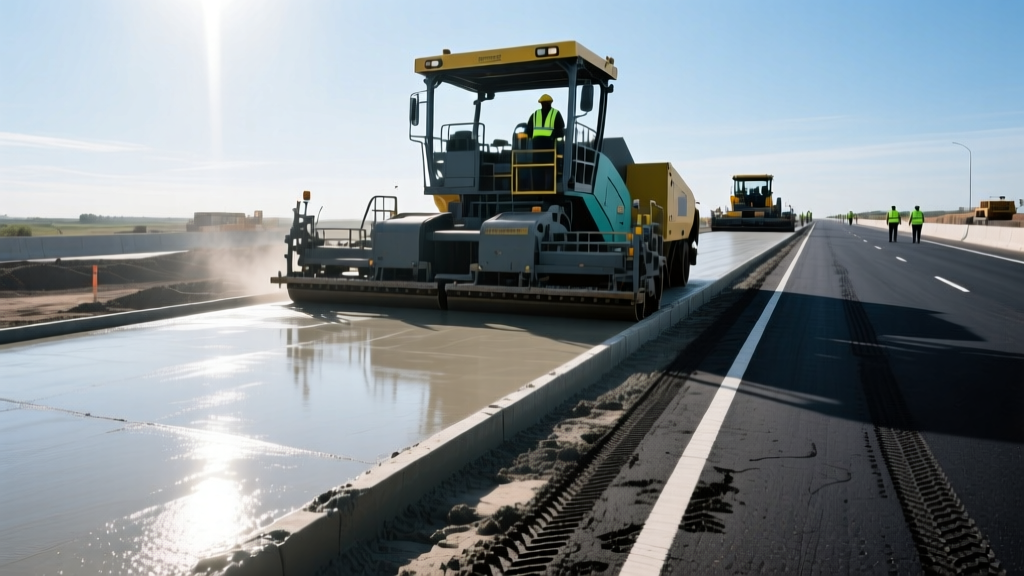
Modern concrete road installation relies on slip-form pavers, which extrude the concrete continuously without fixed side forms. The standard mix design for heavy-duty municipal roads in 2026 specifies a minimum 4,000 psi compressive strength at 28 days, a maximum water-cement ratio of 0.42, and 5% to 8% air entrainment (ASTM C260) for freeze-thaw durability.
Dowel Bar Placement and Jointing
Unlike asphalt, concrete requires precise jointing to control shrinkage cracking. Automatic Dowel Bar Inserters (DBIs) are integrated into the slip-form paver to place 1.5-inch diameter, 18-inch long epoxy-coated steel dowels at transverse joints. These dowels transfer shear loads across the joint while allowing horizontal expansion.
Transverse contraction joints must be saw-cut to a depth of one-quarter the slab thickness. Timing is critical: sawing must occur within 4 to 12 hours of placement. Saw too early, and the aggregate will ravel out; saw too late, and the concrete will have already developed uncontrolled random shrinkage cracks.
Surface Texturing and Curing
Immediately behind the paver, a burlap drag or tine is pulled across the surface to create macro-texture for skid resistance. A white-pigmented, wax-based curing compound (ASTM C309) is then sprayed at a rate of 1 gallon per 200 square feet to trap moisture and prevent plastic shrinkage.
Equipment & Fleet Requirements: Concrete vs Asphalt Road
Mobilizing the correct fleet dictates the profitability of a road paving bid. The machinery required for a concrete vs asphalt road project differs significantly in capital cost and operational complexity.
| Equipment Category | Asphalt Road Fleet | Concrete Road Fleet |
|---|---|---|
| Primary Paver | Tracked asphalt paver with heated vibratory screed ($500k - $800k) | Slip-form concrete paver with DBI and tining carriage ($1.2M - $2.5M) |
| Compaction / Forming | 3 heavy rollers (Vibratory steel, Pneumatic, Static finish) | No rollers required; relies on internal vibratory pans within the paver |
| Material Transport d> | Dump trucks with insulated beds; material transfer vehicle (MTV) | Standard dump trucks feeding a belt-placer or side-delivery mixer |
| Joint / Finish Tools | None required (continuous mat) | Automated saw-cutting machines, dowel bar inserters, curing sprayers |
| Crew Size (Typical) | 8 - 12 personnel | 12 - 18 personnel |
For comprehensive technical guidelines on fleet selection and mix designs, contractors frequently consult the National Asphalt Pavement Association (NAPA) and the American Concrete Pavement Association (ACPA).
Curing vs. Cooling: Opening the Road to Traffic
The most glaring operational difference between the two materials is the timeline for opening the road to traffic, which heavily impacts municipal lane-closure penalties.
- Asphalt Cooling: An asphalt road can typically be opened to traffic once the mat temperature drops below 120°F. Under normal summer conditions, this takes 2 to 4 hours after the finish roller completes its passes. This allows for overnight paving operations with morning lane reopenings.
- Concrete Curing: Concrete requires time to hydrate and gain strength. Standard specifications require a minimum of 7 days of wet curing or membrane curing before allowing heavy truck traffic. However, for critical highway repairs, high-early-strength concrete mixes (using Type III cement or calcium chloride accelerators) can achieve 3,500 psi in 24 to 48 hours, allowing for weekend-only lane closures.
Long-Term Maintenance & Failure Modes Post-Installation
Understanding how installation errors manifest years later is crucial for quality control during the paving process. The Federal Highway Administration (FHWA) categorizes pavement distresses based on material behavior.
Asphalt Failure Modes
If the breakdown roller fails to achieve target density, the road will suffer from rutting and moisture stripping within 3 to 5 years. Poor temperature control during laydown leads to thermal cracking, where the binder becomes brittle in winter cycles. Maintenance requires mill-and-overlay operations every 10 to 15 years.
Concrete Failure Modes
If dowel bars are misaligned by more than 1/2 inch during slip-form insertion, the joints will lock up, causing joint faulting and spalling as the slabs cannot expand. Poor subbase drainage leads to pumping, where water and fine aggregates are ejected from the joints under heavy axle loads, eventually leaving the slab corners unsupported and prone to breaking. Properly installed concrete roads require minimal maintenance for 30 to 40 years, limited primarily to joint resealing every 5 to 7 years.
Quick Decision Framework for Municipal Bids
When advising a client or bidding a municipal contract, use this framework to justify your installation approach:
- Choose Asphalt When: The project demands overnight lane closures, the budget requires a lower initial capital outlay, or the subgrade has unavoidable localized soft spots that a flexible pavement can bridge.
- Choose Concrete When: The route carries high volumes of heavy truck traffic (ESALs > 5 million), the municipality prioritizes a 40-year lifecycle with minimal maintenance disruptions, or the region experiences extreme summer heat that would cause asphalt rutting under stationary heavy loads.
Written by
Sarah WhitfieldSarah Whitfield is a chartered quantity surveyor (MRICS) and construction cost analyst with 15 years of experience in material pricing, procurement strategy, and project budgeting. She earned her degree in Construction Management from the University of Reading (UK) and has worked on projects ranging from $2M custom homes to $180M mixed-use developments across North America and Europe. Sarah currently leads cost estimating for BuildMat Insight, maintaining a proprietary database of 4,000+ material price points updated quarterly. She is a frequent contributor to RSMeans cost data panels and has presented at the International Cost Engineering Council (ICEC) congress. Based in Denver, CO, Sarah is an avid trail runner and volunteer mentor for Women in Construction.
More from Sarah Whitfield
View all
Wood & Lumber
What Are the Different Types of Wood? A Builder's Guide
Compare structural softwoods, finish hardwoods, and engineered lumber. Analyze Janka ratings, MOE values, and 2026 pricing for construction.
Aug 4, 2026

Walls & Panels
Steel Framing vs Wood Framing: Corrosion and Moisture Defense
Compare steel framing vs wood framing for moisture resistance. Learn about galvanized coatings, condensation risks, and corrosion protection strategies.
Jul 21, 2026

Stone & Masonry
How to Cut Stone Veneer: Wet Saw vs Grinder Comparison
Compare the best tools for cutting stone veneer. We review wet saws, angle grinders, and chop saws to help you achieve clean, chip-free cuts.
Jul 21, 2026