Cement vs. Concrete: Key Differences & Buying Guide
Understand the critical differences between cement and concrete. Learn mix ratios, compressive strengths, ASTM standards, and when to use each material.

The Core Distinction: Ingredient vs. Final Product
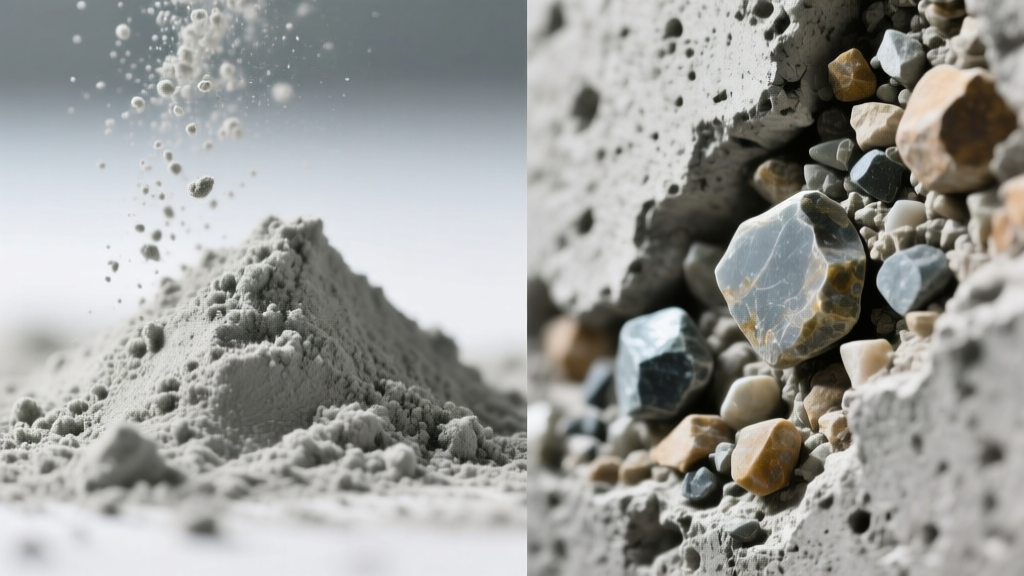
In construction terminology, 'cement' and 'concrete' are frequently used interchangeably by laymen, but confusing them on a job site leads to severe ordering errors, structural failures, and budget blowouts. The fundamental difference is hierarchical: cement is a dry binding powder, while concrete is the hardened, structural composite material created when cement is mixed with water and aggregates.
Portland cement is manufactured by heating limestone and clay in a kiln to form clinker, which is then ground with a small amount of gypsum to control setting time. When water is introduced, a chemical reaction called hydration occurs, forming calcium silicate hydrate (C-S-H) glue. However, cement alone lacks tensile and compressive bulk. To create concrete, this cement paste must coat fine aggregates (sand) and coarse aggregates (crushed stone or gravel). According to the National Ready Mixed Concrete Association (NRMCA), the cement paste typically accounts for only 10% to 15% of the total volume of a standard concrete mix, while aggregates make up 60% to 75%.
Technical Specifications & ASTM Standards
Procurement and quality control for these materials are governed by entirely different American Society for Testing and Materials (ASTM) standards. Understanding these codes is mandatory for structural engineers, architects, and lead contractors.
| Feature | Portland Cement | Concrete |
|---|---|---|
| Governing Standard | ASTM C150 / AASHTO M 85 | ASTM C94 (Ready-Mix) / ASTM C31 (Testing) |
| Physical State | Fine, dry hydraulic powder | Plastic, moldable composite that hardens over time |
| Primary Function | Chemical binder (hydration catalyst) | Load-bearing structural mass |
| Standard Packaging | 94 lb (42.6 kg) paper bags or bulk pneumatic tankers | 80 lb (36.2 kg) pre-mixed bags, or sold by the cubic yard (CY) in transit mixers |
| Compressive Strength | N/A (Measured via mortar cube testing) | Typically 2,500 psi to 5,000+ psi at 28 days |
Decoding ASTM C150 Cement Types
When purchasing raw cement, you must select the correct chemical profile for your environmental conditions. The Portland Cement Association (PCA) outlines five primary types:
- Type I (Normal): General-purpose cement for standard slabs, sidewalks, and non-exposed structures.
- Type II (Moderate Sulfate Resistance): Used in soils or groundwater with moderate sulfate concentrations; generates less heat during hydration than Type I.
- Type III (High Early Strength): Ground finer to accelerate hydration. Ideal for cold-weather pours or projects requiring rapid form removal (often reaches 70% strength in 3 days).
- Type IV (Low Heat of Hydration): Specifically engineered for massive structures like dams and thick retaining walls to prevent thermal cracking during the curing process.
- Type V (High Sulfate Resistance): Mandatory for severe sulfate environments, such as marine foundations or industrial wastewater treatment plants.
When to Use Cement vs. Concrete on the Job Site
Selecting the correct material depends entirely on the structural demands and thickness of the application. A common failure point in DIY and junior contracting is using raw cement or 'mortar mix' for applications requiring coarse aggregate interlock.
Scenarios Requiring Raw Cement (or Mortar)
Raw Portland cement is rarely used alone. It is typically blended on-site to create mortar or grout. Use cement-based mixes for applications under 1 inch thick or where load-bearing structural mass is not required.
- Brick and Block Masonry: Mixing Type I or Type II cement with masonry sand and hydrated lime creates Type N or Type S mortar, which provides the necessary adhesive bond and slight flexibility for masonry joints.
- Tile Grouting and Stucco Base Coats: Cement mixed with fine silica sand creates a smooth, trowelable paste that fills narrow joints without the interference of coarse gravel.
- Concrete Patching and Resurfacing: For repairing spalled edges less than 2 inches deep, a sand-cement mix (often fortified with acrylic polymers) provides a feather-edge finish that standard concrete cannot achieve.
Scenarios Requiring Concrete
Concrete is mandatory for any application subjected to compressive loads, vehicular traffic, or spanning distances. The coarse aggregate (usually 3/4-inch crushed stone) provides the internal skeletal structure that prevents shrinkage cracking and bears structural loads.
- Footings and Foundations: Continuous footings and pier pads require a minimum 3,000 psi concrete mix to distribute dead and live building loads to the soil.
- Driveways and Parking Slabs: A standard 4-inch residential driveway requires 4,000 psi concrete with 6x6 W1.4xW1.4 welded wire mesh or macro-synthetic fibers to resist vehicular shear forces and freeze-thaw cycling.
- Structural Columns and Beams: High-strength concrete (5,000 to 10,000 psi) is pumped into rebar-congested forms. These mixes often utilize superplasticizers to maintain a low water-cement ratio (0.35 to 0.40) while remaining highly flowable.
According to Abram's Law, the strength of concrete is inversely proportional to its water-cement ratio. Adding extra water to a ready-mix truck on-site to make it 'easier to pour' will permanently destroy the compressive strength and increase shrinkage cracking. If the mix is too stiff, order the batch plant to add a mid-range water reducer (superplasticizer), not water.
2026 Cost Breakdown: Bags vs. Ready-Mix
Budgeting accurately requires understanding the unit economics of cement and concrete. While bagged products seem cheaper per pound, the labor cost of mixing large volumes manually makes ready-mix the only viable option for projects exceeding 50 square feet.
| Material Type | Unit Size | Average 2026 Cost | Yield per Unit | Best Application |
|---|---|---|---|---|
| Portland Cement (Type I/II) | 94 lb bag | $16.50 - $21.00 | N/A (Binder only) | Custom mortar, stucco, soil stabilization |
| Bagged Concrete Mix (e.g., Quikrete 5000) | 80 lb bag | $6.50 - $8.50 | 0.60 cubic feet | Fence post holes, small patio pad repairs |
| Ready-Mix Concrete (Standard 4000 psi) | Per Cubic Yard (CY) | $145 - $175 / CY | 27 cubic feet | Driveways, foundations, large slabs |
Hidden Cost Alert: When ordering ready-mix concrete, batch plants charge a 'short-load fee' for any delivery under 3 to 4 cubic yards. This fee typically ranges from $100 to $250. If you only need 1.5 CY for a small sidewalk, the short-load fee can effectively double your per-yard cost. In these edge cases, renting a tow-behind volumetric batch mixer or utilizing heavy-duty bagged concrete mixes may be more cost-effective.
Advanced Admixtures vs. Cement Types
Historically, contractors altered concrete performance by switching cement types (e.g., buying Type III cement for cold weather). Today, the American Concrete Institute (ACI) and modern batch plants rely heavily on chemical admixtures added to standard Type I/II concrete to achieve specific performance metrics without the logistical nightmare of sourcing rare cement types.
- Accelerators (e.g., Calcium Chloride or Non-Chloride alternatives): Replaces the need for Type III cement. Speeds up the hydration reaction for cold-weather pours or early form stripping.
- Retarders: Delays the initial set time. Crucial for hot-weather pours or long transit times from the batch plant to the job site, preventing the concrete from setting inside the drum.
- Air-Entraining Agents (AEA): Microscopic bubbles introduced into the mix that allow water to expand when it freezes. Mandatory for any exterior concrete exposed to freeze-thaw cycles in northern climates (target 5% to 8% air content).
Frequently Asked Questions
Can I use pure cement to patch a deep pothole in my driveway?
No. Pure cement mixed with water will shrink massively as it cures, resulting in severe cracking and structural failure. Deep patches require a coarse aggregate skeleton (concrete) or a specialized high-build epoxy/polyurethane patching compound. For holes between 1 and 4 inches deep, use a sand-topping mix or standard bagged concrete mix.
Why does cement come in 94 lb bags while concrete comes in 80 lb bags?
The 94-pound standard for Portland cement is a historical industry standard established in the early 20th century, roughly equating to one cubic foot of loose powder. Bagged concrete mixes (which contain cement, sand, and gravel) are typically sold in 80-pound or 60-pound bags to make them marginally easier for a single laborer to carry and mix, while yielding exactly 0.60 or 0.45 cubic feet respectively.
Is mortar the same thing as concrete?
No. Mortar is composed of cement, fine sand, water, and often lime. It lacks the coarse gravel aggregate found in concrete. Mortar is designed as an adhesive bond for masonry units (brick, block, stone), whereas concrete is designed as a structural mass. Using concrete to lay bricks will result in a messy, unworkable joint, while using mortar to pour a footing will result in a structurally deficient foundation that cannot bear design loads.
Written by
James ThorntonJames Thornton is a construction industry veteran with 25 years of hands-on experience in wood framing, lumber grading, and residential building codes. He started as a framing carpenter in rural Oregon, earned his ICC Residential Building Inspector certification, and eventually became a senior plan reviewer for the City of Portland Bureau of Development Services. James holds a B.S. in Wood Science & Technology from Oregon State University and is a certified lumber grader through the West Coast Lumber Inspection Bureau (WCLIB). He has inspected over 3,000 residential construction sites and authored the city's internal guide on advanced framing techniques (2x6 at 24" O.C.). James lives in Bend, OR, where he builds custom timber-frame cabins and competes in lumberjack sports.
More from James Thornton
View all
Insulation
Best Home Insulation Materials: Complete 2026 Guide
Compare top home insulation materials for 2026. Find R-values, installed costs per square foot, and best uses for fiberglass, spray foam, and mineral wool.
Aug 4, 2026

Sustainable Building
Certify Your Green Building Material for LEED and WELL
Step-by-step guide to certifying a green building material for LEED v5 and WELL v2. Master EPDs, HPDs, and VOC limits for 2026 project specifications.
Aug 4, 2026

Stone & Masonry
Veneer Stacked Stone Panels: Interior Design & Style Showcase
Discover how veneer stacked stone panels transform interiors. Explore modern design profiles, material pairings, and technical installation specs.
Aug 4, 2026