Clay Tile vs Concrete Tile Roof: Cost, Weight, and Durability Compared
Compare clay tile vs concrete tile roof systems. Expert analysis on weight loads, 2026 costs, ASTM durability standards, and structural requirements.

Material Composition and Manufacturing Science
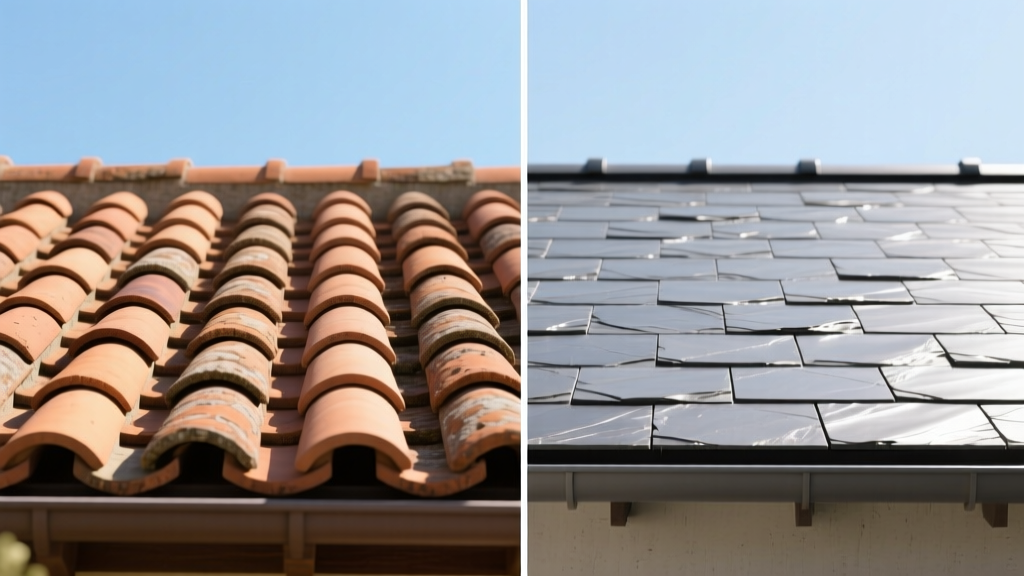
When evaluating a clay tile vs concrete tile roof for your next residential or commercial build, understanding the fundamental manufacturing differences is critical. These materials are often grouped together by laymen, but their chemical compositions, firing processes, and long-term aging characteristics are entirely distinct.
Clay Roof Tiles are manufactured from natural shale and clay deposits. The raw material is extruded or molded into shape, then fired in kilns at extreme temperatures ranging from 1,900°F to 2,000°F. This intense vitrification process transforms the clay into a dense, glass-like ceramic. The color of a clay tile is typically derived from the natural minerals in the earth or added metallic oxides that fuse into the body of the tile during firing.
Concrete Roof Tiles, conversely, are a composite mixture of Portland cement, silica sand, water, and iron oxide pigments. The mixture is extruded onto metal pallets and cured in much lower-temperature kilns (around 150°F to 200°F) or air-dried. Because concrete is a cementitious product rather than a vitrified ceramic, it remains porous on a microscopic level and continues to cure and harden over decades.
Structural Load: The Weight Factor
The most immediate structural constraint when choosing between these materials is the dead load they impose on the roof framing. Both systems are classified as heavy roofing, but concrete is significantly denser. Before specifying either material, a structural engineer must verify that the roof trusses and load-bearing walls can support the weight, especially in regions with heavy snow loads.
| Metric | Clay Tile | Concrete Tile |
|---|---|---|
| Weight per Square (100 sq. ft.) | 600 – 850 lbs | 900 – 1,100 lbs |
| Weight per Sq. Ft. | 6.0 – 8.5 lbs | 9.0 – 11.0 lbs |
| Standard Truss Spacing | 24 inches O.C. | 24 inches O.C. (often requires 2x6 top chords) |
| Retrofit Reinforcement | Moderate | Extensive (often prohibitive) |
2026 Cost Breakdown: Material and Installation
Pricing for heavy tile roofing fluctuates based on regional manufacturing hubs and freight costs. Because both materials are heavy, shipping distances heavily impact the final material quote. Below is the current national average pricing for a standard single-story residential installation.
- Clay Tile Installed Cost: $14.00 – $24.00 per sq. ft.
- Concrete Tile Installed Cost: $9.00 – $16.00 per sq. ft.
While concrete offers a 30% to 40% upfront cost savings, clay tiles frequently yield a higher return on investment in luxury real estate markets due to their status as a premium, lifelong architectural element. Furthermore, premium concrete profiles that mimic slate or wood shake often push the material cost into the lower end of the clay pricing spectrum.
Durability, Weathering, and ASTM Standards
Both materials boast exceptional lifespans, frequently outlasting the underlying decking and underlayment. However, their failure modes and weathering characteristics differ significantly. The National Roofing Contractors Association (NRCA) outlines specific testing standards that govern these materials.
Water Absorption and Freeze-Thaw Cycles
Clay tiles are governed by ASTM C1167. Grade 1 clay tiles (required for northern climates) have a water absorption rate of less than 2%. This near-zero porosity means water cannot penetrate the tile body, freeze, expand, and cause spalling. Concrete tiles are governed by ASTM C1492 and typically exhibit a water absorption rate between 5% and 10%. In regions with severe freeze-thaw cycles, concrete tiles are more susceptible to micro-cracking and edge spalling over time unless treated with specialized silane-siloxane sealants.
Color Retention and Efflorescence
Because clay tile color is fired into the ceramic body, it is entirely UV-stable. A terracotta or slate-gray clay tile will look identical in year 50 as it did on day one. Concrete tiles rely on integral pigments or surface-applied slurry coats. Over 20 to 30 years, UV exposure will cause concrete tile colors to soften and fade. Additionally, concrete tiles are prone to efflorescence—a natural chemical reaction where calcium hydroxide leaches to the surface and reacts with carbon dioxide, leaving a white, powdery residue. While efflorescence eventually stops and washes away, it can cause aesthetic concerns in the first 3 to 5 years of installation.
Installation Nuances: Pitch, Underlayment, and Fastening
The Tile Roofing Institute (TRI) provides strict guidelines for tile installation, emphasizing that tiles are water-shedding systems, not waterproof barriers. The true waterproofing relies entirely on the underlayment.
- Minimum Roof Pitch: Standard installations require a minimum 4:12 pitch. Pitches between 2.5:12 and 4:12 are permissible but require a double layer of underlayment or a fully adhered ice and water shield membrane.
- Batten Systems: Tiles should rarely be nailed directly to the deck. They are hung on horizontal wood battens (1x2 or 2x2 lumber). This creates a critical air channel beneath the tiles, allowing convective ventilation that reduces attic heat gain by up to 48% compared to direct-deck systems, a vital factor for energy-efficient cool roof designs.
- Fastening Patterns: In high-wind zones (HVHZ), every single tile must be mechanically fastened with corrosion-resistant screws or nails, and often secured with tile clips or structural adhesive. In moderate zones, perimeter and ridge tiles are fastened, while field tiles may rely on gravity and interlocking sidelaps.
Decision Matrix: Which Roof System Fits Your Build?
Selecting between clay and concrete requires balancing budget, structural capacity, and architectural intent. Use this framework to finalize your specification.
Specify Clay Tile When:
- You are building a luxury, historic, or Mediterranean-style custom home.
- You require absolute color permanence with zero fading.
- The structure is in a severe freeze-thaw climate where < 2% water absorption is mandatory.
- Budget allows for a premium, multi-generational roofing investment.
Specify Concrete Tile When:
- You want the heavy-tile aesthetic but have a constrained material budget.
- You are utilizing complex profiles (like wood-shake replicas) that are difficult to extrude in clay.
- The roof framing is already engineered for heavy dead loads (e.g., new commercial builds).
- The project is located in a warm, southern climate where freeze-thaw spalling is not a factor.
Ultimately, both systems offer Class A fire ratings, exceptional wind resistance when properly fastened, and lifespans exceeding 75 years. The choice hinges on whether the project demands the uncompromising, vitrified permanence of fired clay, or the versatile, cost-effective mass of cured concrete.
Written by
Priya KapoorPriya Kapoor is a real estate market analyst and construction economics researcher with expertise in housing affordability, development feasibility, and infrastructure investment. She holds a Master of Regional Planning from Cornell University and previously worked as a senior analyst at CBRE's Investment Properties group, where she modeled returns for $4B in mixed-use development pipelines. Priya now runs an independent research practice advising developers, municipalities, and REITs on construction cost forecasting and market timing. She publishes the quarterly "BuildMat Market Pulse" report tracking material price indices across 12 commodity categories. Based in Austin, TX, Priya serves on the board of Habitat for Humanity Austin and is a marathon runner.
More from Priya Kapoor
View all
Construction Cost
Cost to Build a 1600 Sq Ft Home in 2026: Full Breakdown
Accurate 2026 cost to build a 1600 sq ft home—material, labor, and regional pricing breakdowns included. Plan your budget with real-time estimates.
Aug 11, 2026

Wood & Lumber
Name the Types of Wood for Pressure Treatment and Preservation
Learn how to name the types of wood best suited for pressure treatment. Compare species treatability, chemical retention levels, and 2026 preservation costs.
Aug 4, 2026

Stone & Masonry
Stone Veneer Suppliers Lindenhurst: 2026 Cost Analysis
Analyze 2026 stone veneer costs in Lindenhurst, NY. Compare local supplier pricing, delivery fees, and Suffolk County installation labor rates.
Aug 4, 2026