Waterproof Material for Concrete: Technical Specs and ASTM Standards
Compare technical specifications for top waterproof material for concrete options, including crystalline, polyurethane, and bentonite systems.

Hydrostatic Pressure and Material Selection Criteria
Selecting the correct waterproof material for concrete requires moving beyond generic "water-resistant" claims and evaluating performance against specific hydrostatic loads. Dampproofing materials (like asphalt-based coatings) only resist soil moisture vapor and capillary action. True waterproofing systems must resist positive-side hydrostatic pressure, which exerts approximately 0.433 psi per foot of water head. A below-grade structure with a 15-foot water table exerts 6.5 psi of continuous lateral pressure on the concrete substrate.
According to the National Institute of Building Sciences (NIBS), material selection must account for the substrate's Concrete Surface Profile (CSP), anticipated structural cracking, and chemical exposure from soil contaminants. The three dominant technologies in modern commercial and high-performance residential construction are crystalline capillary systems, polyurethane liquid-applied membranes, and sodium bentonite clay panels.
Crystalline Capillary Waterproofing Systems
Crystalline waterproofing utilizes a proprietary blend of Portland cement, finely graded silica sand, and active catalytic chemicals. When applied to a damp concrete substrate, the chemicals react with the free lime (calcium hydroxide) and moisture present in the concrete capillaries. This reaction produces an insoluble calcium silicate hydrate (C-S-H) crystalline structure that blocks micro-cracks and pores.
Chemical Mechanics and Self-Healing Properties
The primary technical advantage of crystalline systems is their autogenous healing capability. If a new hairline crack forms (up to 0.4 mm or 1/64 inch), unreacted chemicals in the concrete matrix reactivate upon contact with incoming moisture, precipitating new crystals to seal the breach. This makes it an ideal integral or surface-applied solution for water retention tanks and deep foundations.
Technical Data Sheet (TDS) Parameters
| Parameter | Specification / Value | Testing Standard |
|---|---|---|
| Application Rate | 1.5 lbs/sq yd (0.8 kg/m²) minimum | Manufacturer TDS |
| Maximum Crack Bridging | 0.016 in (0.4 mm) | ACI 224R |
| Permeability Reduction | Decreases water penetration by >90% | ASTM C1512 / EN 12390-8 |
| Substrate Moisture Requirement | Saturated Surface Dry (SSD) condition | ICRI Guideline No. 310.2 |
Polyurethane Liquid-Applied Membranes
For applications requiring high elasticity and the ability to bridge dynamic structural cracks, one-component or two-component moisture-cured polyurethane liquid membranes are the industry standard. These systems cure to form a seamless, fully adhered elastomeric sheet that accommodates structural movement without tearing.
Elastomeric Properties and Crack Bridging
Polyurethane membranes exhibit elongation properties exceeding 600%, allowing them to bridge live cracks up to 1/16 inch (1.6 mm) wide. The Building Science Corporation notes that liquid-applied membranes are highly effective for complex geometries, such as pipe penetrations and irregular footings, where sheet goods would require excessive seaming.
Application Specifications and Curing
| Parameter | Specification / Value | Testing Standard |
|---|---|---|
| Dry Film Thickness (DFT) | 60 mils (1.5 mm) minimum | ASTM D4138 |
| Tensile Strength | > 300 psi (2.07 MPa) | ASTM D412 |
| Tack-Free Time (at 75°F/50% RH) | 2 to 4 hours | ASTM C836 |
| VOC Content | < 50 g/L (Low-odor formulations) | EPA Method 24 |
Sodium Bentonite Clay Panels
Bentonite waterproofing relies on the unique swelling properties of sodium montmorillonite clay. When exposed to water, high-grade sodium bentonite absorbs up to 10 times its dry weight in moisture, expanding to 15 times its original volume to form an impermeable, self-sealing gel. Modern systems encapsulate the clay between two layers of geotextile fabric or corrugated cardboard for ease of installation.
Swelling Index and Confinement Requirements
The critical technical specification for bentonite is the Swell Index, which must exceed 24 mL/2g per ASTM D5890. However, bentonite requires physical confinement to function. If the clay is not compressed against the concrete substrate by the surrounding backfill (requiring a minimum confinement pressure of 30 psf), the gel will wash away or fail to form a continuous barrier. It is strictly a blind-side or positive-side application material and cannot be used in interior retrofit scenarios.
Comparative Performance Matrix
The following matrix synthesizes the operational parameters of the three primary systems to aid in specification decisions.
| Metric | Crystalline Capillary | Polyurethane Liquid | Sodium Bentonite Panel |
|---|---|---|---|
| Installation Side | Positive or Negative | Positive Only | Positive / Blind-Side Only |
| Hydrostatic Resistance | Up to 400 ft head | Up to 250 ft head | Up to 200 ft head |
| Substrate Prep (CSP) | CSP 3 to 5 (Rough) | CSP 1 to 3 (Smooth) | None (Applied to forms/soil) |
| Vulnerability | Efflorescence blocking pores | Pinholes from substrate outgassing | Lack of backfill confinement |
| Estimated Material Cost | $0.85 - $1.20 / sq ft | $1.50 - $2.80 / sq ft | $1.10 - $1.60 / sq ft |
Common Failure Modes and Edge Cases
According to the Portland Cement Association (PCA), the vast majority of below-grade waterproofing failures are not due to material degradation, but rather improper substrate preparation and application errors.
Substrate Outgassing and Pinholing in Liquid Membranes
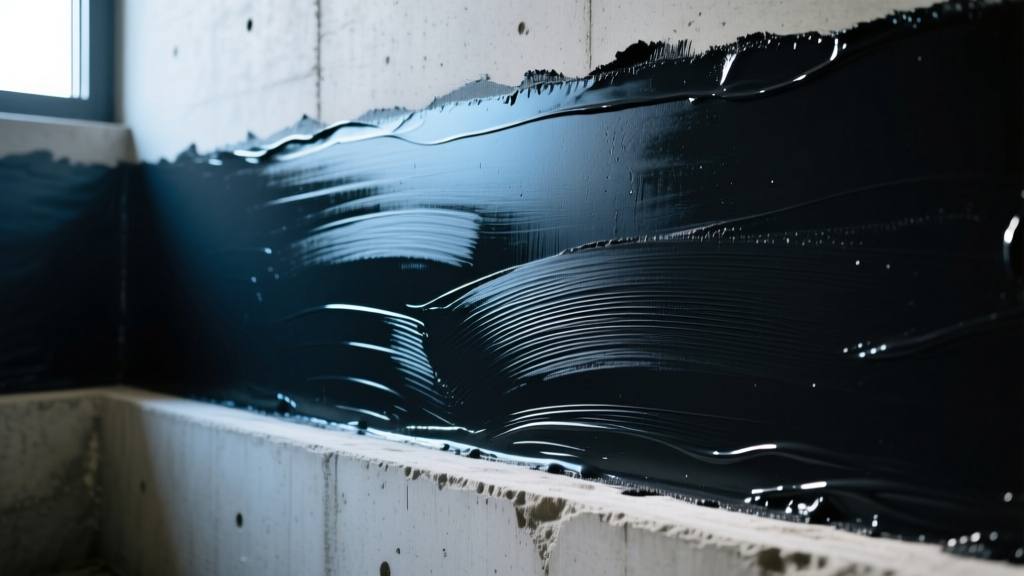
When applying polyurethane or bituminous liquid membranes to newly poured concrete, trapped air and moisture vapor migrate to the surface as the concrete cures (outgassing). If the membrane is applied too thickly in a single pass, these vapors become trapped, creating microscopic pinholes that compromise the hydrostatic seal. Solution: Always specify a multi-coat application. Apply a thin 20-mil primer coat to fill the pores, allow it to become tack-free, and then apply the remaining 40 mils in a cross-hatch pattern.
Efflorescence Interference in Crystalline Systems
Crystalline systems require direct contact with the concrete's internal capillaries. If the substrate surface is heavily coated with efflorescence (water-soluble salts) or form-release oils, the catalytic chemicals cannot penetrate. Solution: Mandate high-pressure water blasting (minimum 3,500 psi) or light mechanical scarification to achieve an ICRI CSP 3 profile prior to application. Acid etching is strictly prohibited, as it alters the surface pH and neutralizes the alkaline catalyst required for the crystalline reaction.
Blinding Concrete Requirements for Bentonite
When installing bentonite panels horizontally under a slab-on-grade, the panels must be placed over a smooth, compacted sub-base or a lean concrete mud-slab (blinding concrete). If placed directly over jagged, uncompacted gravel, the hydrostatic pressure will push the clay gel into the voids between the stones, thinning the barrier and causing localized leaks. A 2-inch minimum blinding slab is required for all horizontal bentonite installations.
"The performance of any below-grade waterproofing system is intrinsically linked to the quality of the concrete substrate and the rigor of the detailing at cold joints, penetrations, and transitions." — ACI 515.1R Guide to Barrier Systems for Concrete
Written by
Marcus ChenMarcus Chen is a licensed structural engineer (PE) and building materials analyst with over 12 years of experience across residential, commercial, and industrial construction. He holds a Master of Science in Civil Engineering from UC Berkeley and spent six years at Thornton Tomasetti before transitioning to independent consulting and technical writing. Marcus specializes in material selection for seismic-prone regions, concrete reinforcement strategies, and lifecycle cost analysis. His work has been cited by the American Concrete Institute (ACI) and the Structural Engineers Association of California (SEAOC). When he is not on a job site or at his desk, you will find him hiking the Sierra Nevada or restoring a 1920s craftsman bungalow in Oakland, CA.
More from Marcus Chen
View all
Construction Cost
How Much Did the Eiffel Tower Cost to Build?
How much did the Eiffel Tower cost to build in 1889? We adjust for inflation and compare its budget to modern skyscraper construction.
Aug 4, 2026

Fire Resistance
What Is a Fire Resistant Material? Testing & Certification Guide
Discover what is a fire resistant material through ASTM and UL testing. Learn how fire ratings, certifications, and assemblies work in construction.
Aug 4, 2026

Construction Cost
How Much Did the Burj Khalifa Cost to Build?
How much did the Burj Khalifa cost to build? We break down the $1.5B project and extract 5 money-saving strategies for your next build.
Jul 30, 2026